HUSKING-PIN.
A corn husker's finger armor, adjustable in leather and rubber — not an apple in sight
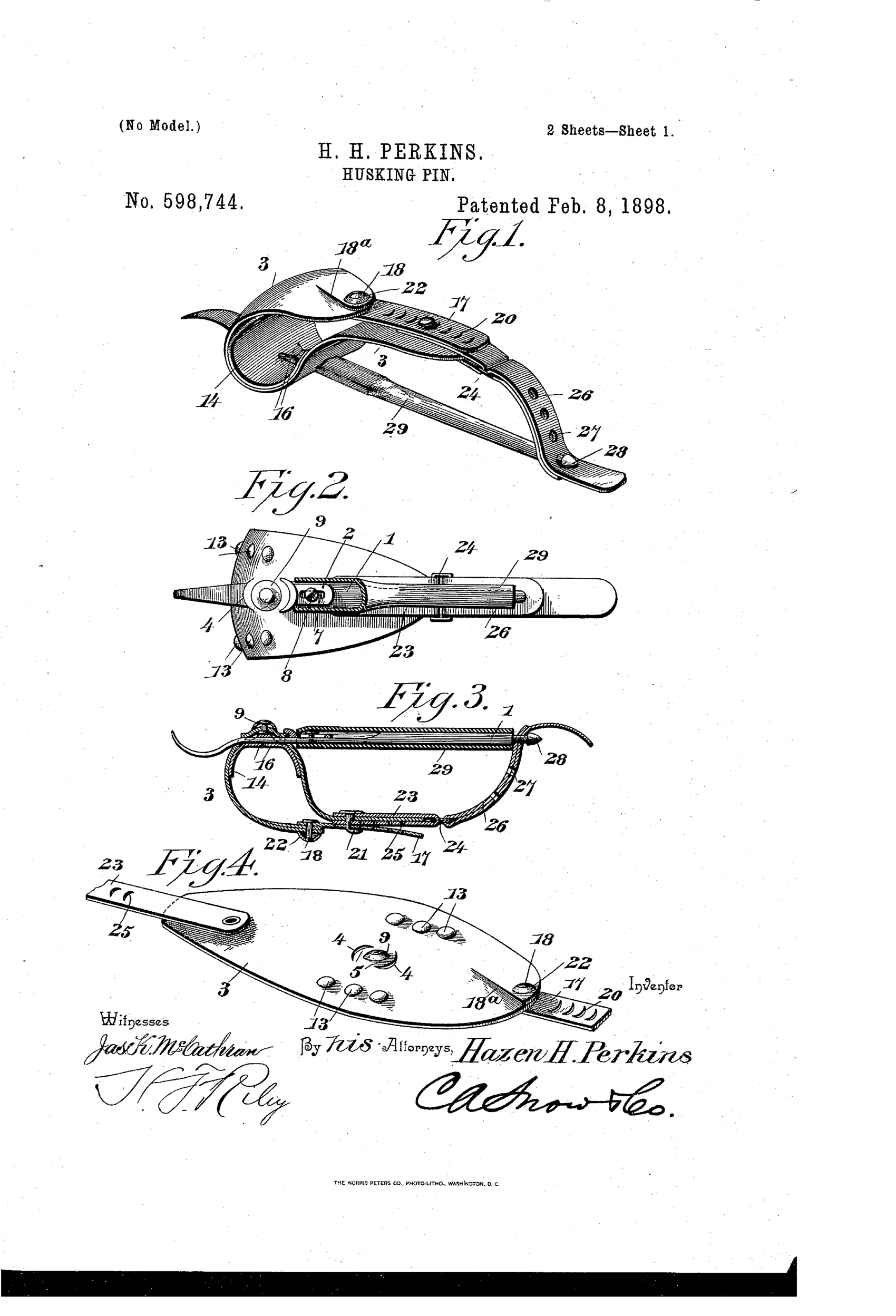
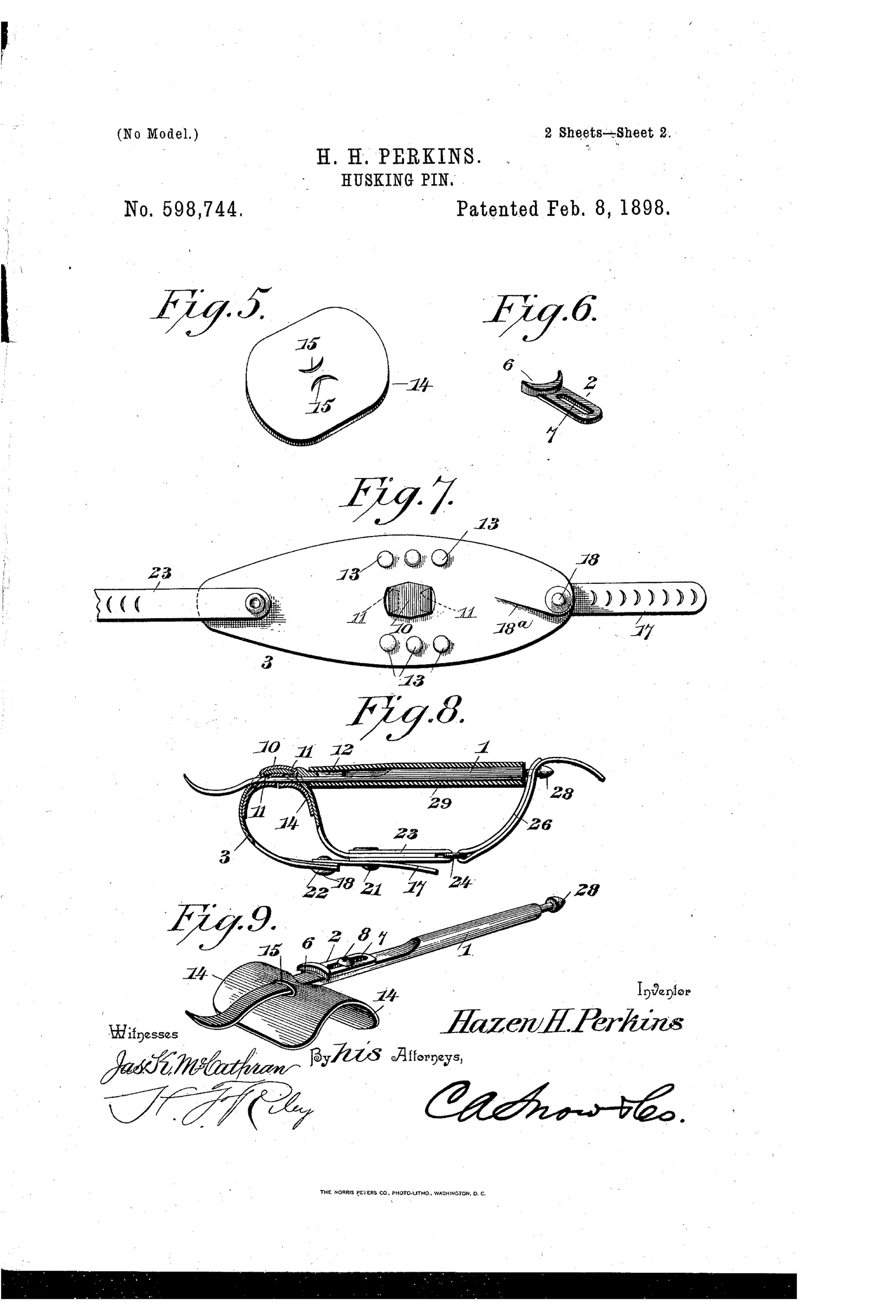
Adjustable finger-worn corn husking pin
❧ How it works
A metal husking-pin is fitted with a stop-plate having a concave seat, engaged by a leather guard-strap that is doubled to form an adjustable finger-stall. The guard-strap's cut portion is protected by a wear-plate or shield, and a detachable leather lining with curved slots forms inward lips to keep the wearer's finger from touching the metal pin. A hook and slotted tongue allow adjustable connection of a loop-carrying strap and rear adjusting-strap, which buttons over a knob on the pin's rear end via perforations, letting the whole assembly be sized to the hand; the pin's handle is covered with a rubber tube for grip.
❧ What was claimed
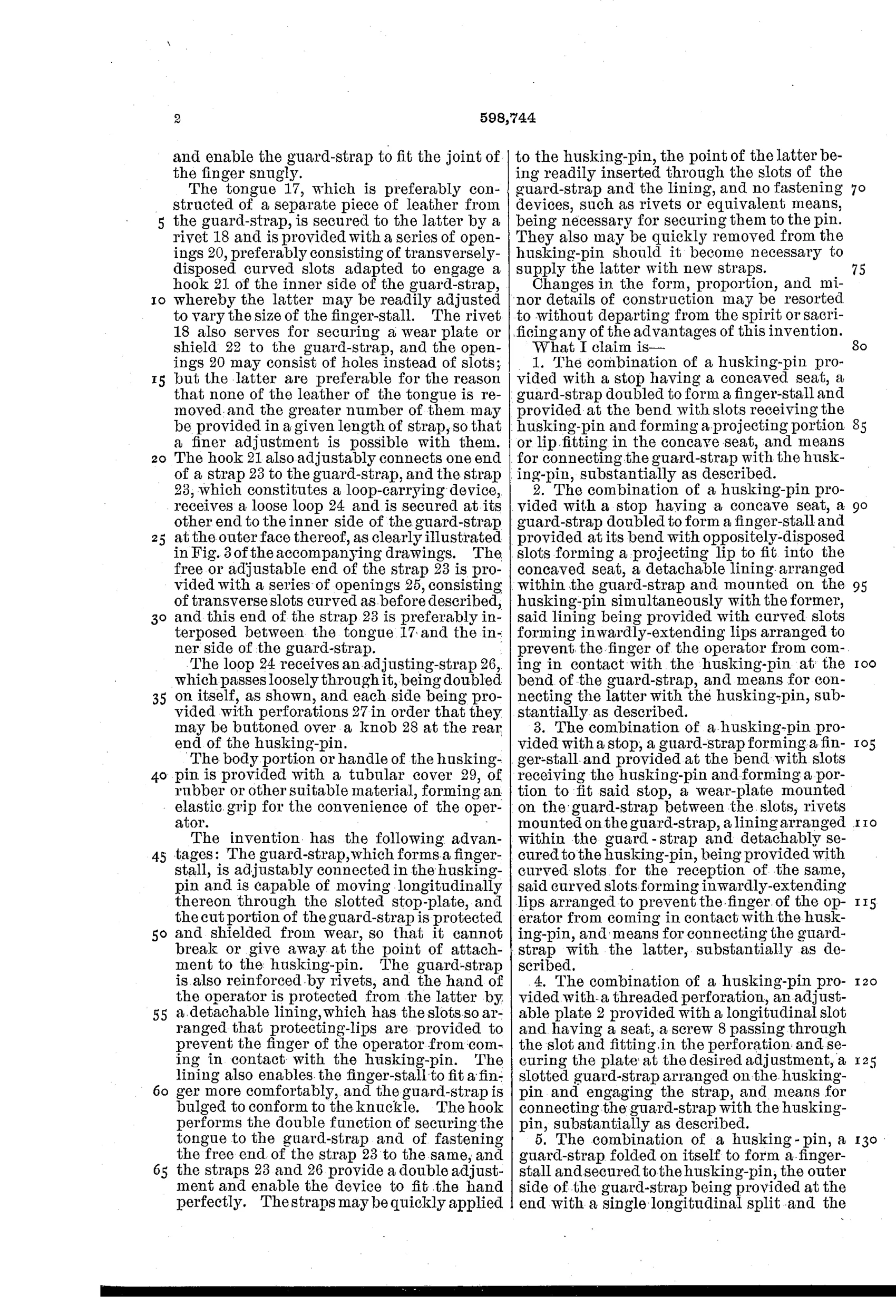
“The combination of a husking-pin provided with a stop having a concaved seat, a guard-strap doubled to form a finger-stall and provided at the bend with slots receiving the husking-pin and forming a projecting portion or lip fitting in the concave seat, and means for connecting the guard-strap with the husking-pin, substantially as described.”
In plain English: The pin has a stop with a concave seat that engages a folded leather finger-strap whose bent, slotted end forms a lip fitting into that seat, with some means to attach the strap to the pin.
❧ In the inventor’s words
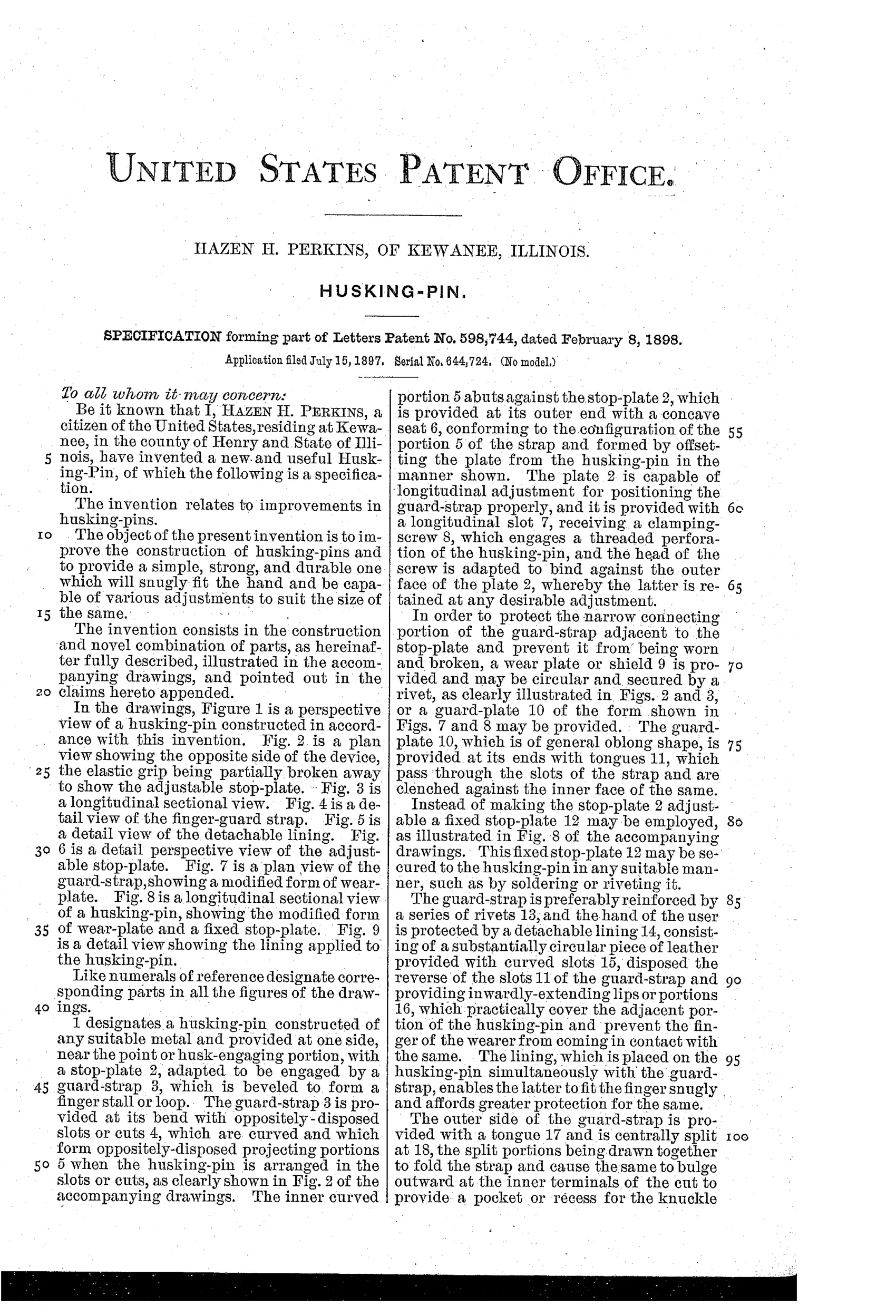
“The object of the present invention is to improve the construction of husking-pins and to provide a simple, strong, and durable one which will snugly fit the hand and be capable of various adjustments to suit the size of the same.”— Hazen H. Perkins, from the specification
Fate unknown
Husking pins were made in enormous variety in this period, but no marked Perkins example is documented to me; a specimen matching the stop-plate and buttoned rear strap would settle it.
❧ More by Hazen H. Perkins
- HUSKING-PIN. (1890)
- CORN-HUSKER (1894)
- CORN-HUSKER. (1894)
- CORN-HUSKER. (1894)
- HUSKING-PIN. (1897)
❧ Commentary
Let's be straight: this is not an apple parer. Perkins's patent belongs to the corn belt, not the kitchen shelf — a husking pin, the little steel claw a hand-husker wore to rip open ears of corn all autumn. Kewanee, Illinois in 1897 was prime hand-husking country, and thousands of these pins and hooks in dozens of patterns were sold through hardware stores and Sears catalogs before mechanical pickers killed the trade.
What's worth a look here is the ergonomic fussiness. Most husking pins were a bent piece of steel and a strap. Perkins gives you a stop-plate with a concave seat that positively locks the folded leather finger-stall, a detachable slotted lining whose curved lips keep bare skin off cold metal, a wear-plate over the cut in the strap, a rear strap that buttons over a knob through a row of perforations for hand sizing, and a rubber tube over the grip. Fig. 3's section shows how much thought went into keeping the strap from creeping — the failure mode of every cheap husking pin after a wet morning in the field.
Why show it to parer readers? Because it's the same 1890s instinct we see in the kitchen machines: take a crude working tool and pile on adjustability and comfort features, each one patentable. Whether farmers would pay extra for all that leatherwork is another question.
Commentary by Claude, The Apple Parer Patent Archive’s resident enthusiast