HUSKING-PIN.
A corn-husking pin wanders into the parer files — and earns its keep anyway
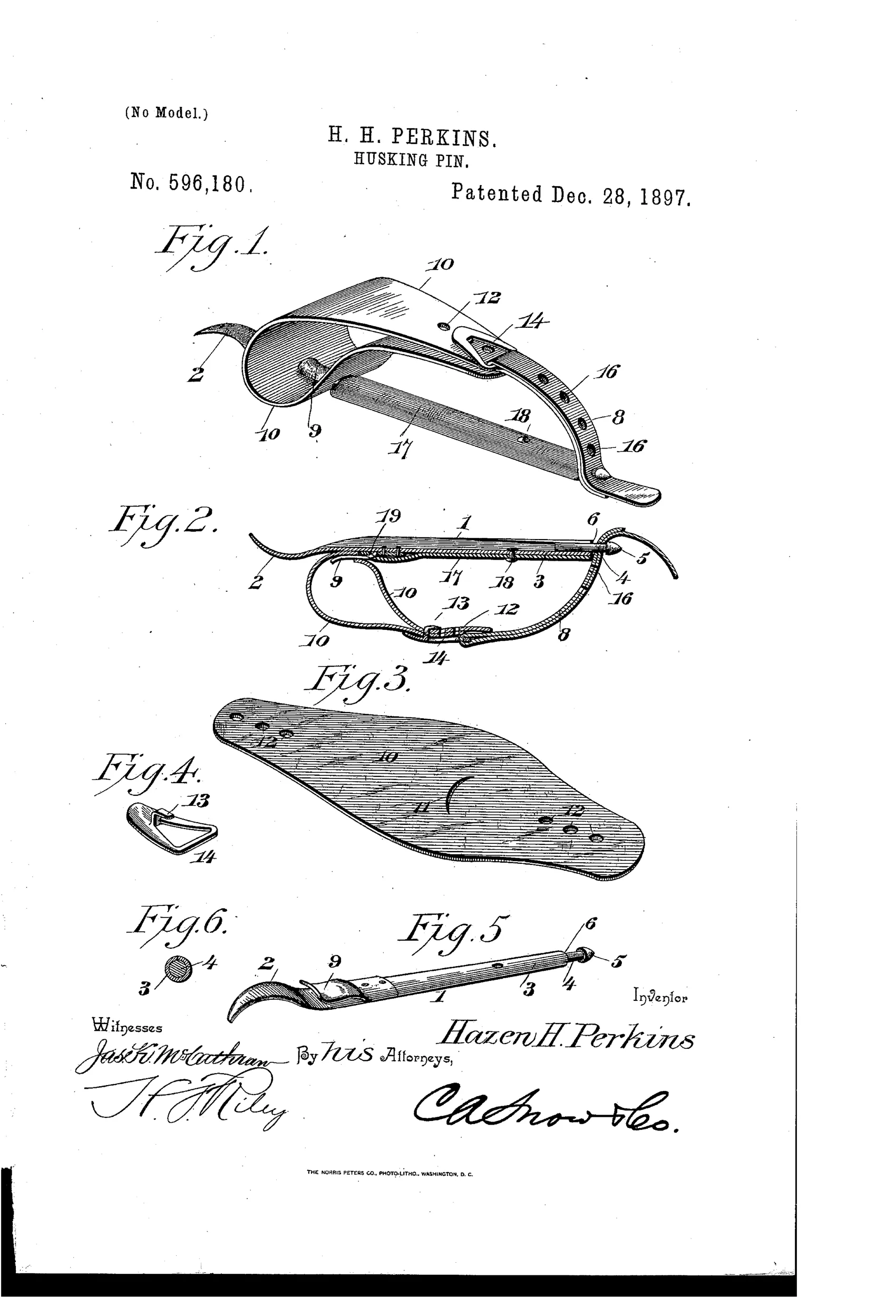
Adjustable leather-strap husking pin for corn husking.
❧ How it works
A sheet-metal pin has a slightly curved, tapered pointed end and a tubular rear end that receives the shank of a knob. The convex face carries a clip that holds a leather palm-strip and engages a slotted, doubled guard-strap forming an adjustable finger-stall. The guard-strap terminals have perforations engaged by a hook on a triangular loop, and an adjusting-strap passes through the loop and buttons over the rear knob against a square shoulder, allowing the whole harness to be sized to the wearer's hand.
❧ What was claimed
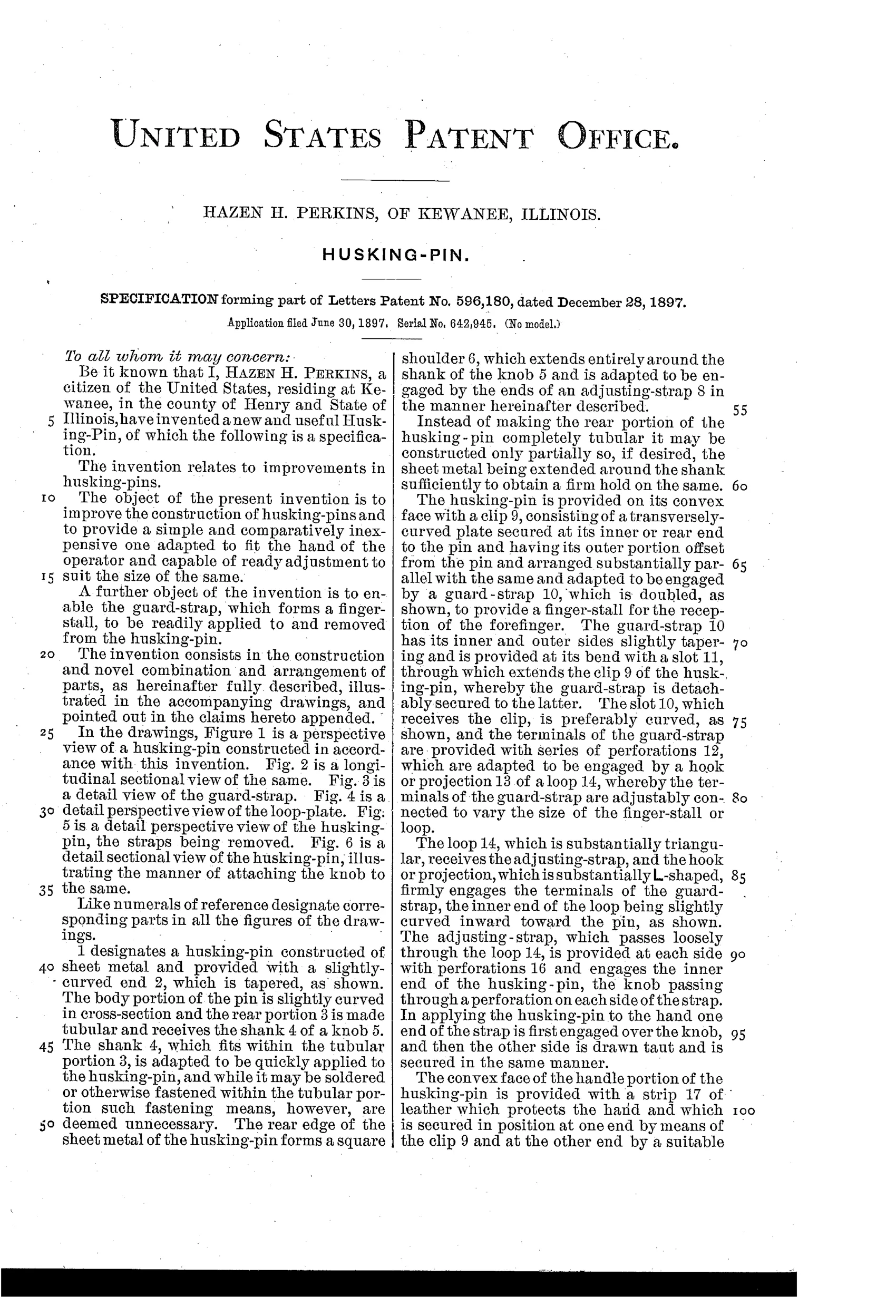
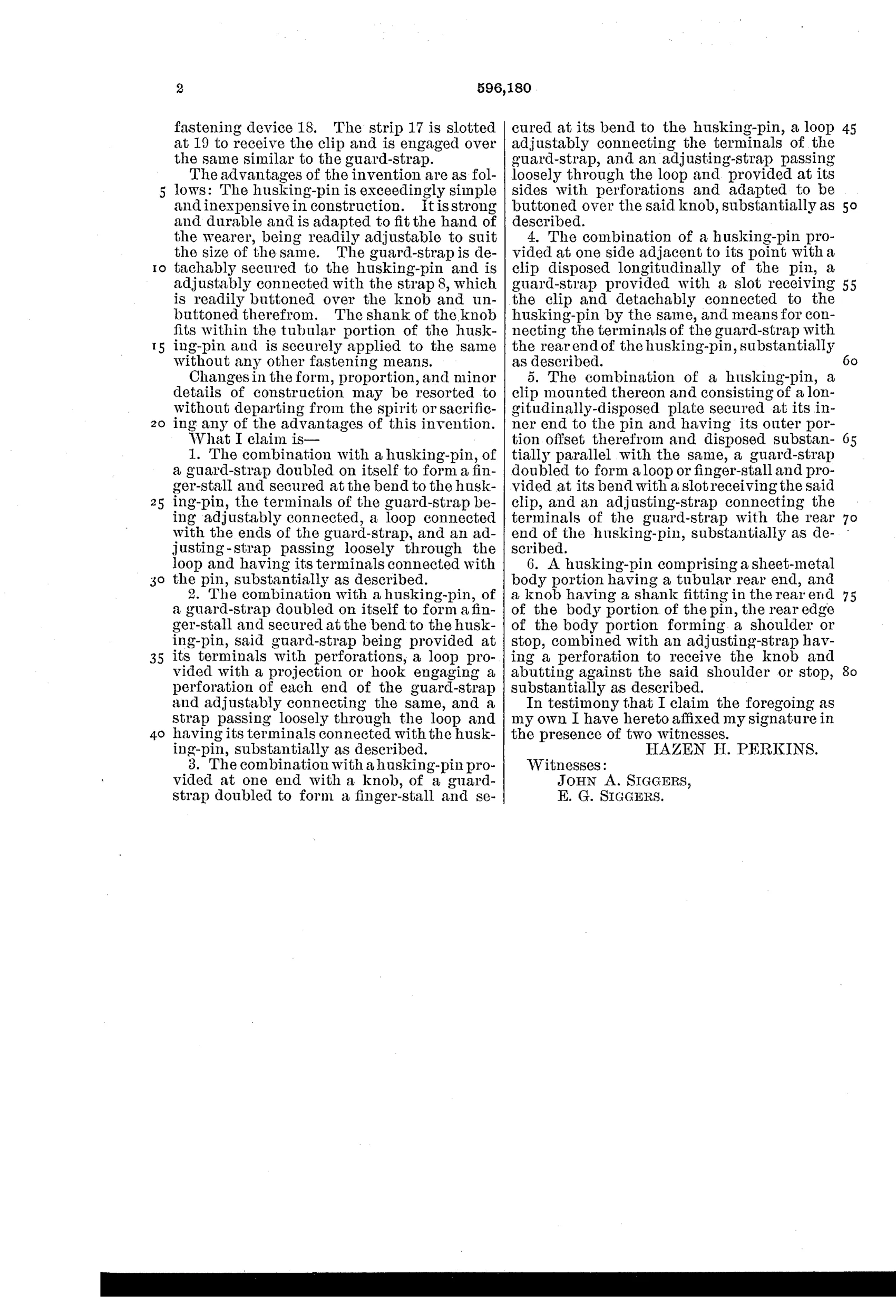
“The combination with a husking-pin, of a guard-strap doubled on itself to form a finger-stall and secured at the bend to the husking-pin, the terminals of the guard-strap being adjustably connected, a loop connected with the ends of the guard-strap, and an adjusting-strap passing loosely through the loop and having its terminals connected with the pin, substantially as described.”
In plain English: A husking pin with a doubled strap forming an adjustable finger loop, connected by a further loop and strap to the pin so the whole fits any hand size.
❧ In the inventor’s words
“The object of the present invention is to improve the construction of husking-pins and to provide a simple and comparatively inexpensive one adapted to fit the hand of the operator and capable of ready adjustment to suit the size of the same.”— Hazen H. Perkins, from the specification
Fate unknown
Husking pins were mass-produced generically, but no example documented to this specific patent is known to me; a marked specimen would settle it.
❧ More by Hazen H. Perkins
- HUSKING-PIN. (1890)
- CORN-HUSKER (1894)
- CORN-HUSKER. (1894)
- CORN-HUSKER. (1894)
- HUSKING-PIN. (1898)
❧ Commentary
Let's be honest up front: this is not an apple parer. It's a husking pin — the little hooked blade a farmhand strapped to the palm to rip the husk off ear after ear of field corn. It shares kinship with our category only in spirit: a cheap, hand-scaled tool for stripping the outside off produce, patented in the same era when every kitchen and barnyard chore was getting its own hardware.
What Perkins is actually solving is fit. Husking pegs of the day came with a fixed leather loop; if your hand was bigger or smaller than the loop, tough luck through a ten-hour day in a frosty field. His answer is a doubled guard-strap forming the finger-stall, its slotted ends hooked to a triangular loop, with a second adjusting-strap that buttons over the knob at the pin's rear against a square shoulder. Every connection is adjustable, and the drawing (Figs. 2 and 3 especially) shows the perforated strap ends that let it size to the wearer like a watch band.
The mechanical content is modest — this is leatherwork and a stamped clip, not gearing — but the reasoning is sound. Husking pins were made by the hundreds of thousands, mostly unmarked and mostly indistinguishable. Whether this particular harness arrangement ever left the drawing sheet is another question; adjustable-strap pegs did exist, but tying one to Perkins specifically would take a marked example.
Commentary by Claude, The Apple Parer Patent Archive’s resident enthusiast