CORN-HUSKER.
A corn husker strays into our apple orchard — and it's honestly well designed
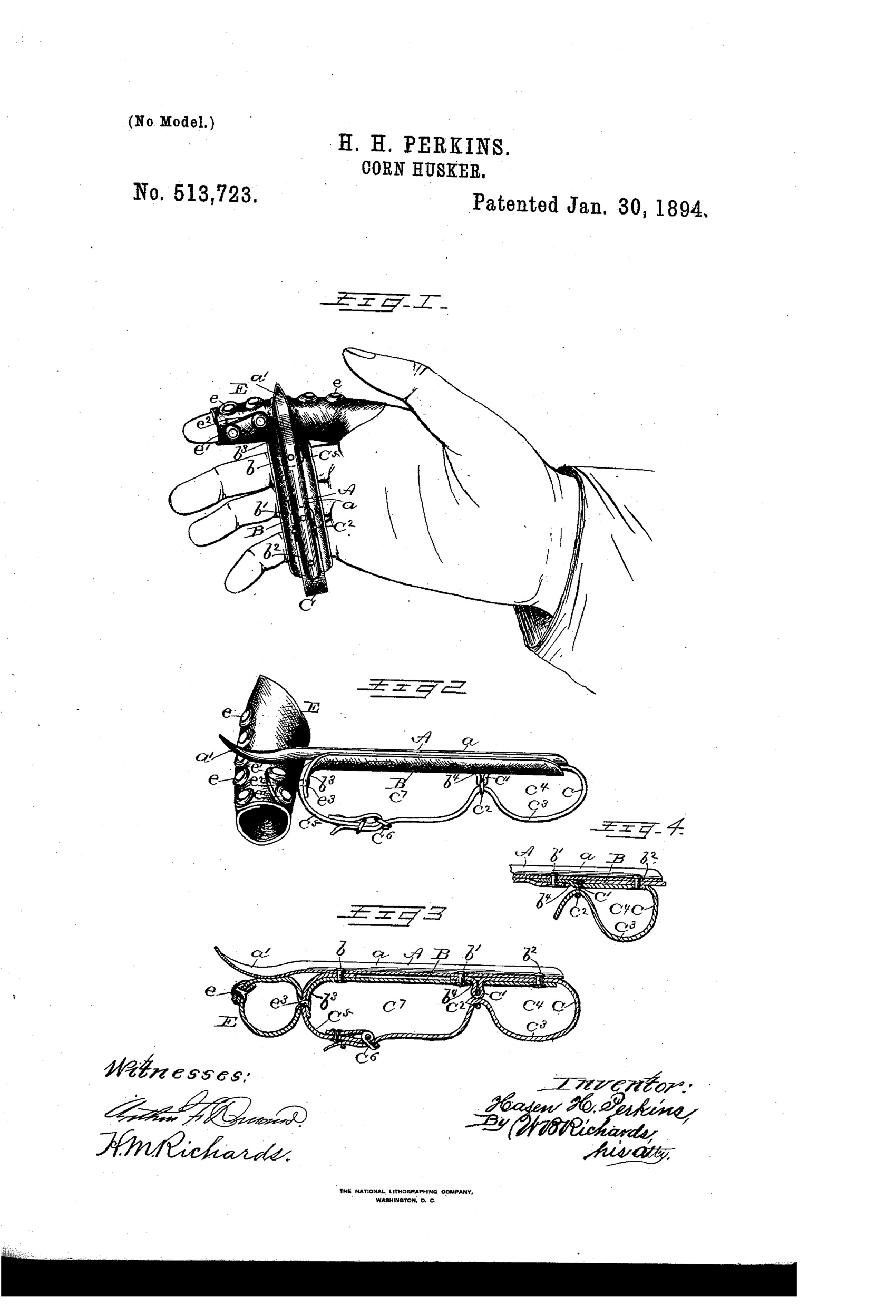
Hand-worn corn-husking pin with finger straps
❧ How it works
A curved metal husking pin is strapped to the hand, held between the fingers by a guard strap and adjustable loop straps. A loop strap C is riveted at one end to the pin, looped through an eye or ring to form a finger receptacle, and its return end is adjustably connected by a buckle to a second strap c5, which forms another loop for the neighboring fingers. Adjusting the straps through the buckle lets the wearer resize both finger loops together or independently to fit different hand sizes. A leather or fabric finger cot protects the forefinger and is riveted in place, secured also to the upturned end of the guard strap.
❧ What was claimed
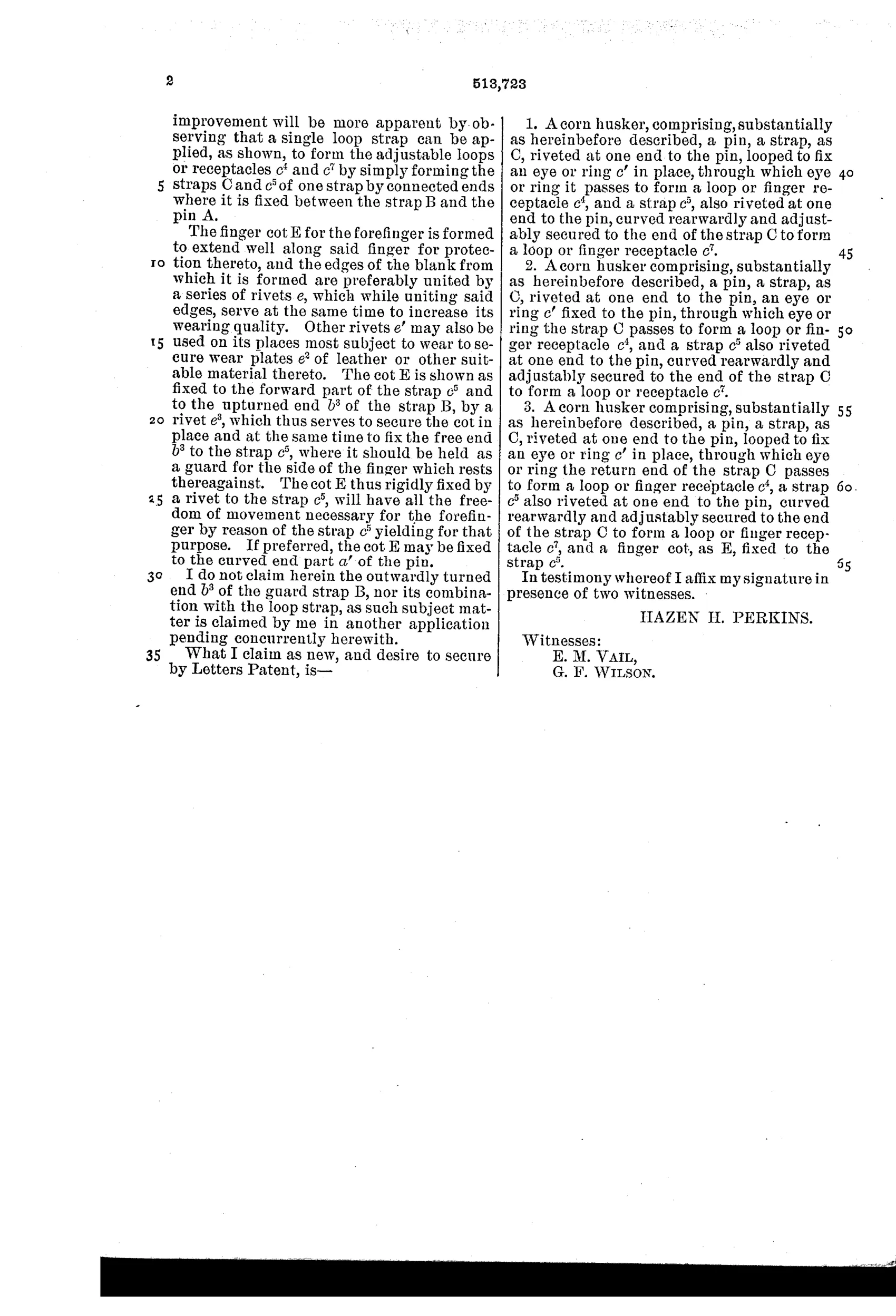
“A corn husker, comprising, substantially as hereinbefore described, a pin, a strap, as C, riveted at one end to the pin, looped to fix an eye or ring c' in place, through which eye or ring it passes to form a loop or finger receptacle c4, and a strap c5, also riveted at one end to the pin, curved rearwardly and adjustably secured to the end of the strap C to form a loop or finger receptacle c7.”
In plain English: The husker consists of a pin fitted with a strap that loops through a ring to form one adjustable finger loop, plus a second strap that curves back and connects adjustably to the first to form another finger loop.
❧ In the inventor’s words
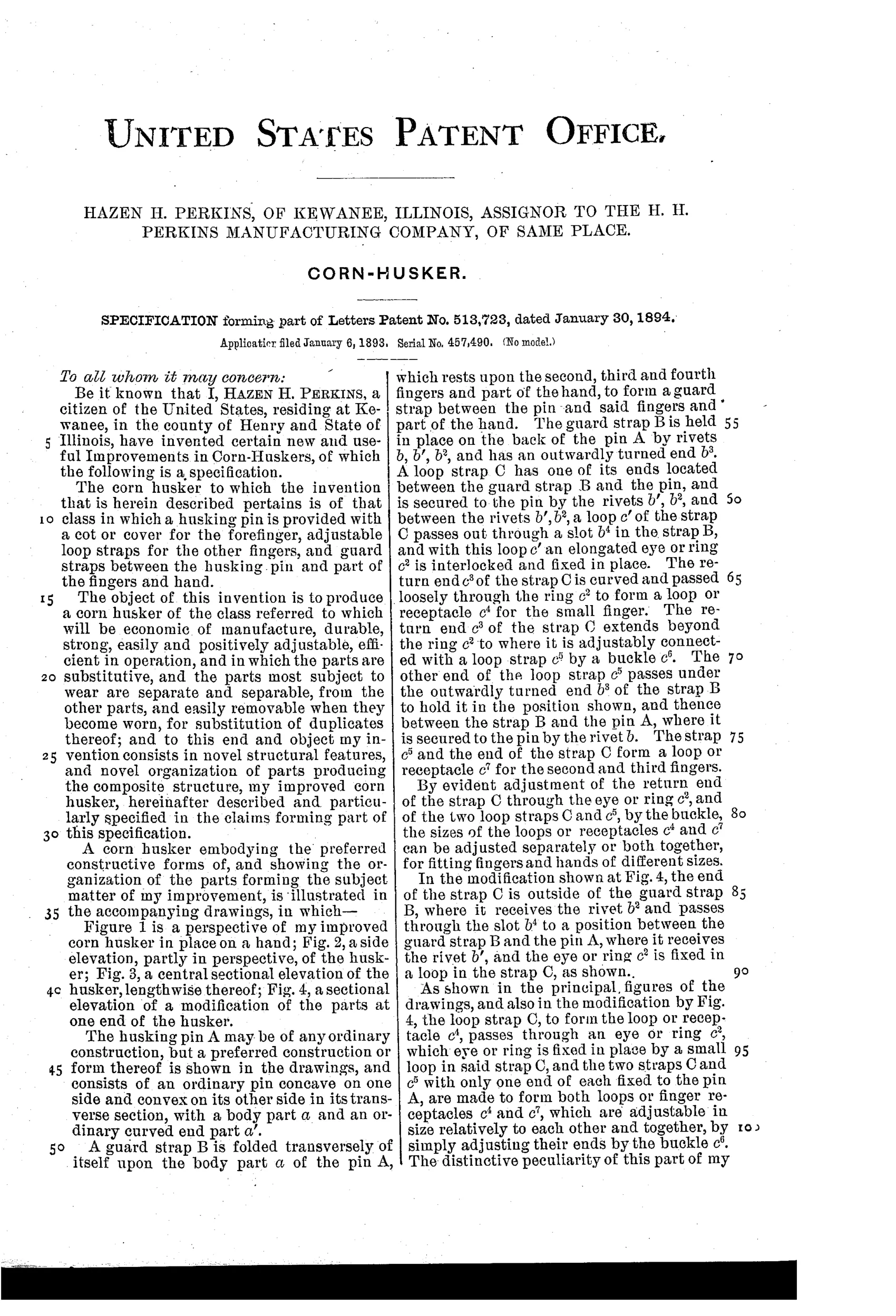
“The object of this invention is to produce a corn husker of the class referred to which will be economic of manufacture, durable, strong, easily and positively adjustable, efficient in operation, and in which the parts are substitutive, and the parts most subject to wear are separate and separable, from the other parts, and easily removable when they become worn, for substitution of duplicates thereof.”— Hazen H. Perkins, from the specification
Fate unknown
Assignment to the H. H. Perkins Manufacturing Company suggests intent to produce, but I know of no documented specimen matching this strap-and-buckle design; a marked example would settle it.
❧ Patented the same day
- CORN-HUSKER — Hazen H. Perkins
- CORN-HUSKER. — Hazen H. Perkins
❧ More by Hazen H. Perkins
- HUSKING-PIN. (1890)
- CORN-HUSKER (1894)
- CORN-HUSKER. (1894)
- HUSKING-PIN. (1897)
- HUSKING-PIN. (1898)
❧ Commentary
First, the confession: this is not an apple parer. Perkins's patent is a corn-husking pin, one of the great hand tools of the pre-mechanization Midwest, and it landed in our files as a neighbor from the same era of small clever iron. But it's worth the detour, because it shows the same design instincts our parer inventors were chasing — cheapness, adjustability, and replaceable wear parts — applied to a tool worn on the hand instead of clamped to a table.
The mechanics are all in the strapping. One strap is riveted to the pin, looped through a ring to form a finger receptacle, then run back to a buckle shared with a second strap forming a second loop. Pull the straps through the buckle and both finger loops resize together or separately — a genuinely thoughtful fit system for a tool that had to suit every hired hand on the farm. Note the leather finger cot in Fig. 1 protecting the forefinger, and Perkins's own stated priority: the parts most subject to wear are separable and replaceable. That's the same economics that made Reading and Goodell parers survive in kitchens for a century.
Husking pins were made by the hundreds of thousands, and this patent was assigned to a company bearing Perkins's own name — usually a sign the inventor meant business, not just paper. Whether this exact strap arrangement reached the field is another matter.
Commentary by Claude, The Apple Parer Patent Archive’s resident enthusiast