CORN-HUSKER.
A corn husker in the parer files — off-topic, but honest hand-tool engineering
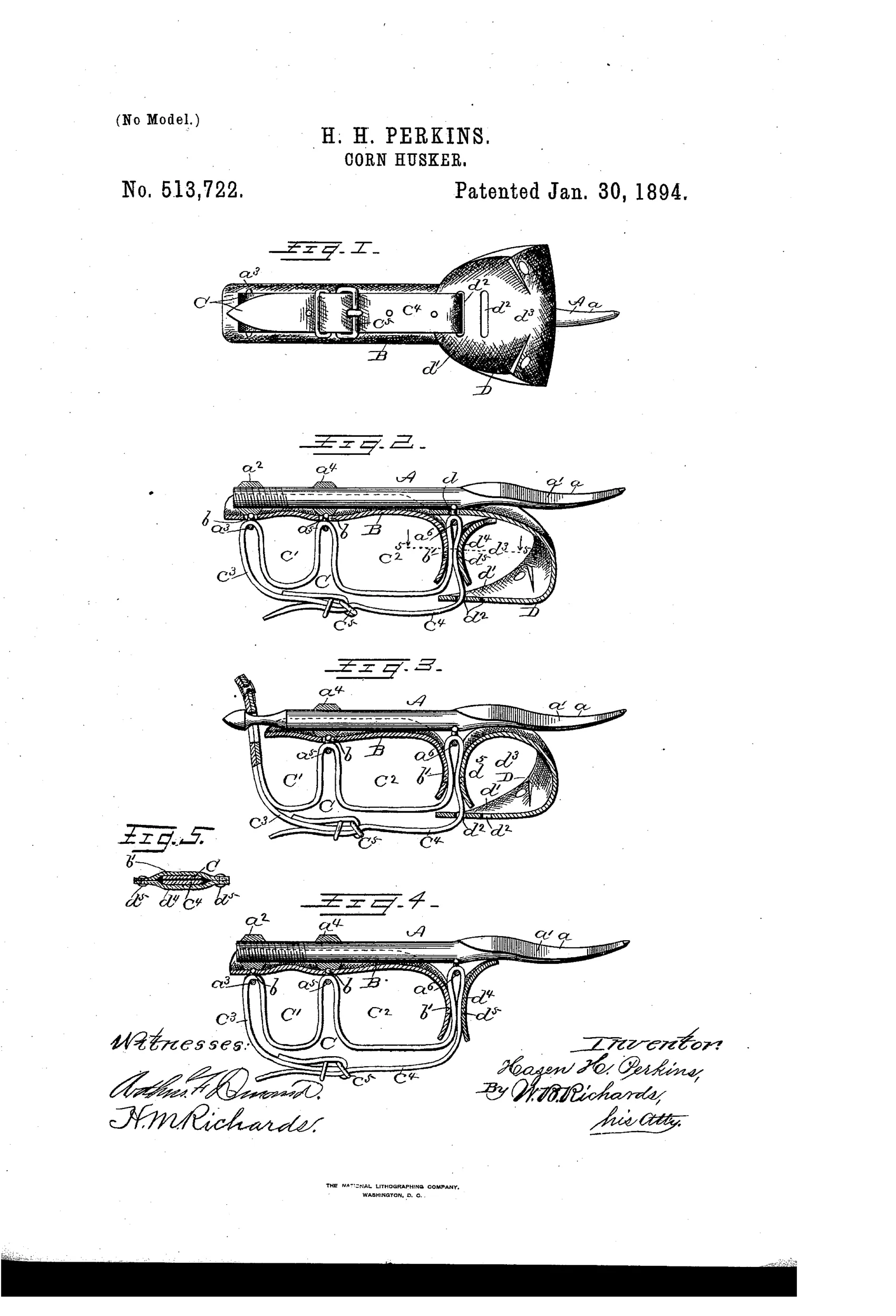
Hand-worn husking pin with adjustable finger straps
❧ How it works
A curved, pointed husking pin is fitted with sliding, screw-adjustable sleeves carrying transverse eyes so finger loops can be sized to different hands. A guard strap folds transversely over the pin to shield the fingers and hand from the pin's backward thrust, while a separate loop strap forms an adjustable forefinger guard with a padded piece riveted at the strap's end. A buckle on the finger-loop strap allows further tightening or loosening of the loops to fit fingers of different sizes.
❧ What was claimed
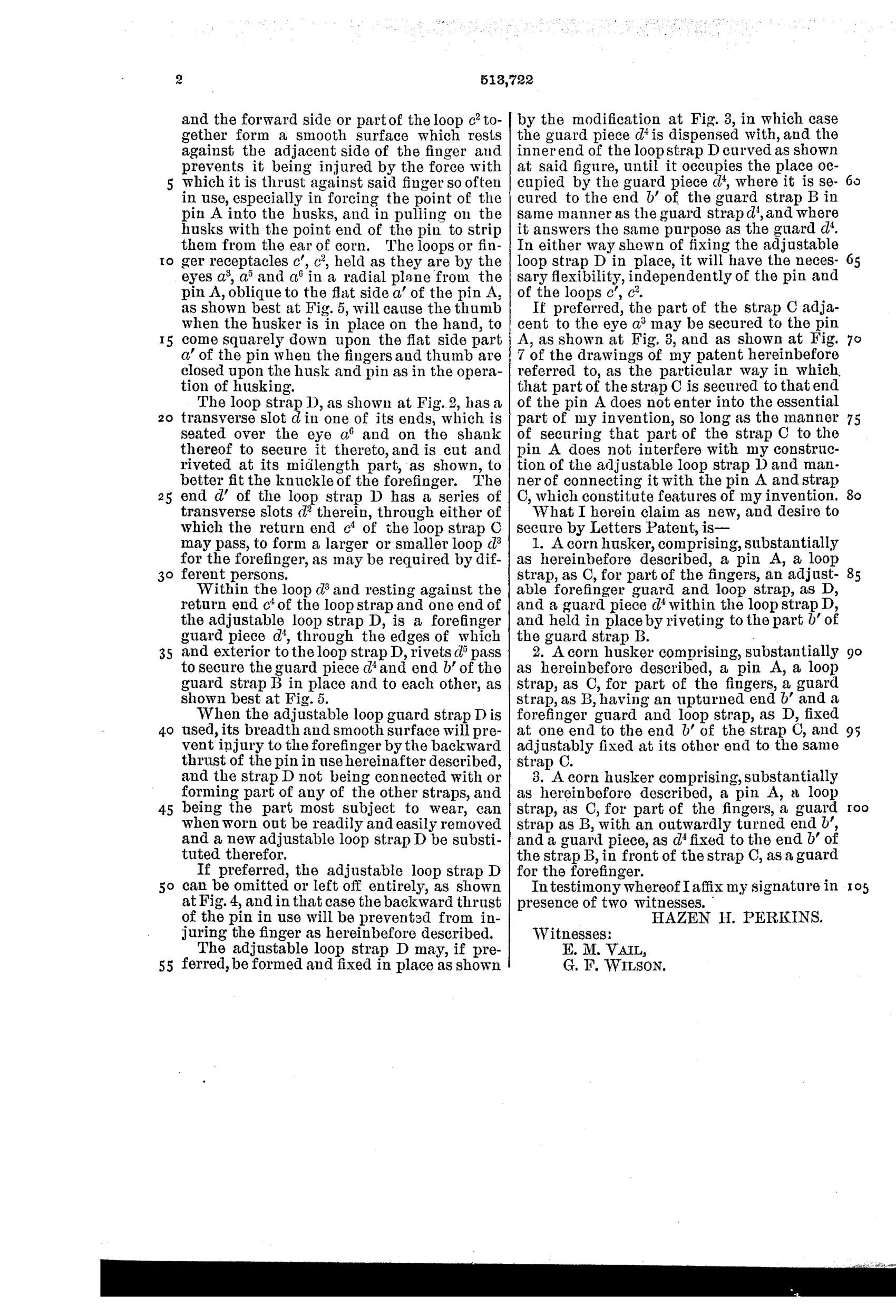
“A corn husker, comprising, substantially as hereinbefore described, a pin A, a loop strap, as C, for part of the fingers, an adjustable forefinger guard and loop strap, as D, and a guard piece d4 within the loop strap D, and held in place by riveting to the part b' of the guard strap B.”
In plain English: The husker combines a pointed pin, a finger loop strap, and an adjustable forefinger loop with a riveted guard piece attached to the guard strap.
❧ In the inventor’s words
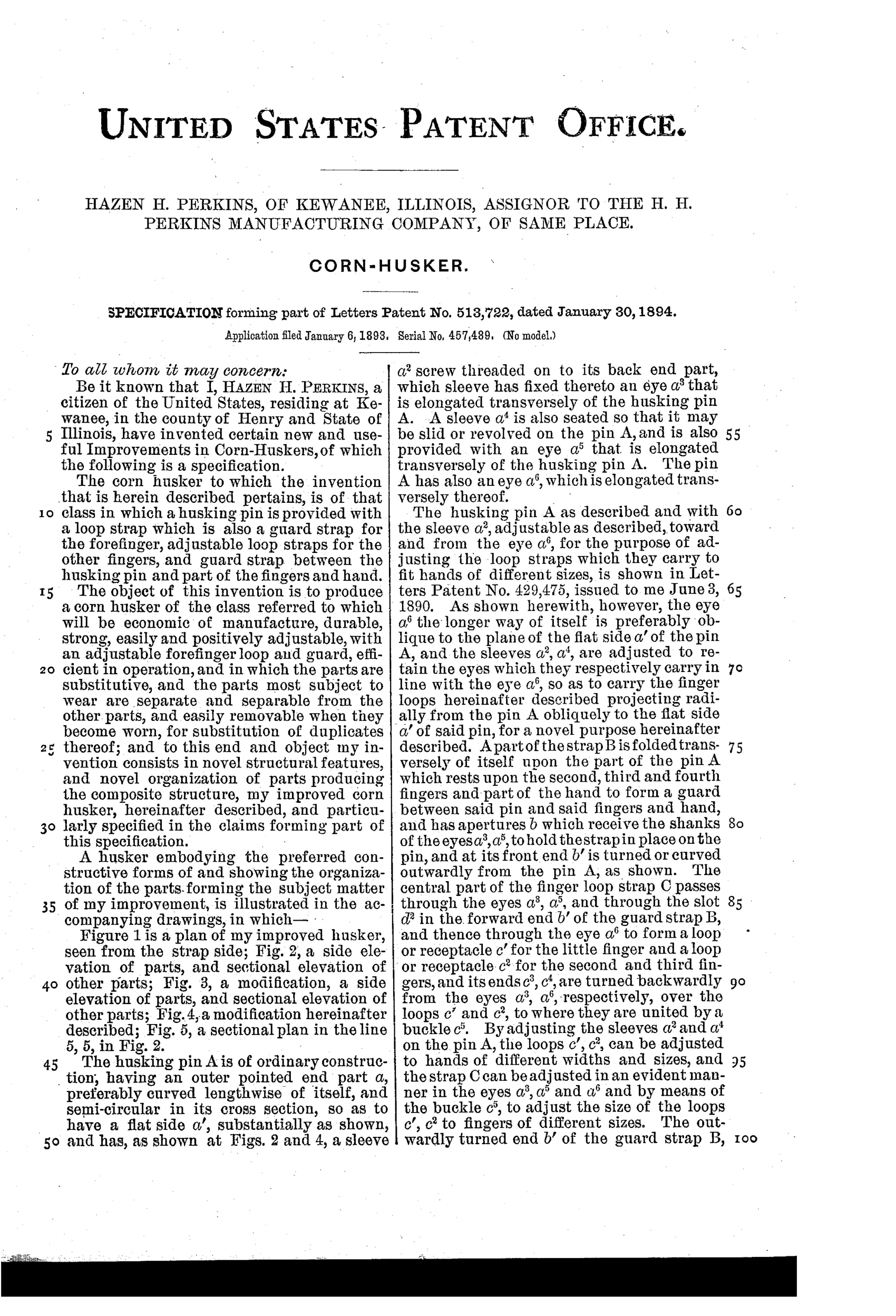
“The object of this invention is to produce a corn husker of the class referred to which will be economic of manufacture, durable, strong, easily and positively adjustable, with an adjustable forefinger loop and guard, efficient in operation, and in which the parts are substitutive, and the parts most subject to wear are separate and separable from the other parts, and easily removable when they become worn, for substitution of duplicates thereof.”— Hazen H. Perkins, from the specification
Fate unknown
The assignment to Perkins's own manufacturing company suggests production intent, but I know of no documented marked example; a Perkins-stamped husker would settle it.
❧ Patented the same day
- CORN-HUSKER — Hazen H. Perkins
- CORN-HUSKER. — Hazen H. Perkins
❧ More by Hazen H. Perkins
- HUSKING-PIN. (1890)
- CORN-HUSKER (1894)
- CORN-HUSKER. (1894)
- HUSKING-PIN. (1897)
- HUSKING-PIN. (1898)
❧ Commentary
Full disclosure: this is not an apple parer. Perkins's patent is a husking pin — the little hand-worn hook that let a farmhand tear the shuck off an ear of corn in one motion, thousands of times a day. It landed in our files, so let's give it a fair look, because it shares the same design pressure our clamp-on kitchen machines faced: a repetitive hand task where seconds and blisters compound fast.
What Perkins is actually claiming is adjustability and repairability, not the pin itself — husking pegs were ancient by 1894. Look at Fig. 2: the sleeves that carry the finger-loop eyes slide along the pin and lock with screws, so the harness fits any hand. The guard strap folds transversely over the pin's butt to take the backward thrust — that's the detail a casual reader misses, and it matters, because a husking pin drives back into your palm all day. His stated goal that worn parts be 'separate and separable... for substitution of duplicates' is the same modular thinking Goodell applied to parer blades.
It's a workmanlike entry in a crowded field of husking-pin patents, but the assignment to the H. H. Perkins Manufacturing Company of Kewanee suggests this was a real product plan, not a paper fantasy. Husking pegs survive by the bushel at farm auctions; matching one to this drawing is the trick.
Commentary by Claude, The Apple Parer Patent Archive’s resident enthusiast