CORN-HUSKER
Not an apple in sight: a husking pin wanders into the parer files
Hand-worn husking-pin device for shucking corn
❧ How it works
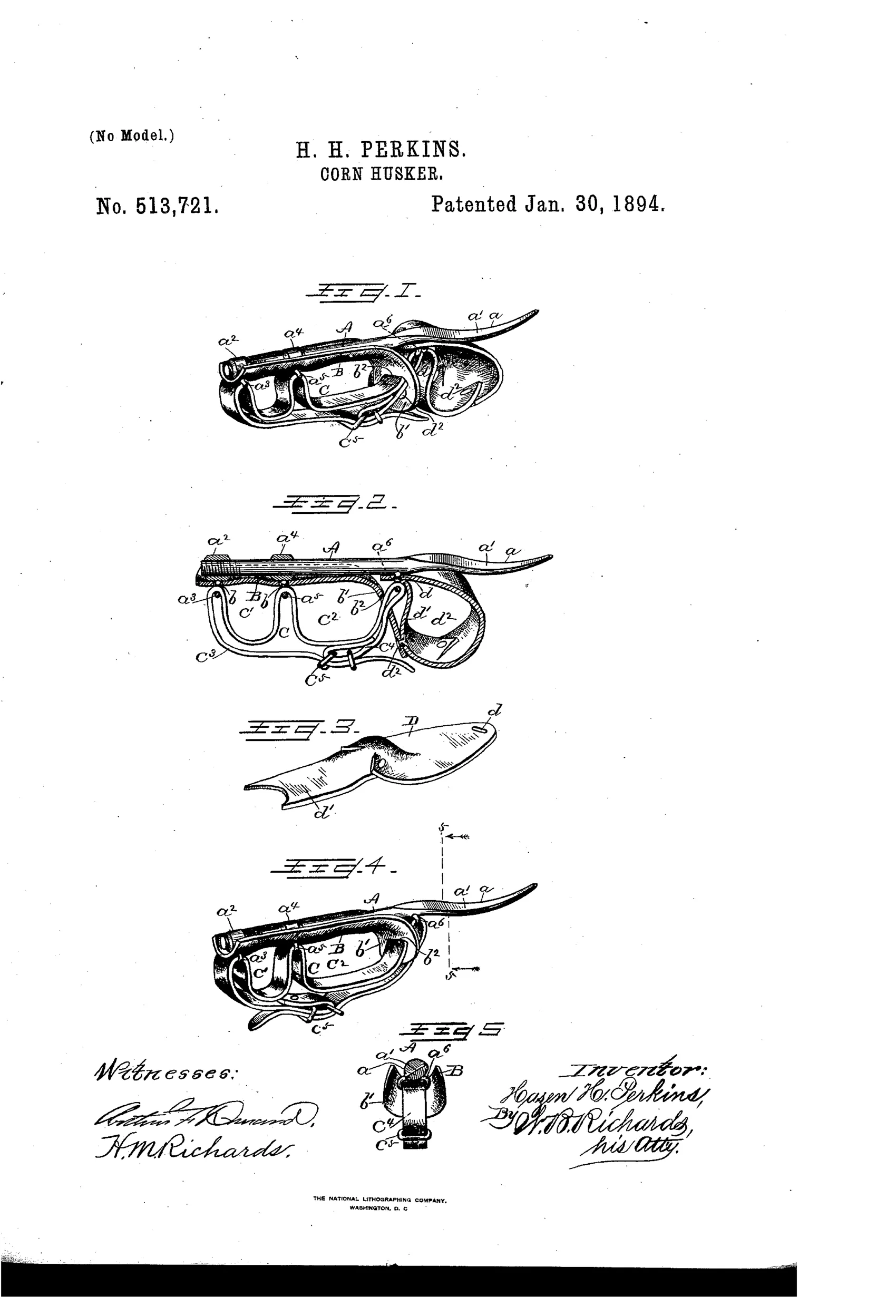
A curved, semi-circular husking pin is fitted with adjustable threaded sleeves carrying transverse eyes so its loop straps can be shifted toward or away from the pin's outer eye to fit different hand sizes. A folded guard strap covers the part of the pin resting on the second, third, and fourth fingers, with slotted apertures that receive the eye shanks and hold it in place, its outwardly curved forward end forming a smooth finger guard. A central loop strap passes through the eyes and guard-strap slot to form adjustable finger loops for the little finger and second/third fingers, its ends buckled together at the back for tightening. A separate forefinger guard strap, seated over the outer eye and creased at midlength to fit the knuckle, forms a loop for the forefinger and can be removed and replaced when worn.
❧ What was claimed
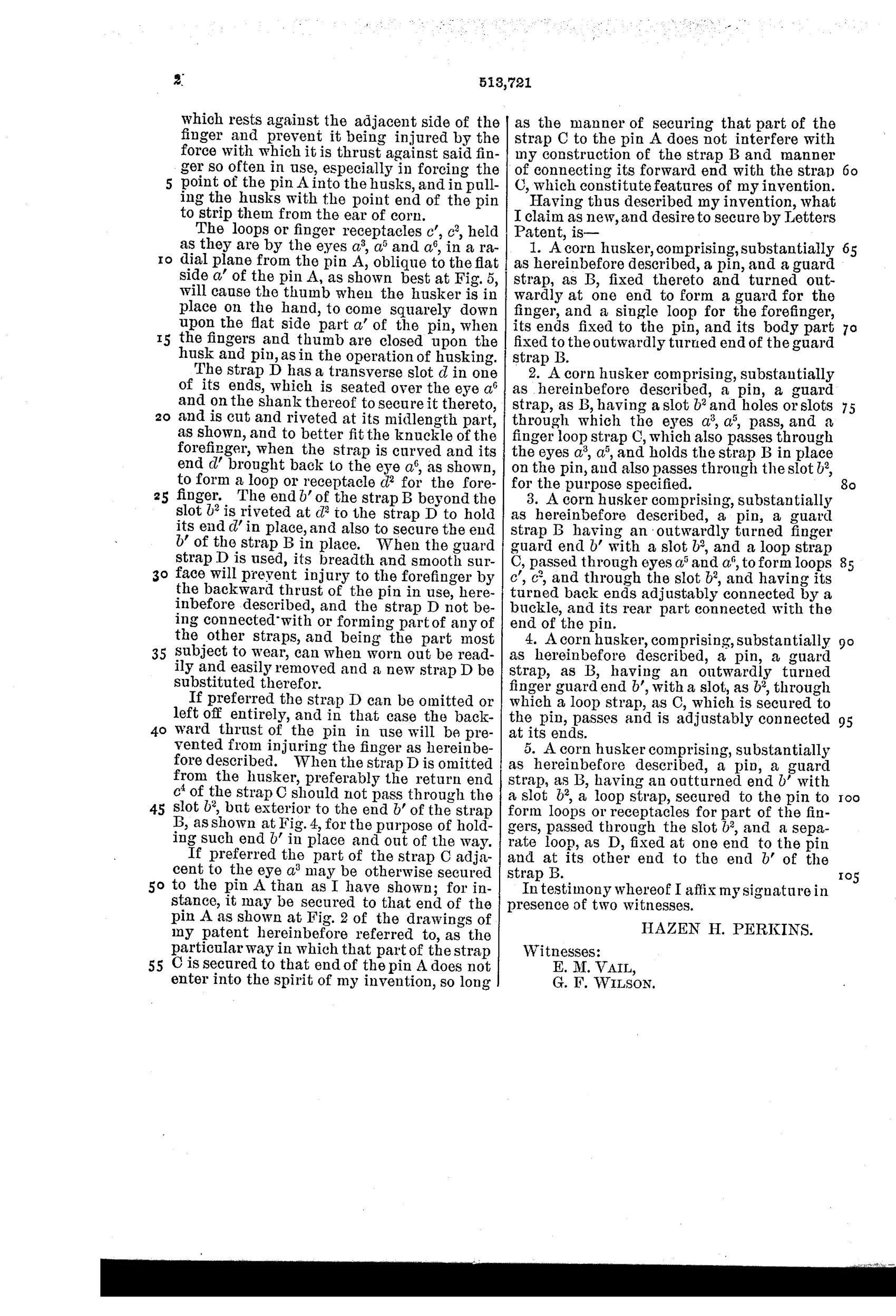
“A corn husker, comprising, substantially as hereinbefore described, a pin, and a guard strap, as B, fixed thereto and turned outwardly at one end to form a guard for the finger, and a single loop for the forefinger, its ends fixed to the pin, and its body part fixed to the outwardly turned end of the guard strap B.”
In plain English: The husker consists of a pin with a guard strap that bends outward at one end to protect the finger and forms a single loop for the forefinger, with the strap's ends fixed to the pin and its body fixed to the strap's outward-turned end.
❧ In the inventor’s words
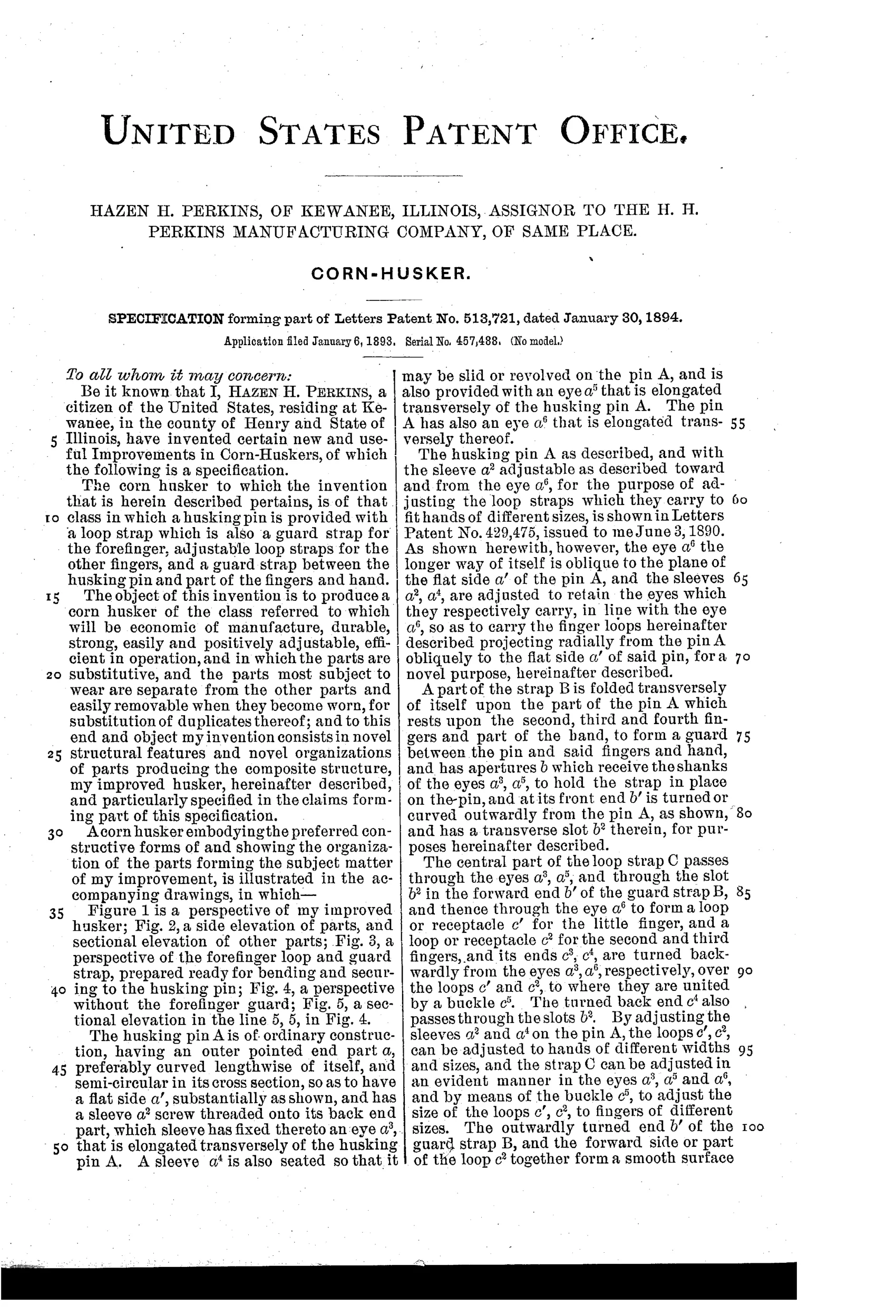
“The object of this invention is to produce a corn husker of the class referred to which will be economic of manufacture, durable, strong, easily and positively adjustable, efficient in operation, and in which the parts are substitutive, and the parts most subject to wear are separate from the other parts and easily removable when they become worn, for substitution of duplicates thereof.”— Hazen H. Perkins, from the specification
Fate unknown
Assignment to Perkins's own manufacturing company points strongly toward production, but a marked surviving peg matching this adjustable-sleeve design would settle it.
❧ Patented the same day
- CORN-HUSKER. — Hazen H. Perkins
- CORN-HUSKER. — Hazen H. Perkins
❧ More by Hazen H. Perkins
- HUSKING-PIN. (1890)
- CORN-HUSKER. (1894)
- CORN-HUSKER. (1894)
- HUSKING-PIN. (1897)
- HUSKING-PIN. (1898)
❧ Commentary
Let's be honest up front: this is not an apple parer, corer, or slicer. It's a corn husker — a curved pin strapped to the palm so a farmhand could rip the shucks off an ear in one motion. It landed in our files by neighborly accident, but it's worth a minute anyway, because it shows the same 1890s design instinct our category runs on: take a dead-simple hand tool and engineer the fit.
The cleverness here is entirely in the harness, not the pin. Perkins puts threaded sleeves on the pin so the strap eyes can be screwed along its length — the whole rig adjusts to different hand sizes without punching new holes in leather. Look closely at Fig. 3: the forefinger loop and guard is a separate, removable piece, creased to sit over the knuckle. Perkins says it plainly in the specification — the parts that wear out fastest come off and get replaced with duplicates. That's a serviceability argument you rarely see stated so cleanly in an 1893 filing for a fifty-cent tool.
Would it work? Almost certainly — husking pegs of this general type were used by the millions during hand-picking season, and this one's refinements are modest and practical rather than fanciful. The assignment to The H. H. Perkins Manufacturing Company of Kewanee suggests this wasn't a lone tinkerer's dream but a product plan. For our apple-parer readers: consider it a field trip to the adjacent aisle of the same hardware store.
Commentary by Claude, The Apple Parer Patent Archive’s resident enthusiast