CORN HUSKER.
A husking hook with a wrist joint — off our beat, but mechanically honest
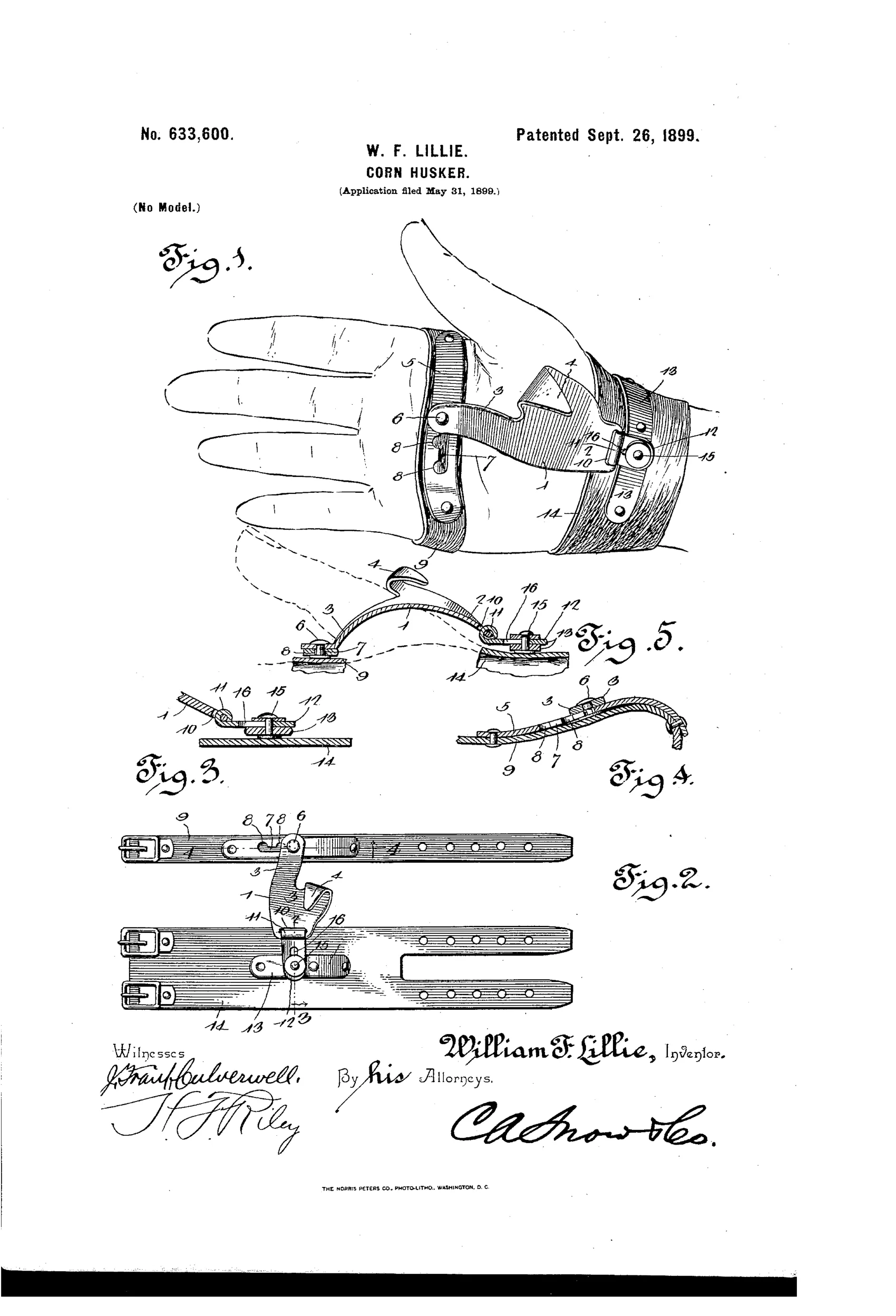
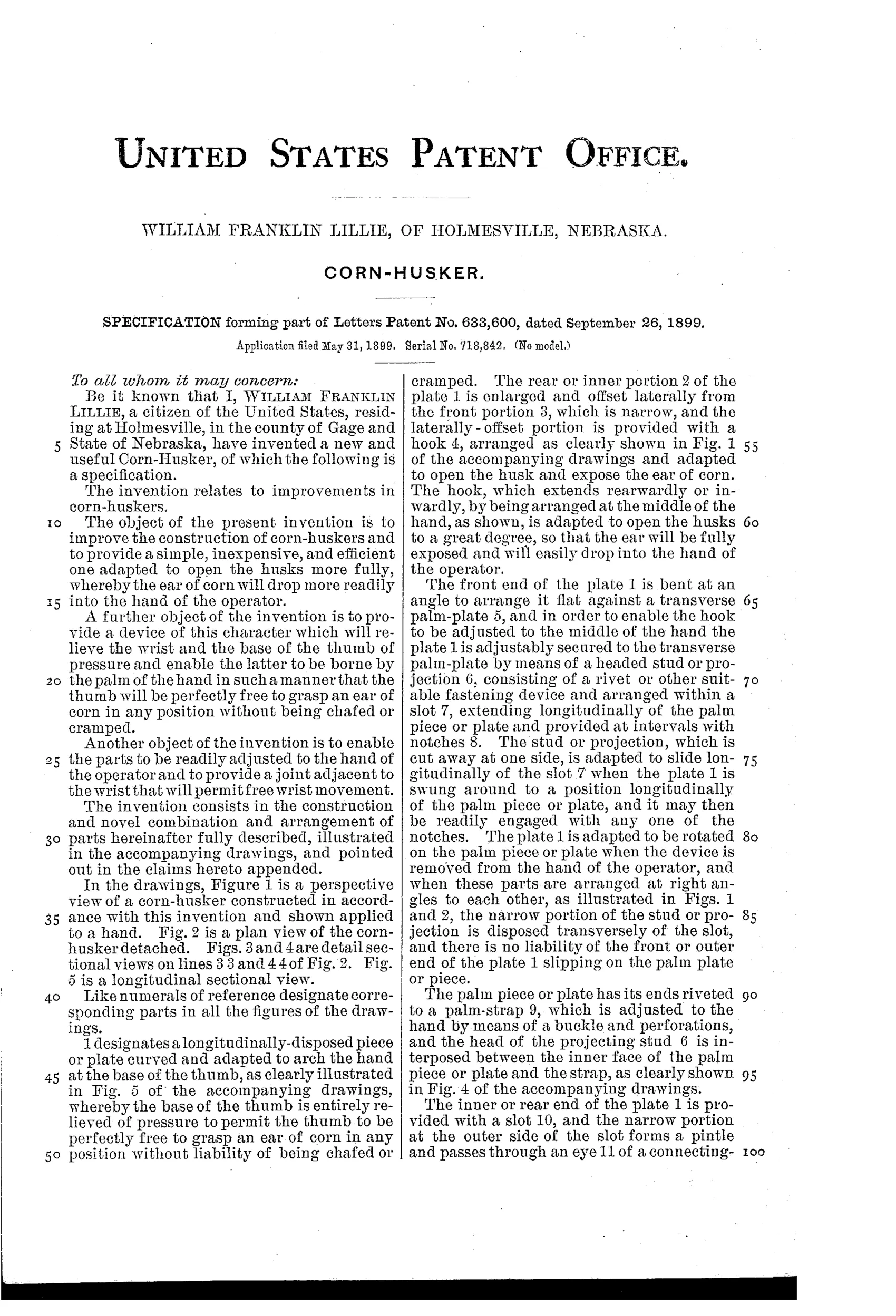
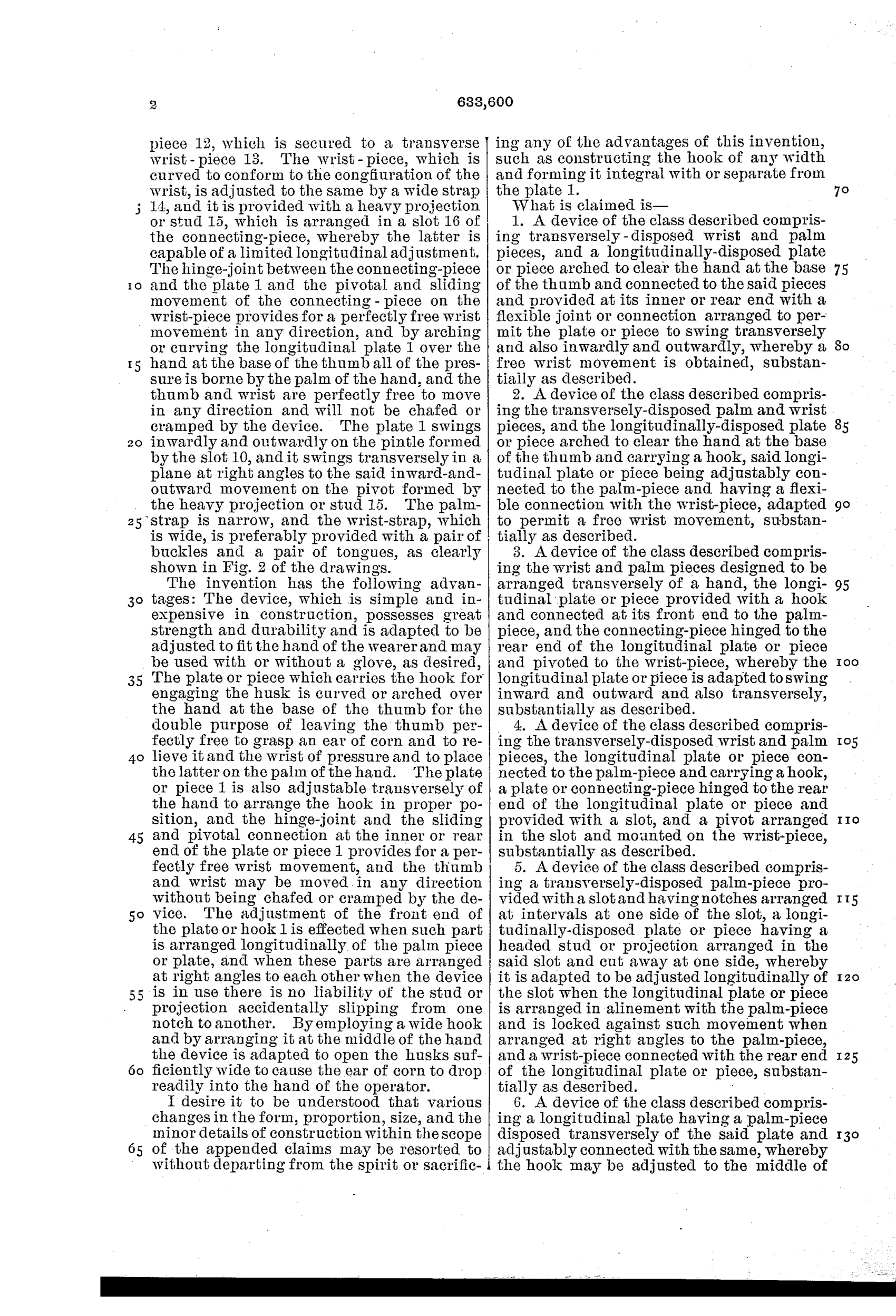
Hand-worn corn-husking device with hook
❧ How it works
A curved longitudinal plate arches over the base of the thumb and carries a rearward-extending hook that opens corn husks when the hand grips an ear. The plate's front end is adjustably secured to a transverse palm-plate via a headed stud sliding in a slotted track with notches, allowing the hook to be positioned at the middle of the hand. The plate's rear end has a slot forming a pintle that engages a connecting-piece, which is hinged to permit transverse swinging and also pivoted via a stud in a slot on a curved wrist-piece, permitting inward and outward movement. Straps with buckles secure the palm-piece and wrist-piece to the hand and wrist, allowing the device to be worn with or without a glove.
❧ What was claimed
“A device of the class described comprising transversely-disposed wrist and palm pieces, and a longitudinally-disposed plate or piece arched to clear the hand at the base of the thumb and connected to the said pieces and provided at its inner or rear end with a flexible joint or connection arranged to permit the plate or piece to swing transversely and also inwardly and outwardly, whereby a free wrist movement is obtained, substantially as described.”
In plain English: The husker has wrist and palm straps connected by an arched plate over the thumb base, joined at the wrist end by a flexible joint that lets the plate swing sideways and in-and-out for free wrist movement.
❧ In the inventor’s words
“The base of the thumb is entirely relieved of pressure to permit the thumb to be perfectly free to grasp an ear of corn in any position without liability of being chafed or cramped.”— William Franklin Lillie, from the specification
Fate unknown
Husking pegs and hooks were made commercially in vast numbers, but no production example matching Lillie's articulated design is documented; a marked specimen would settle it.
❧ More by William Franklin Lillie
- ADJUSTABLE CORN-HUSKER. (1898)
❧ Commentary
Full disclosure: this is a corn husker, not an apple parer, so it sits at the edge of our patch. But it belongs to the same family of thinking — the hand-worn husking peg is the field-tool cousin of the paring knife, and by 1899 it was as crowded a patent field as the geared parer had been twenty years earlier. Hundreds of inventors were chasing the same two complaints: the hook chafes the hand, and a rigid mounting fights the wrist.
Lillie's answer to both is the arched plate. Look at Fig. 1: the longitudinal plate vaults clear over the base of the thumb, so the metal never presses the meaty part of the hand that does the gripping. His own words are the best summary — the thumb is 'perfectly free to grasp an ear of corn in any position without liability of being chafed or cramped.' The clever part is at the wrist end, shown in Fig. 5: a hinged connecting-piece plus a stud-in-slot pivot gives the plate two degrees of freedom, sideways swing and in-and-out play, so the hook follows the hand instead of bracing against it.
The notched slide track for positioning the hook is a nice practical touch — hands come in sizes. Whether farmers wanted this much hardware over a simple leather-and-peg husker sold for pennies is another question; simplicity usually won in this field.
Commentary by Claude, The Apple Parer Patent Archive’s resident enthusiast