ADJUSTABLE CORN-HUSKER.
A corn husker on the apple parer site — hand-worn hook, jointed thumb armor
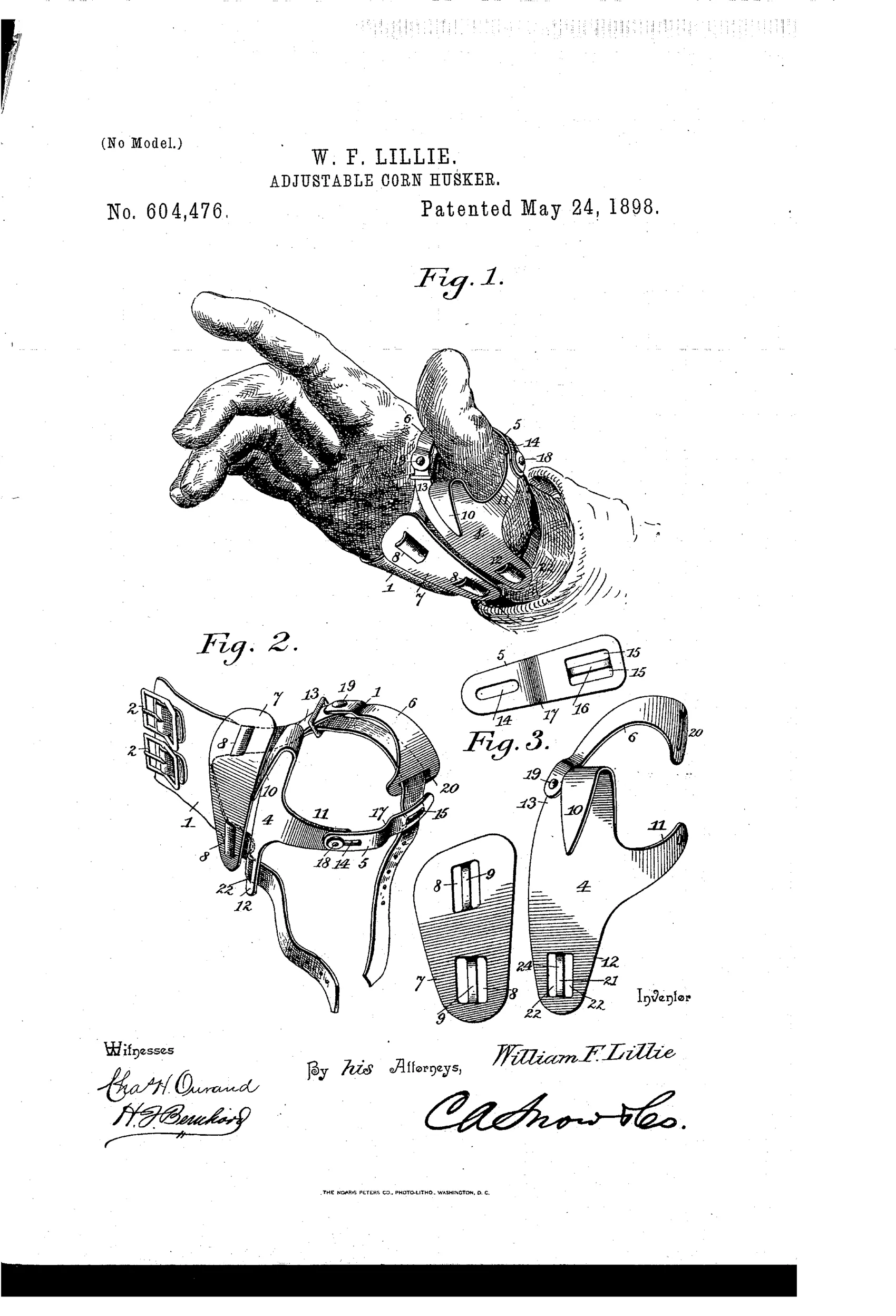
Hand-worn adjustable corn husking implement with hook
❧ How it works
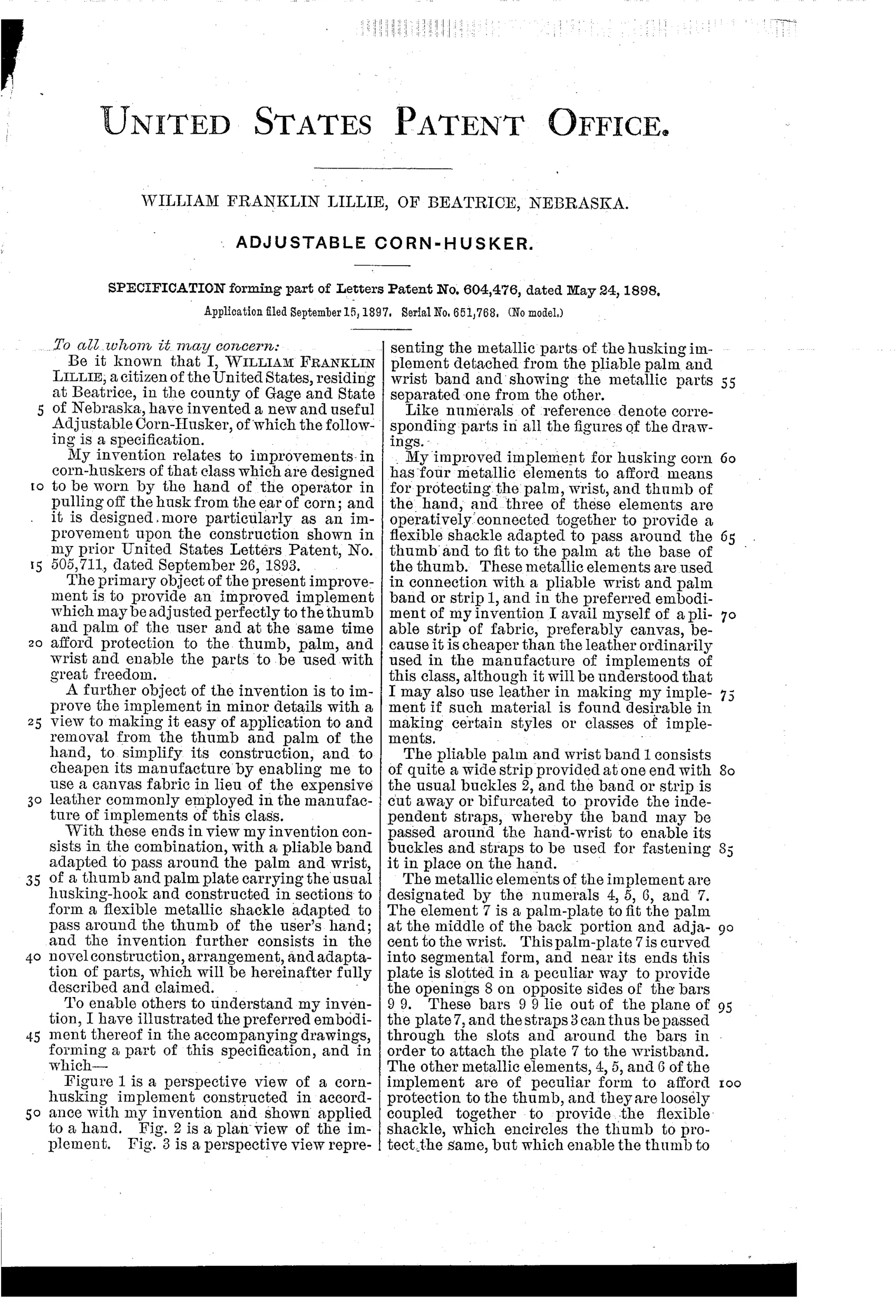
A pliable canvas or leather band wraps around the wrist and palm, secured with buckles and bifurcated straps. Four metallic plates (4, 5, 6, 7) protect the thumb, palm, and wrist, with plate 4 carrying a curved husking hook. Plates 5 and 6 are loosely and pivotally connected to arms of the main plate 4 to form a flexible shackle that encircles the thumb, allowing free movement. Straps pass through slots and over cross-bars in the plates to hold all the metallic elements in operative relation while permitting play between them.
❧ What was claimed
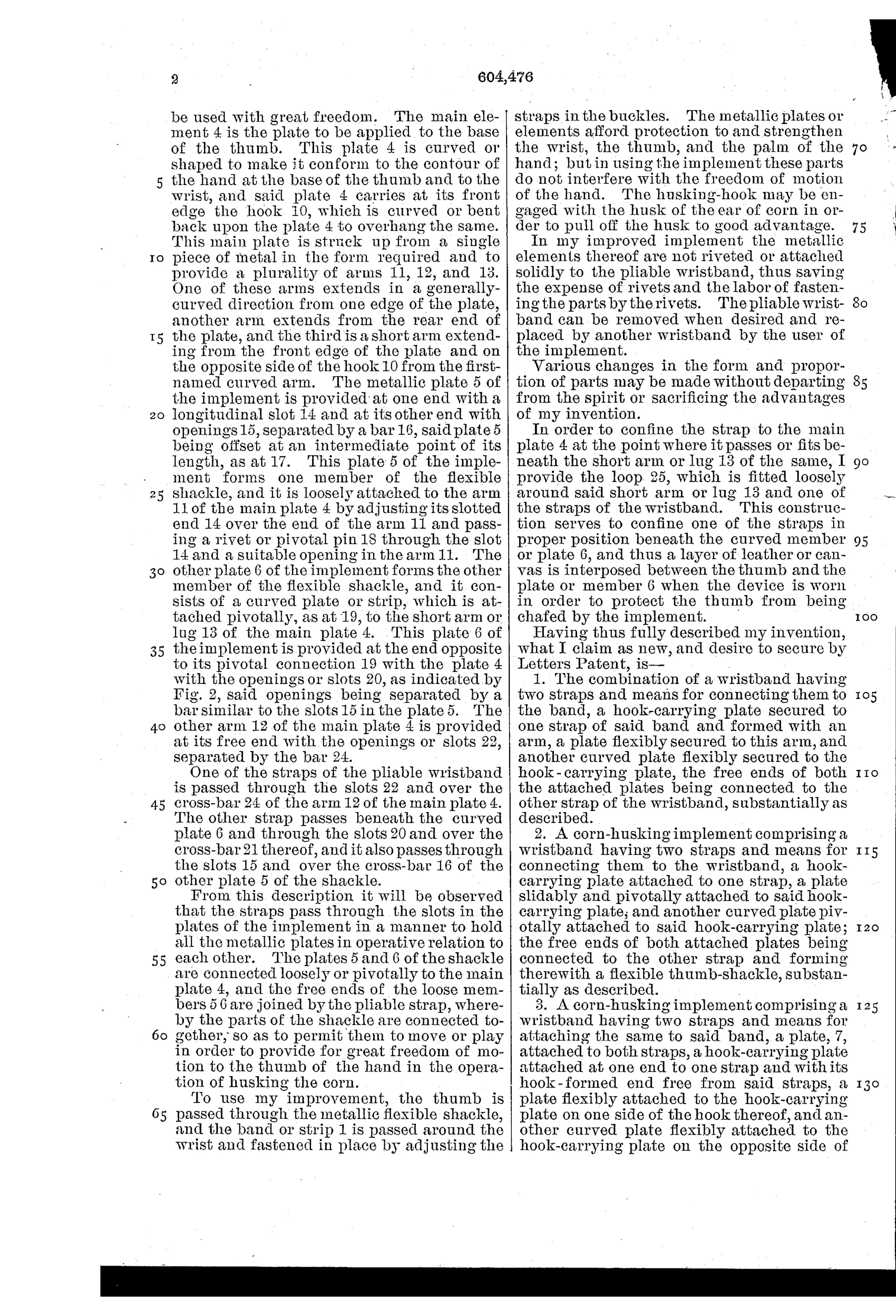
“The combination of a wristband having two straps and means for connecting them to the band, a hook-carrying plate secured to one strap of said band and formed with an arm, a plate flexibly secured to this arm, and another curved plate flexibly secured to the hook-carrying plate, the free ends of both the attached plates being connected to the other strap of the wristband, substantially as described.”
In plain English: The device combines a two-strap wristband with a hook-carrying plate that has an arm holding a flexible plate, plus another curved plate flexibly attached to the hook plate, with both plates' free ends connected to the other strap.
❧ In the inventor’s words
“The primary object of the present improvement is to provide an improved implement which may be adjusted perfectly to the thumb and palm of the user and at the same time afford protection to the thumb, palm, and wrist and enable the parts to be used with great freedom.”— William Franklin Lillie, from the specification
Fate unknown
Husking hooks were made by the million, but no example matching this articulated three-plate design is documented to me; a marked specimen would settle it.
❧ More by William Franklin Lillie
- CORN HUSKER. (1899)
❧ Commentary
First, honesty: this is not an apple parer. It wandered into the collection because it belongs to the same family of thinking — the late-century conviction that every repetitive kitchen and farm chore deserved purpose-built hardware. Where our clamp-on parers put the gearing on the table, Lillie puts the machine on the hand itself.
The mechanical idea worth a look is the thumb shackle. Husking corn by hand shredded thumbs; a rigid thumb guard solved that but killed dexterity. Lillie's answer is three plates loosely pivoted to one another — Fig. 3 shows plates 5 and 6 hanging off arms of the main hook-carrying plate 4 — so the assembly flexes like crude articulated armor while the straps hold everything in working position. The straps run through slots and over cross-bars rather than being riveted, which is what he means by 'adjusted perfectly': the whole rig can shift on the hand without coming apart. That looseness is the invention.
Husking hooks and pegs were a genuinely enormous market around 1900 — Midwestern hardware catalogs carried dozens of patterns, and Nebraska was the heartland of them. Lillie was in Beatrice, right where the demand lived. Whether this particular articulated-plate pattern reached production I can't say; most surviving huskers are simpler stamped-plate designs, and the extra pivots here add cost that farmers rarely paid for.
Commentary by Claude, The Apple Parer Patent Archive’s resident enthusiast