CORN HUSKER
A wire husking hook strays into our parer files — hand-worn, not crank-driven
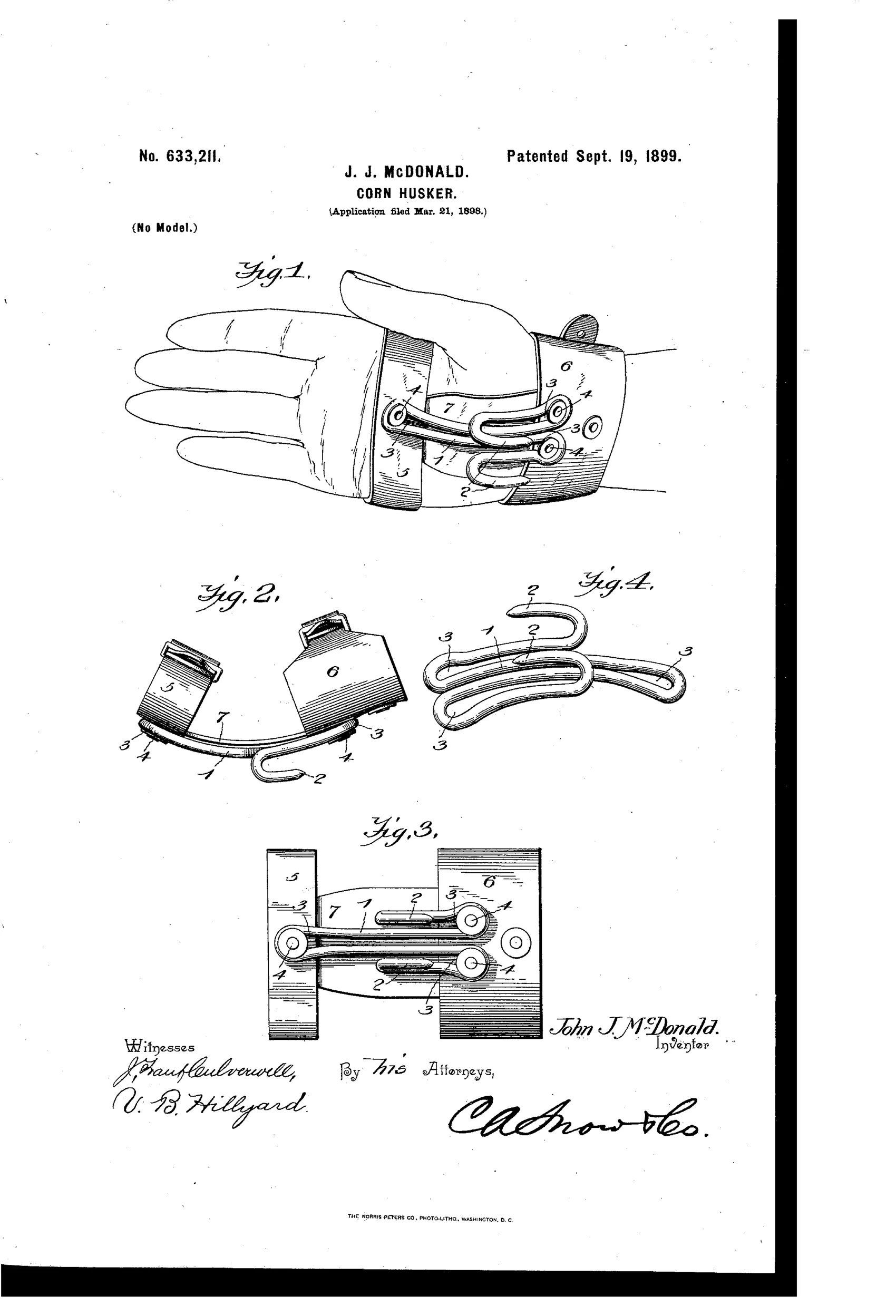
Hand-worn wire hook husking device
❧ How it works
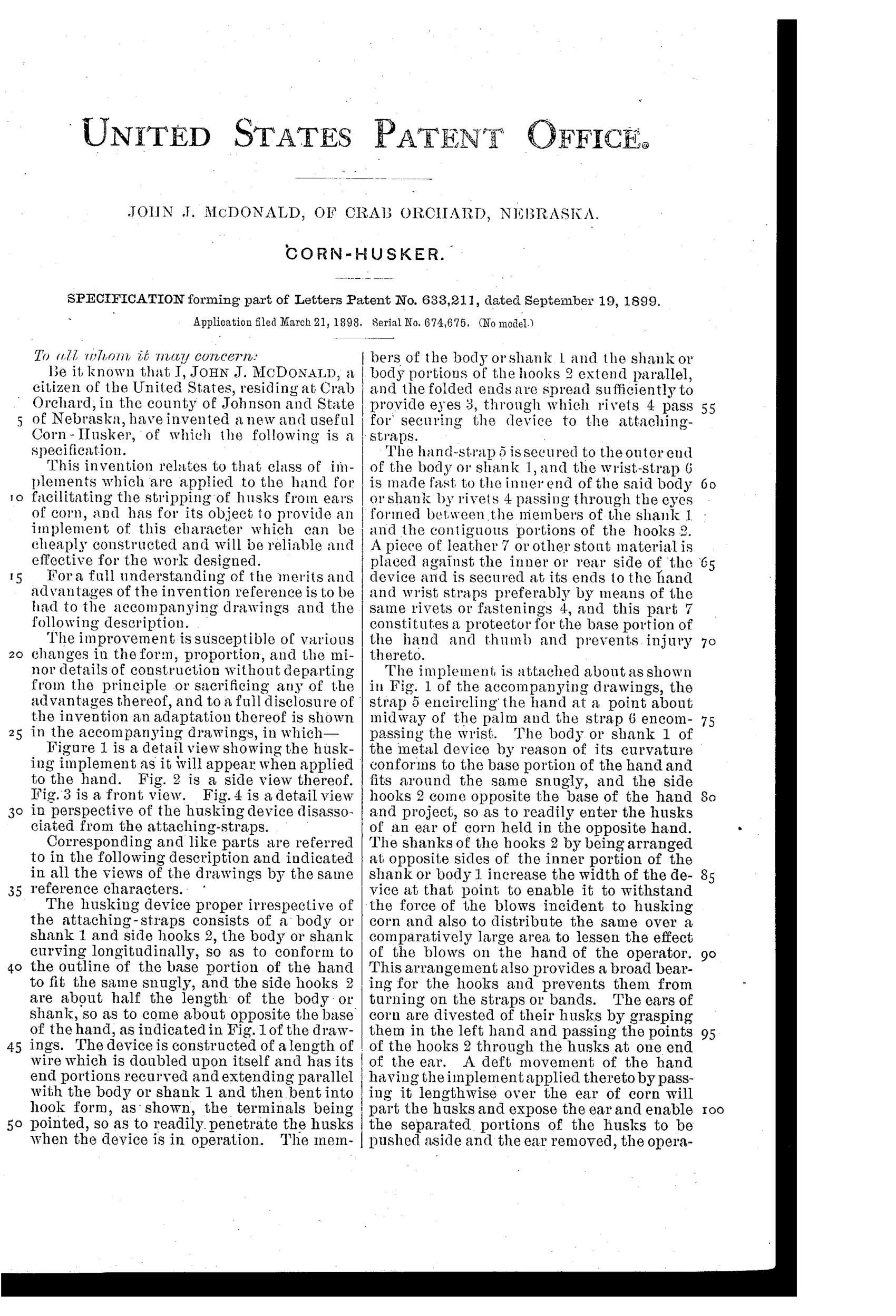
A doubled length of wire forms a curved shank that conforms to the base of the hand, with its folded ends spread into eyes for riveting. The wire ends extend past the shank and bend into pointed hooks projecting from opposite sides near the palm base. A hand-strap and a wrist-strap, riveted through the eyes, secure the device to the hand, and a leather piece is placed against the inner side to protect the palm. The hooks are passed through corn husks and drawn along the ear to part and strip the husk from the cob.
❧ What was claimed
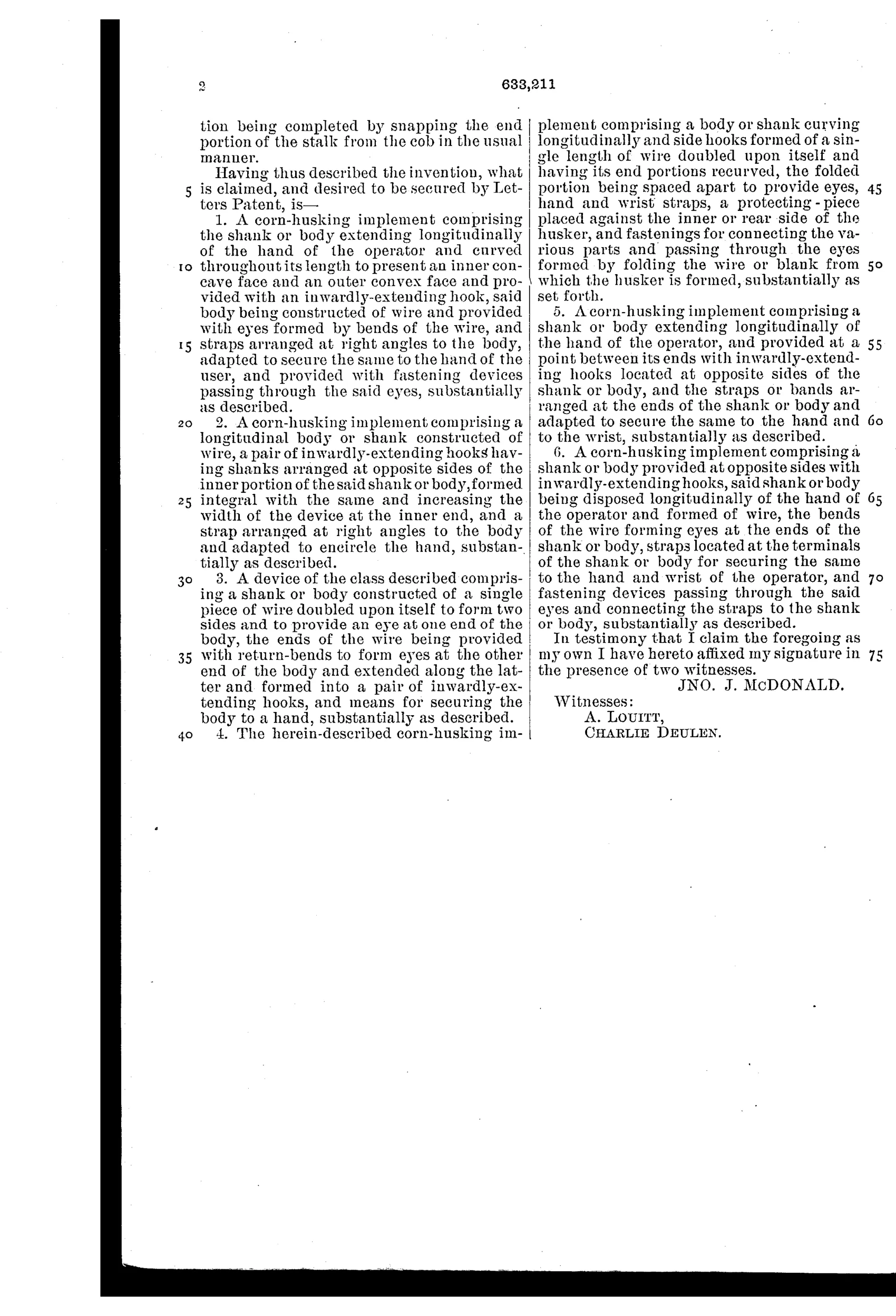
“A corn-husking implement comprising the shank or body extending longitudinally of the hand of the operator and curved throughout its length to present an inner concave face and an outer convex face and provided with an inwardly-extending hook, said body being constructed of wire and provided with eyes formed by bends of the wire, and straps arranged at right angles to the body, adapted to secure the same to the hand of the user, and provided with fastening devices passing through the said eyes, substantially as described.”
In plain English: A wire husking device that curves to fit the hand, has an inward-pointing hook, and is held on by straps riveted through wire loops formed in the wire's bends.
❧ In the inventor’s words
“A deft movement of the hand having the implement applied thereto by passing it lengthwise over the ear of corn will part the husks and expose the ear and enable the separated portions of the husks to be pushed aside and the ear removed, the operation being completed by snapping the end portion of the stalk from the cob in the usual manner.”— John J. McDonald, from the specification
Fate unknown
Husking hooks of this general type were made in enormous numbers, but I know of no marked example tying production to McDonald's specific wire design; a surviving specimen would settle it.
❧ Patented the same day
- CORN-HUSKER — Howard N. F. Sholl
❧ Commentary
Full disclosure: this is not an apple parer. It's a corn husker from Crab Orchard, Nebraska, and how it wandered into our category files I can't say. But since it's here, it deserves a fair reading, because it belongs to a genuinely huge family of American hand tools — the husking peg and palm hook, of which hundreds of variants were patented between the 1860s and the 1920s.
McDonald's contribution is economy of material. The whole working part is one doubled length of wire: the fold-backs form the riveting eyes for the straps, the free ends become the two pointed hooks, and the doubled midsection is curved to lie against the base of the palm. No forging, no stamping, no cast parts — a wire-bending jig and a rivet press could turn these out by the thousand. Fig. 4 shows it plainly: the eyes aren't added hardware, they're just bends in the same wire that makes the hooks. That's the clever bit, and it's the sort of thinking apple-parer men of the same era applied to sheet metal and gearing.
Whether it worked well is another matter. Husking is brutal, repetitive work, and a smooth wire shank under a leather pad might dig into the palm heel less kindly than the broad stamped-steel palm hooks that came to dominate. Those, not wire novelties, are what survive in barn-sale quantity today.
Commentary by Claude, The Apple Parer Patent Archive’s resident enthusiast