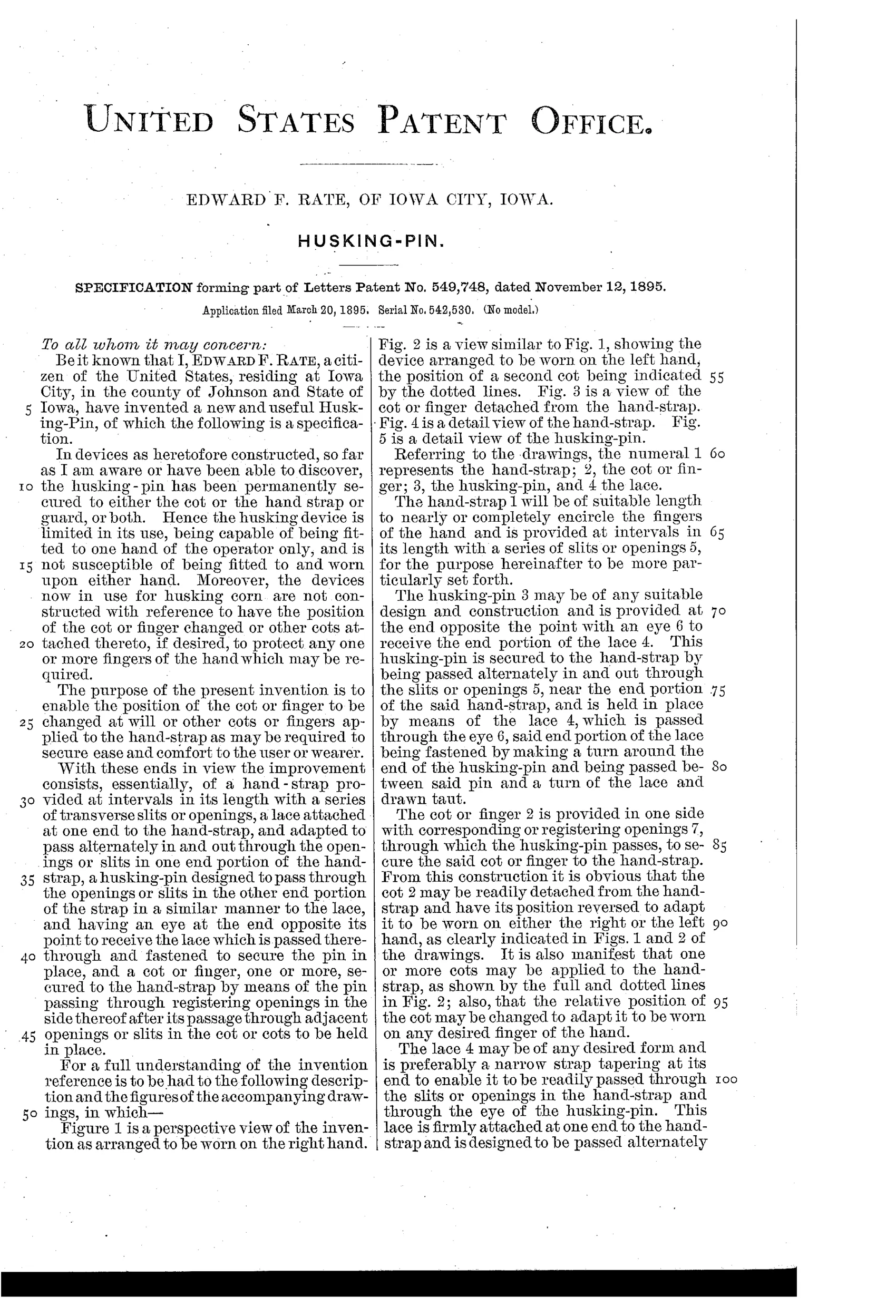
HUSKING-PIN.
A corn husker wanders into the parer files — and it's honest hand-tool thinking
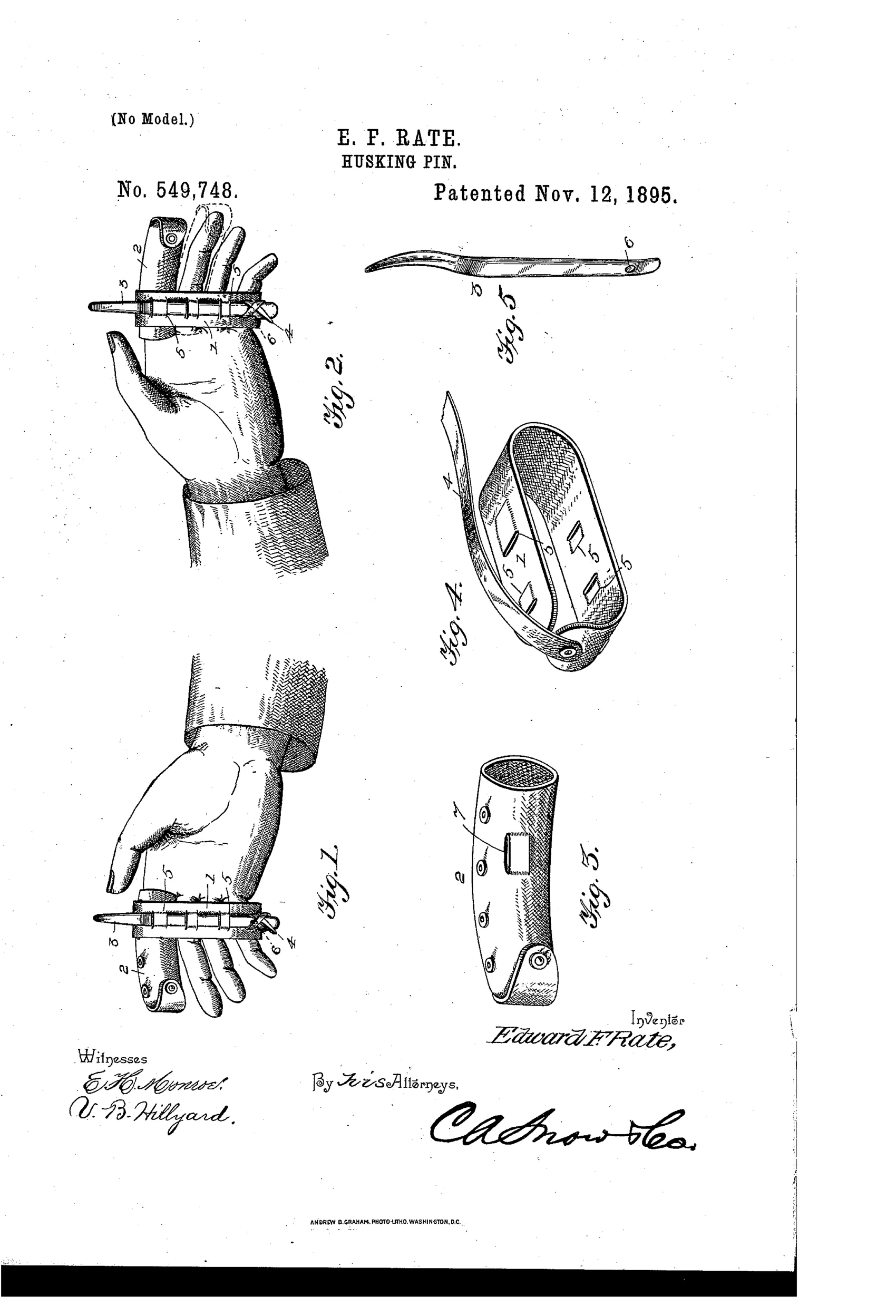
Adjustable, reversible corn husking hand strap
❧ How it works
A hand strap encircling the fingers has a row of slits near each end. A husking pin is laced alternately in and out through slits at one end and passed through registering openings in a detachable finger cot, then the free end of a lace is passed through an eye in the pin and drawn taut to hold everything together. Because the cot and pin engage the strap through simple slit-and-lace connections rather than being permanently fixed, the cot can be detached, reversed, or repositioned to fit either hand or protect a different finger. The lace itself tapers at its end for easy threading through the slits and the pin's eye.
❧ What was claimed
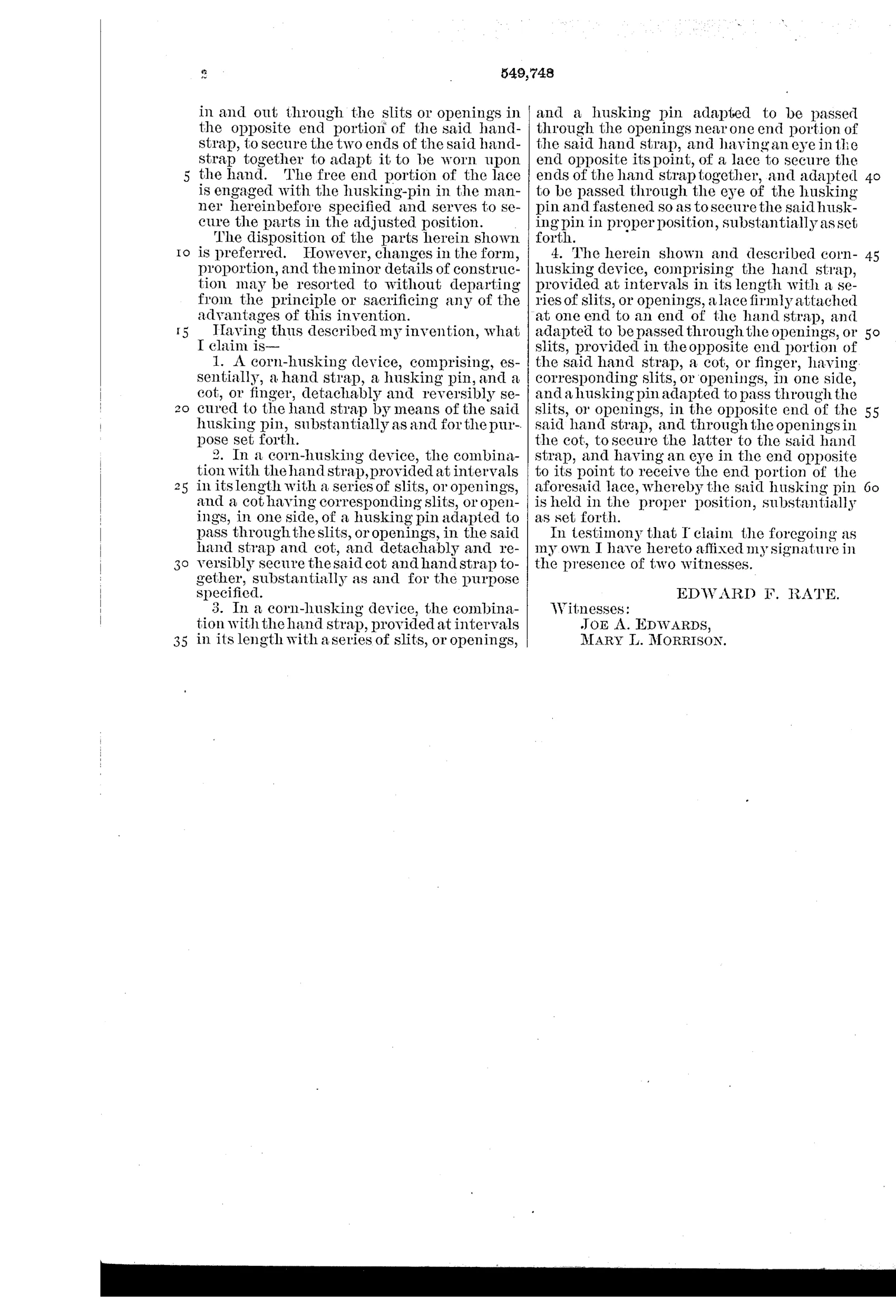
“A corn-husking device, comprising, essentially, a hand strap, a husking pin, and a cot, or finger, detachably and reversibly secured to the hand strap by means of the said husking pin, substantially as and for the purpose set forth.”
In plain English: The device is basically a hand strap with a husking pin that lets a removable finger cot be attached and reversed to fit either hand.
❧ In the inventor’s words
“Hence the husking device is limited in its use, being capable of being fitted to one hand of the operator only, and is not susceptible of being fitted to and worn upon either hand.”— Edward F. Rate, from the specification
Fate unknown
Husking pins were common commercial goods, but no marked example of Rate's specific reversible slit-and-lace design is documented to my knowledge; a surviving attributed specimen would settle it.
❧ More by Edward F. Rate
- Corn-Husking Implement. (1878)
❧ Commentary
First, full disclosure: this is not an apple parer. Edward F. Rate of Iowa City patented a corn-husking hand strap, and it sits in our files as a neighbor rather than a family member. But it's worth a look precisely because it shows the opposite philosophy from our cast-iron geared machines. While the parer men were adding segment gears to do three jobs in one crank turn, Rate was solving a problem with leather, slits, and a lace.
The problem is stated plainly in the specification: existing husking rigs fit one hand only. A left-handed husker, or a man who wanted to switch hands during a long day in the field, was out of luck. Rate's answer is elegant in a saddler's way — the husking pin itself is the fastener. Laced alternately through a row of slits, it pins the detachable finger cot to the strap, and the tapered lace end draws through the pin's eye to lock it all down. Unlace it, flip the cot, relace, and you have a left-hand tool. No rivets, no sewn-in handedness.
Figures 1 and 2 show exactly this — the same hardware on right and left hands. Husking pins and hooks were made by the tens of thousands in this era; whether Rate's particular reversible lacing scheme ever went into production is another question. Leather tools rarely survive with patent attribution the way a dated cast-iron parer frame does.
Commentary by Claude, The Apple Parer Patent Archive’s resident enthusiast