Corn-Husking Implement.
A husking pin, not a parer — the hand-tool road cast iron left behind
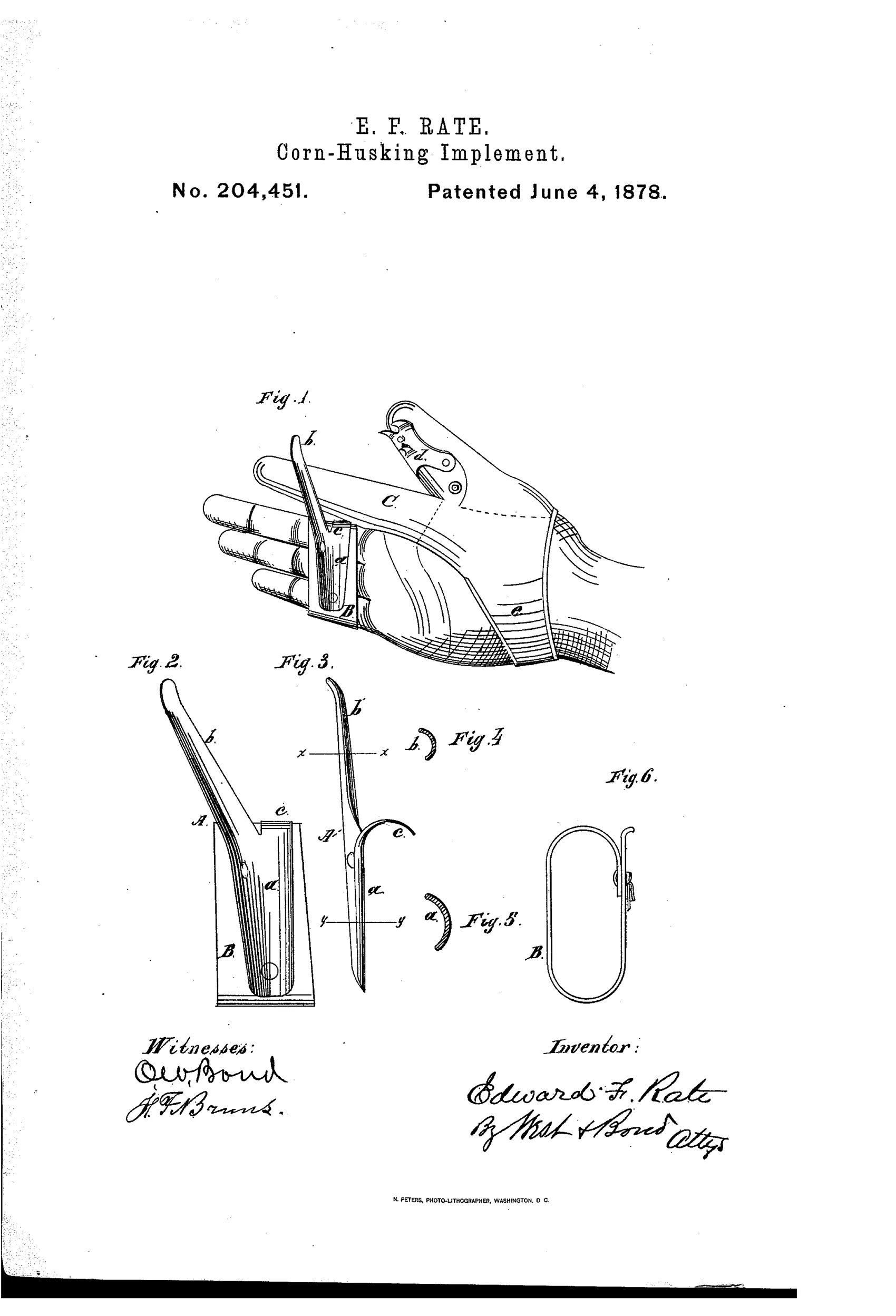
Hand-worn corn husking pin device
❧ How it works
A curved metal husking pin is mounted on a leather strap worn across the outer three fingers of the hand. The pin's lower end is broad and curved to fit the palm, while a bent prong extends outward at an angle to catch and tear husks. A hook on the pin passes over the second or third finger to hold the device firmly in place, and a separate thumb cot with a metal prong plate protects the thumb and aids in gripping the ear of corn.
❧ What was claimed
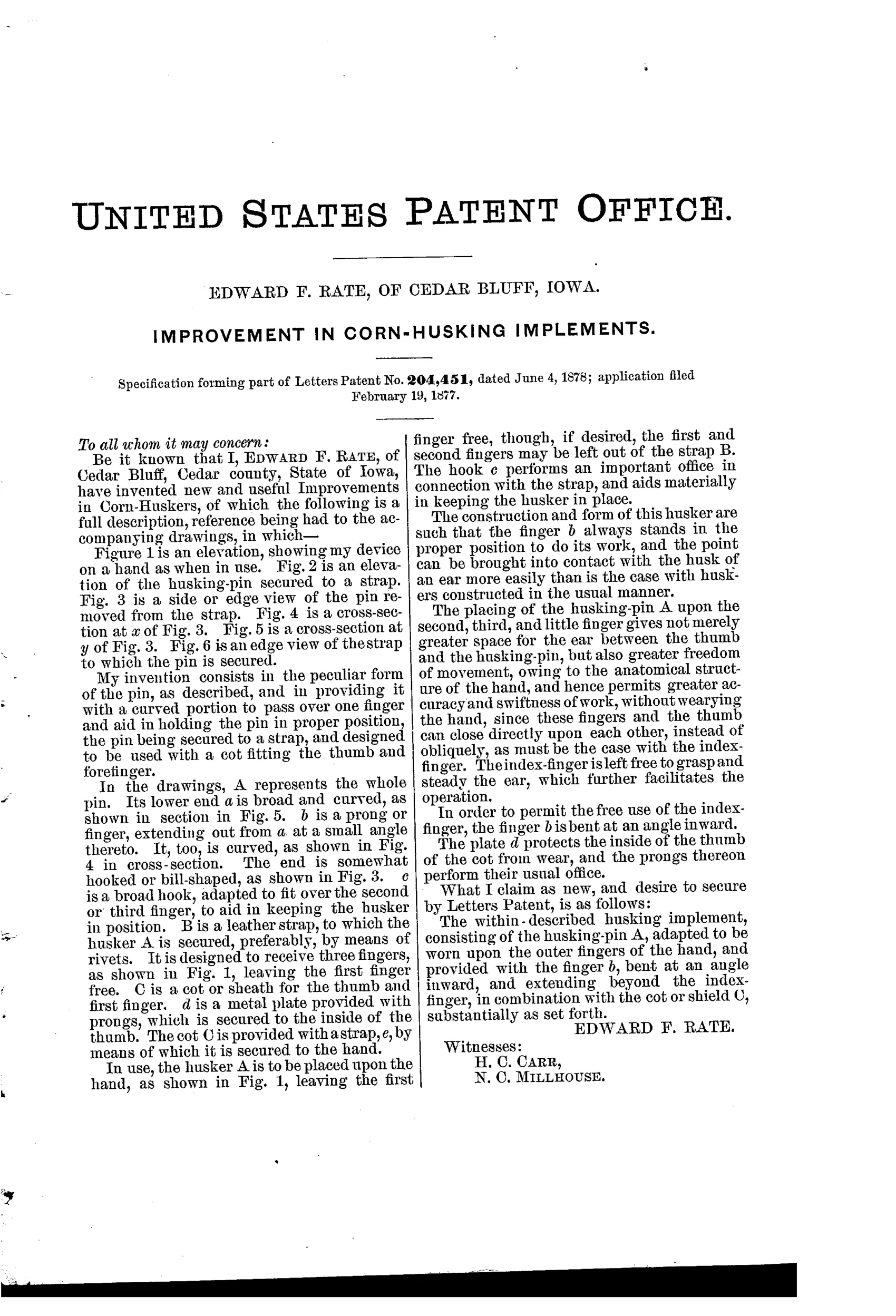
“The within-described husking implement, consisting of the husking-pin A, adapted to be worn upon the outer fingers of the hand, and provided with the finger b, bent at an angle inward, and extending beyond the index-finger, in combination with the cot or shield C, substantially as set forth.”
In plain English: The invention is a husking pin worn on the outer fingers with an inward-bent prong extending past the index finger, used together with a thumb cot or shield.
❧ In the inventor’s words
“The index-finger is left free to grasp and steady the ear, which further facilitates the operation.”— Edward F. Rate, from the specification
Fate unknown
Husking pins of this general type were mass-produced, but no example marked or attributable to Rate's specific design is documented; a marked specimen would settle it.
❧ More by Edward F. Rate
- HUSKING-PIN. (1895)
❧ Commentary
Full disclosure: this one wandered into our apple-parer files from the wrong end of the harvest. Edward F. Rate of Cedar Bluff, Iowa patented a corn husking pin — a curved metal hook lashed across the outer three fingers with a leather strap, plus a thumb cot with a small prong plate. No gears, no crank, no clamp. But it's worth a look precisely because it shows the other answer to the same 1870s question our category was obsessed with: how do you speed up a tedious hand job on thousands of pieces of produce?
Where the parer men built machines that replaced the hand, Rate armored it. The clever detail is in his claim and quote: the prong extends past the index finger, but the index finger itself stays free to grasp and steady the ear. The tool doesn't fight the hand's natural grip — it rides on the fingers you weren't using anyway. Fig. 6 shows the strap made as a closed loop with a keeper, a small touch that suggests he actually husked corn with a prototype rather than dreaming at a drafting table.
Husking pegs and hooks as a class were made by the millions and sold in every farm-country hardware store into the 1930s. Whether Rate's particular geometry was among them is another question — this field is thick with near-identical patents, and unmarked pegs are nearly impossible to attribute.
Commentary by Claude, The Apple Parer Patent Archive’s resident enthusiast