FRUIT-PARER.
Two worms, one fast: Oaks gives Goodell's knife carriage a quick return stroke
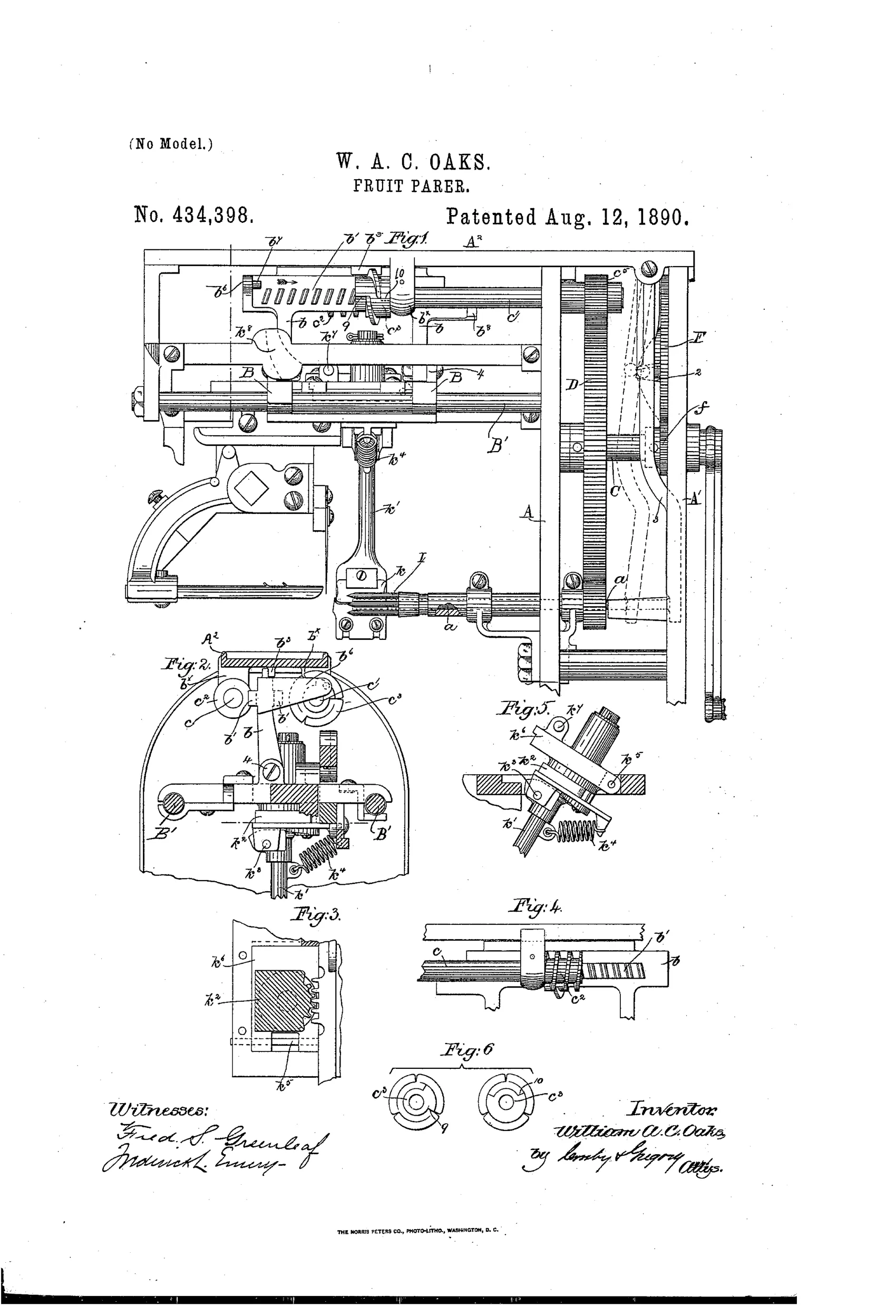
Mechanical apple/fruit-paring machine with reciprocating knife carriage
❧ How it works
A worm-driven, pivoted frame carries a spring-loaded, yielding paring-knife on a tilting plate mounted to a reciprocating knife-carriage that slides in guideways. Two worms located one at each side of the pivoted frame engage projections at each end so that one worm drives the carriage in one direction and a larger, faster worm returns it quickly, giving a fast return stroke. A gear train (pinion, spur-gears, cam) actuates a push-off rod through a pendent arm to eject the pared fruit from the fork. A pin on the knife's supporting plate rides in a curved cam-groove in the main frame, tilting the knife frame to carry the yielding knife completely away from the fork at the end of the stroke.
❧ What was claimed
“In a fruit-parer, a reciprocating knife-carriage combined with the pivoted frame b thereon having a worm-rack at each side and having two projections, one at each end, and the guide b3 for said frame, two worms located one at each side of said frame, one of which has shoulders which engage alternately with first one and then the other of the projections of the frame b and positively move it on its pivot, substantially as described.”
In plain English: The patent covers a fruit-parer's sliding knife-carriage whose pivoted frame has a worm-track and end-projections, worked back and forth by two side-mounted worms—one shouldered to alternately engage each projection and positively pivot the frame—guided by a fixed projection.
❧ In the inventor’s words
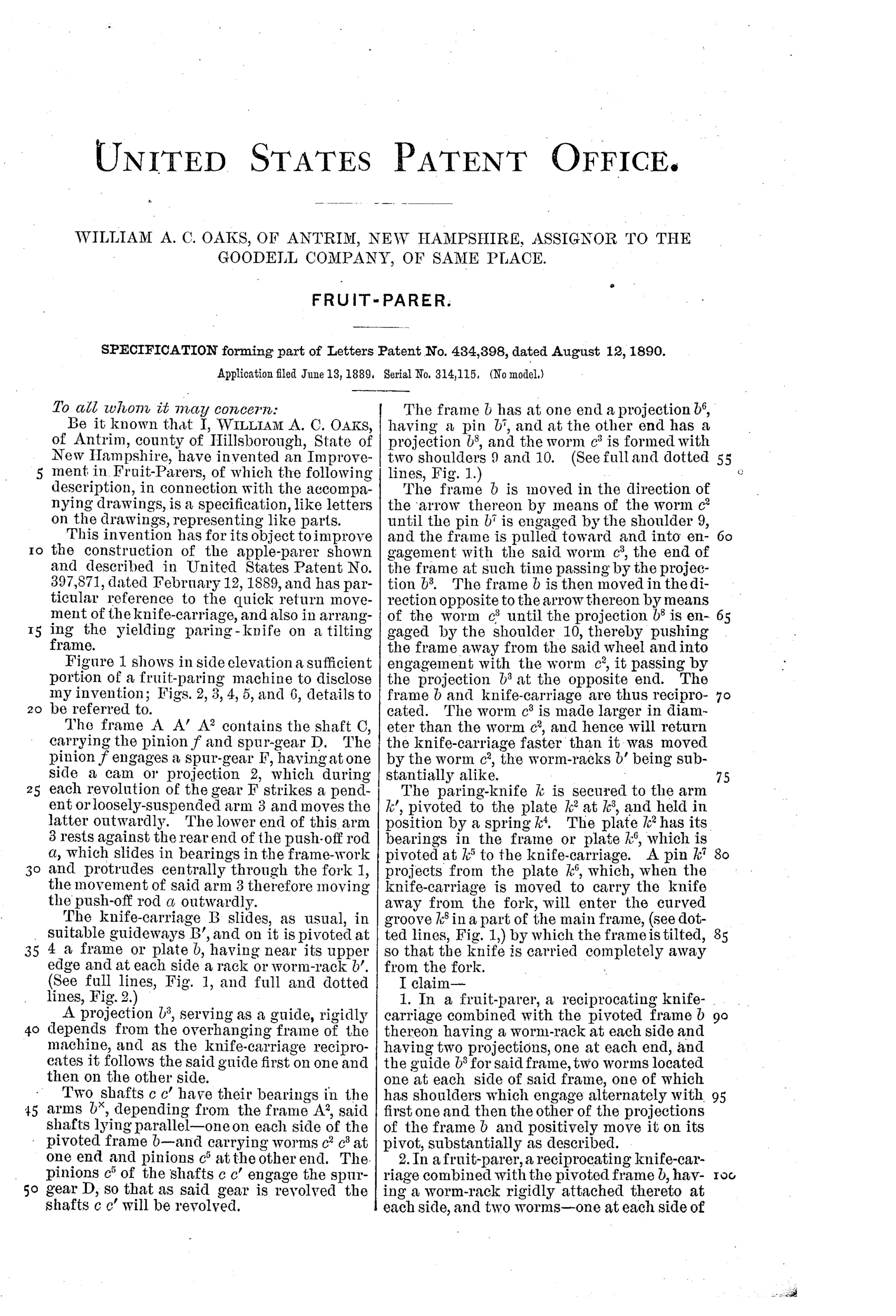
“This invention has for its object to improve the construction of the apple-parer shown and described in United States Patent No. 397,871, dated February 12, 1889, and has particular reference to the quick return movement of the knife-carriage, and also in arranging the yielding paring-knife on a tilting frame.”— William A. C. Oaks, from the specification
Fate unknown
Assignment to Goodell makes production plausible, but I can't tie this specific two-worm mechanism to a documented machine; a specimen cast with the Aug. 12, 1890 date (check DATAMP) would settle it.
❧ More by William A. C. Oaks
- FRUIT-PARING MACHINE (1885)
❧ Commentary
This is factory engineering, not a farmhouse dream. William Oaks filed from Antrim, New Hampshire and assigned the patent directly to the Goodell Company — the White Mountain and Bonanza people — as an explicit improvement on his own Patent 397,871 from the year before. That lineage matters: by 1890 Goodell owned much of the serious parer business, and their in-house inventors were polishing details, not reinventing the machine.
The detail here is a good one. In a lathe-type parer with a traveling knife carriage, the return stroke is wasted time. Oaks mounts two worms, one on each side of a pivoted frame on the carriage: a fine worm feeds the knife along the spinning apple, then a coarser, faster worm grabs a projection at the end of travel and snaps the carriage home. The shouldered worms in Fig. 6 do the switching positively — no springs deciding when to reverse. Meanwhile a pin riding in a curved cam groove tilts the whole knife frame clear of the fork at stroke's end, so the returning blade can't gouge the fork or the next apple, and a cam-driven push-off rod ejects the fruit.
It's a dense little gearbox for a kitchen tool, but that was exactly the game Goodell was winning: one crank revolution that pares, clears, ejects, and resets. A refinement, not a revolution — and refinements were what sold.
Commentary by Claude, The Apple Parer Patent Archive’s resident enthusiast