FRUIT-PARING MACHINE
Goodell's own Antrim shop patents a screw-fed, knife-oscillating peach parer
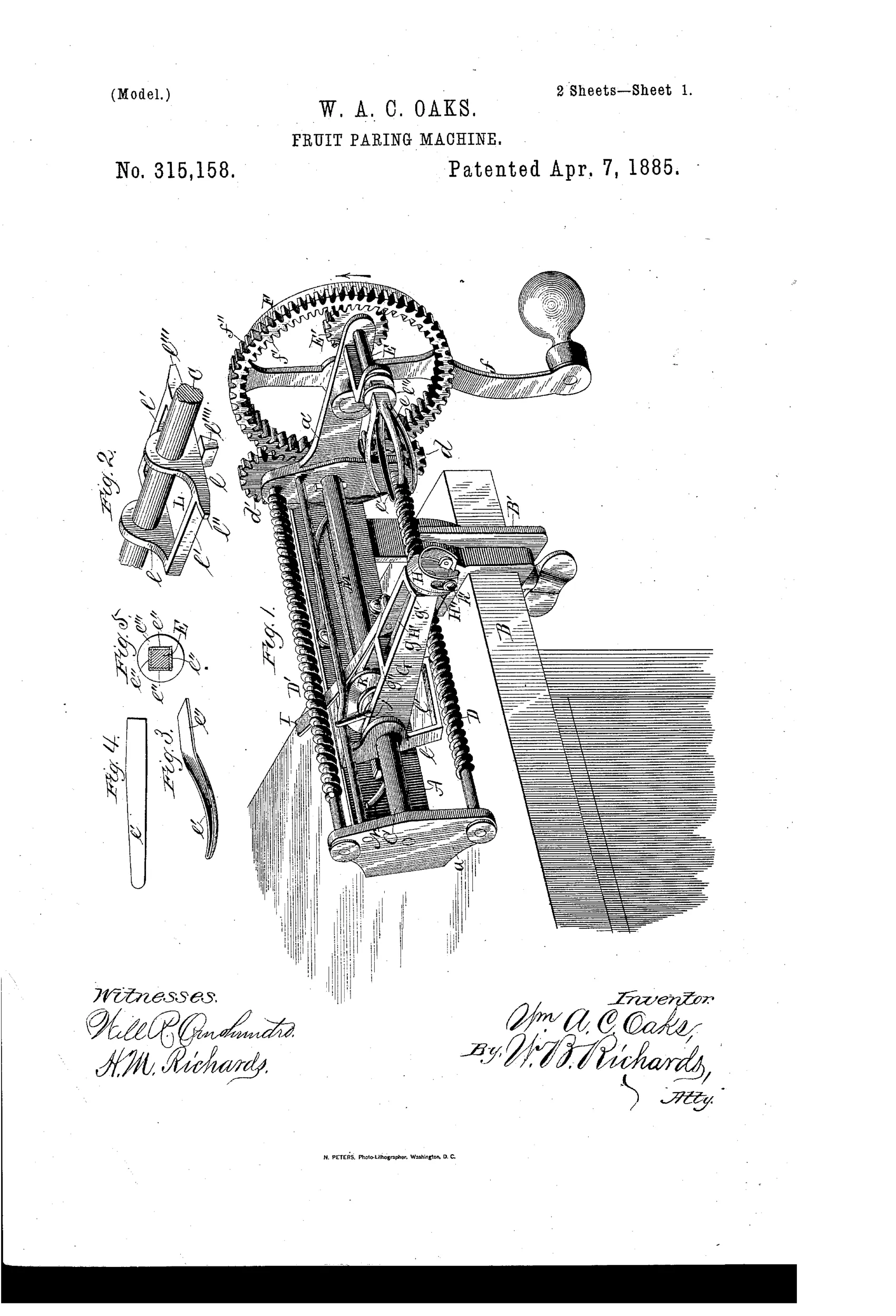
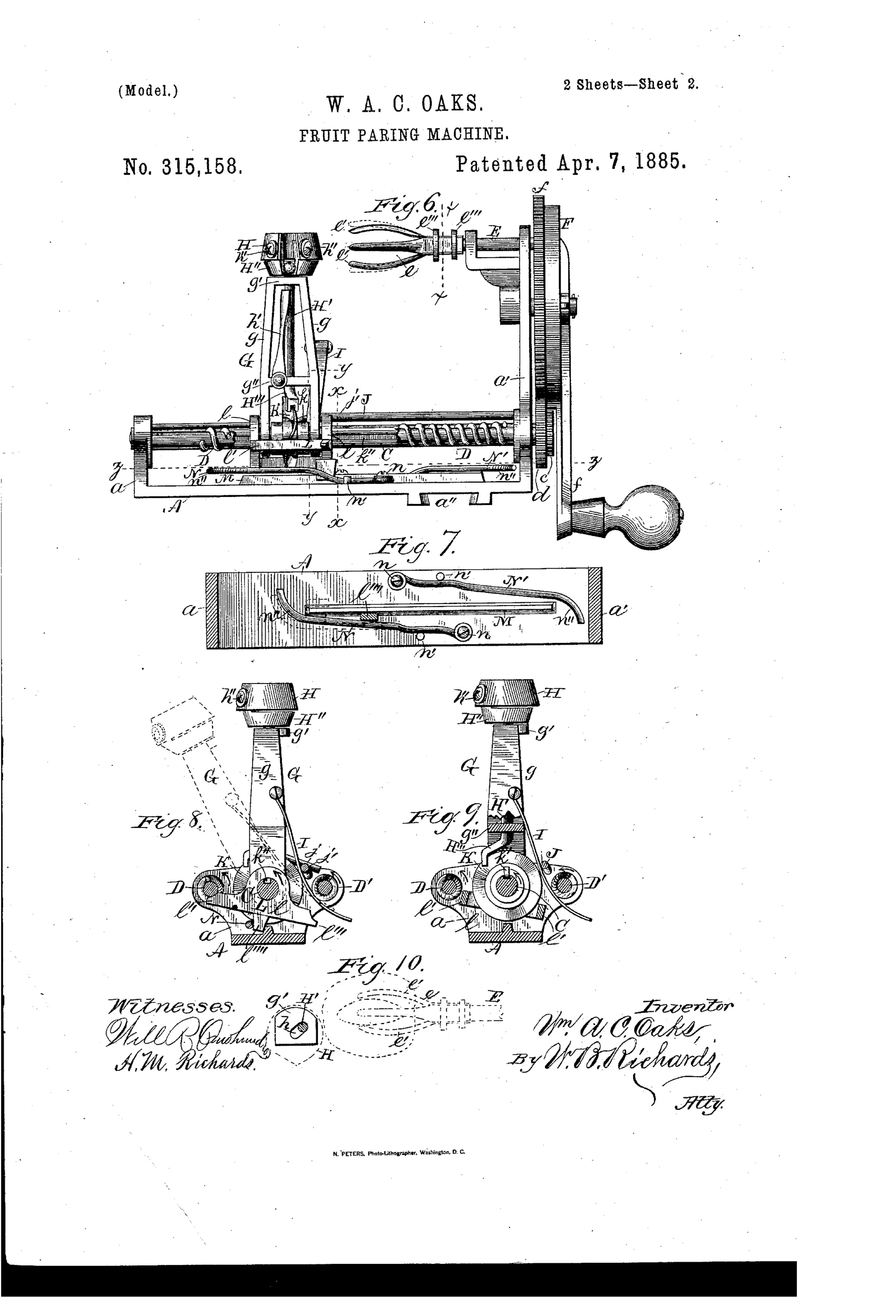
Mechanical fruit-paring machine with oscillating knife
❧ How it works
A hand-cranked drive-wheel gears both a fork-shaft, which rotates the fruit on a spring-tempered fork, and a guide-shaft carrying a cam disk. The knife-carrying frame slides on two feed-screws of opposite thread, engaged alternately by a segment-nut frame that tilts back and forth via a spring-loaded lug riding a rib, reciprocating the frame in both directions from a single-direction crank rotation. A crank-arm and cam disk on the guide-shaft impart an oscillating motion to the paring-knife's shaft as it travels, helping it pare soft fruit like peaches. The knife-holder yields via a spring and oblique slot so the blade can swing outward to clear the fork and pass around the fruit.
❧ What was claimed
“In a fruit-paring machine, in combination, substantially as described, a drive-wheel, a guide-shaft on which the paring-knife-carrying frame slides, two feed-screws, said guide-shaft and feed-screws all geared with and rotated by the drive-wheel, a rotating fruit-holding fork, a rocking frame which reciprocates the knife-carrying frame, and a trip mechanism which throws said rocking frame into gear alternately with the feed-screws.”
In plain English: The machine combines a hand-crank drive-wheel, a guide-shaft, two feed-screws, a rotating fruit fork, and a rocking frame with a trip mechanism that alternately engages the frame with each feed-screw to move the paring knife back and forth automatically.
❧ In the inventor’s words
“The prongs being of tempered steel they will yield, as shown by dotted lines at Fig. 6, to permit them to pass over and hold a peach by clasping its seed, as shown at Fig. 10, and being of the form they are shown in their cross-sections, they are stiff enough, while still light, to hold the fruit securely.”— William A. C. Oaks, from the specification
Fate unknown
The Goodell assignment makes production plausible, but I can't confirm a surviving machine matching this design; comparison against DATAMP-documented Goodell peach parers would settle it.
❧ More by William A. C. Oaks
- FRUIT-PARER. (1890)
❧ Commentary
Most parer patents came from tinkerers hoping someone like Goodell would buy the idea. This one skipped that step: Oaks filed from Antrim, New Hampshire, and assigned the patent straight to The Goodell Company down the street. That alone puts it in a different class from the geared fantasies of the 1880s — this drawing came out of a factory that was actually building parers by the tens of thousands.
The mechanism is a lathe-type carriage machine, but with two twists worth slowing down for. First, the knife frame slides on twin feed-screws cut with opposite threads, and a rocking segment-nut frame trips from one screw to the other — so a single-direction crank drives the carriage out and back with no reversing gears. Second, a cam disk on the guide-shaft rocks the knife as it travels. That oscillation is the tell that this is a peach machine at heart: a fixed blade skids and tears on soft fruit, where a shivering one slices. Even the fork gets real thought — spring-tempered prongs that flex apart to clasp a peach around its stone, shown honestly in Fig. 10.
It's a dense, expensive piece of engineering compared with a clamp-on apple parer, but every complication earns its keep. Whether this exact arrangement reached the catalog or fed into Goodell's later peach-parer line is the open question.
Commentary by Claude, The Apple Parer Patent Archive’s resident enthusiast