IMPROVED APPLE-PARER
A wartime cam-and-spur parer that steers its own knife and clears itself
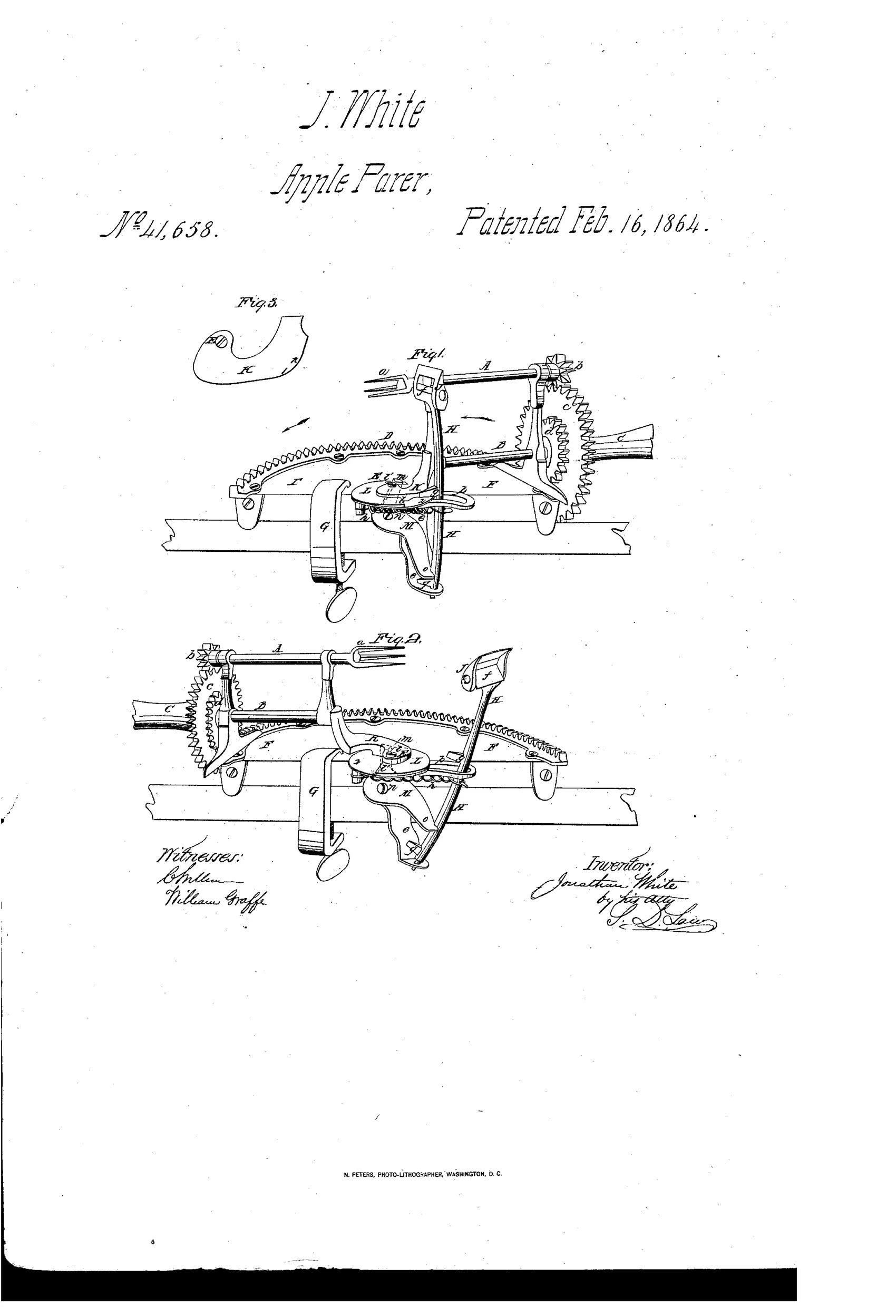
Hand-cranked mechanical apple-paring machine
❧ How it works
A forked mandrel holds the apple and is geared to revolve on its own axis while an arm sweeps it along an arc-shaped sector. A cam on the pivoting frame acts against a spur on the knife-arm, causing the knife to swivel and adapt to the changing shape of the fruit as it spirals from one end to the other. A spring keeps the knife pressed against the fruit during paring. Once paring is complete, a plate strikes a bent lever which pushes the knife arm backward and away from the fruit so the pared apple can be removed, then a return spring resets the knife arm for the next apple.
❧ What was claimed
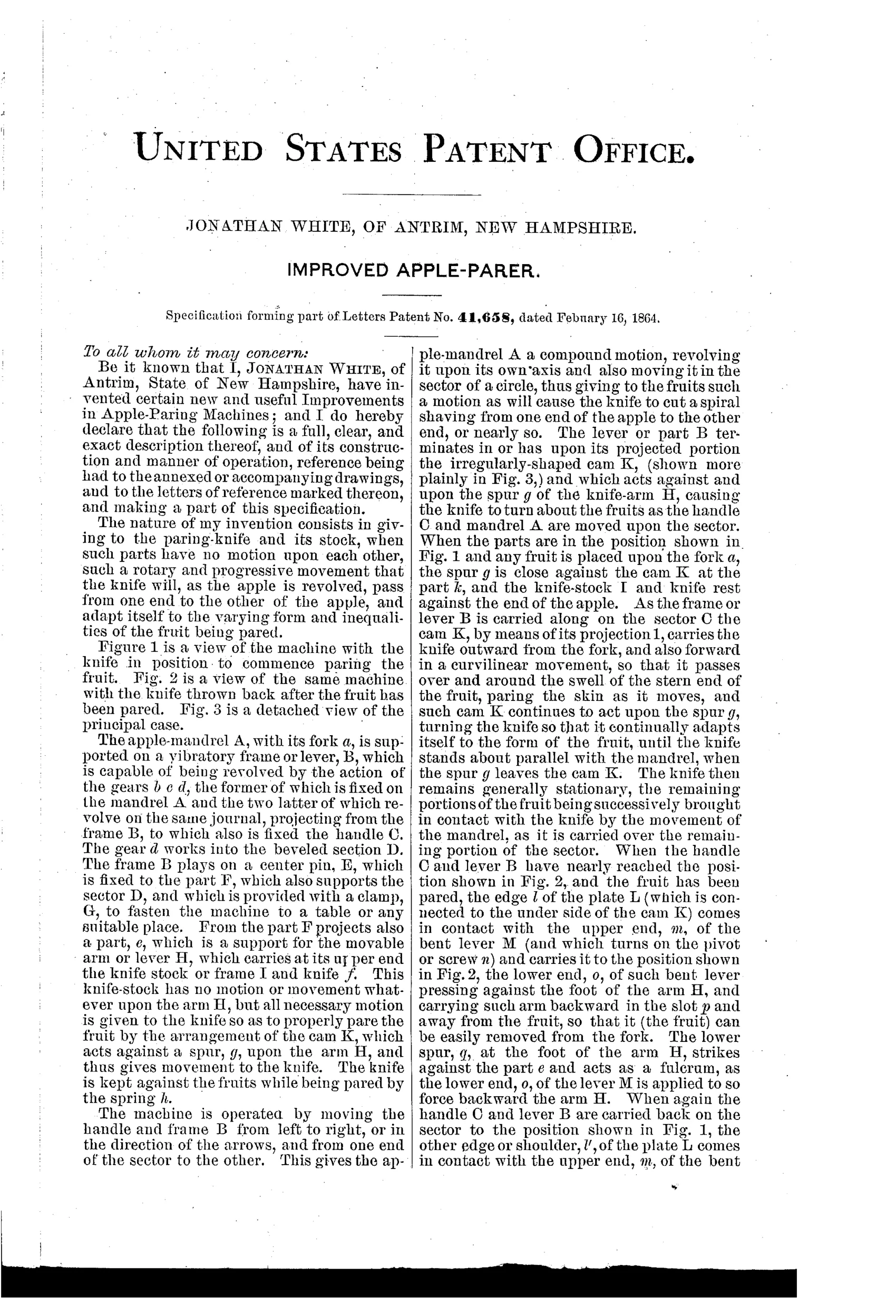
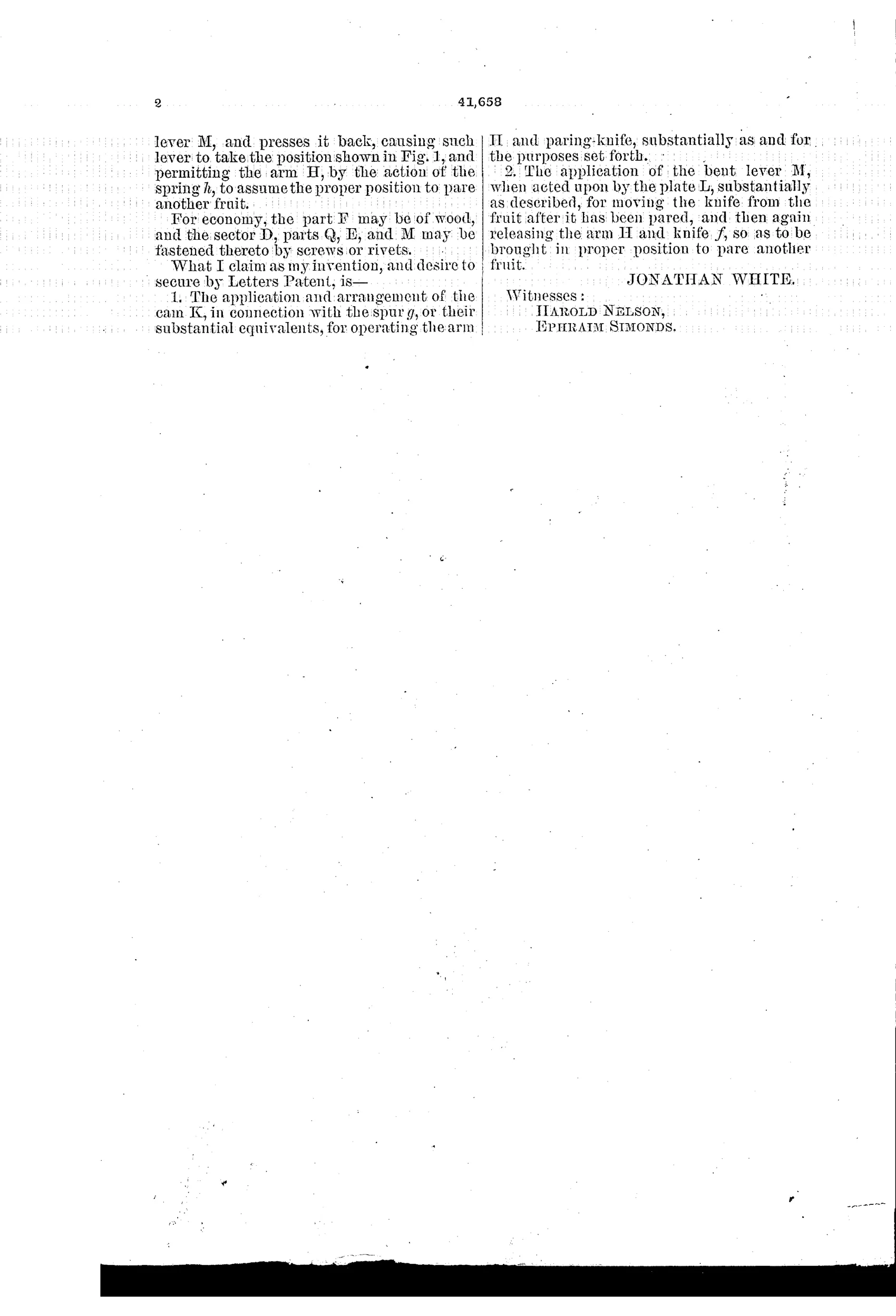
“1. The application and arrangement of the cam K, in connection with the spur g, or their substantial equivalents, for operating the arm H and paring-knife, substantially as and for the purposes set forth. 2. The application of the bent lever M, when acted upon by the plate L, substantially as described, for moving the knife from the fruit after it has been pared, and then again releasing the arm H and knife f, so as to be brought in proper position to pare another fruit.”
In plain English: The inventor claims the cam-and-spur mechanism that steers the paring knife to follow the apple's shape, and the bent-lever-and-plate mechanism that automatically pulls the knife away from the fruit once paring is finished and then resets it for the next apple.
❧ In the inventor’s words
“The nature of my invention consists in giving to the paring-knife and its stock, when such parts have no motion upon each other, such a rotary and progressive movement that the knife will, as the apple is revolved, pass from one end to the other of the apple, and adapt itself to the varying form and inequalities of the fruit being pared.”— Jonathan White, from the specification
Fate unknown
No production machine matching this design is documented in the collector literature (see DATAMP); a marked surviving specimen would settle it.
❧ More by Jonathan White
- IMPROVED APPLE-PARER (1862)
❧ Commentary
White's 1864 machine is chasing the problem that defined the whole category: an apple is not a sphere, and a knife on a fixed arc will either gouge the fat middle or miss the ends. His answer is the cam K working against a spur on the knife-arm, so that as the geared arc sector sweeps the arm across the fruit, the cam continuously re-angles the knife stock — the spring supplies pressure, the cam supplies geometry. His own summary is the best part: the knife and stock 'have no motion upon each other,' yet the assembly as a whole rotates and advances so the blade spirals end to end. That's a genuinely thoughtful way to fake a profile-following knife without a floating pivot.
The second claim is the one that puts him ahead of his moment: the plate-and-bent-lever trip that knocks the knife arm clear once the paring stroke ends, then a return spring resets it. Compare Figs. 1 and 2 — same machine, knife engaged and knife thrown back. That automatic clear-and-reset cycle is exactly what the great 1870s-80s segment-gear machines (Reading's '78', the Goodell line) would perfect a decade later.
At fourteen years before that golden age, this reads as an ambitious early sketch of the idea rather than a production design — the toothed arc and cam case look fussy to cast and fit at 1864 prices.
Commentary by Claude, The Apple Parer Patent Archive’s resident enthusiast