IMPROVED APPLE-PARER
An Antrim arc parer two years before Goodell set up shop next door
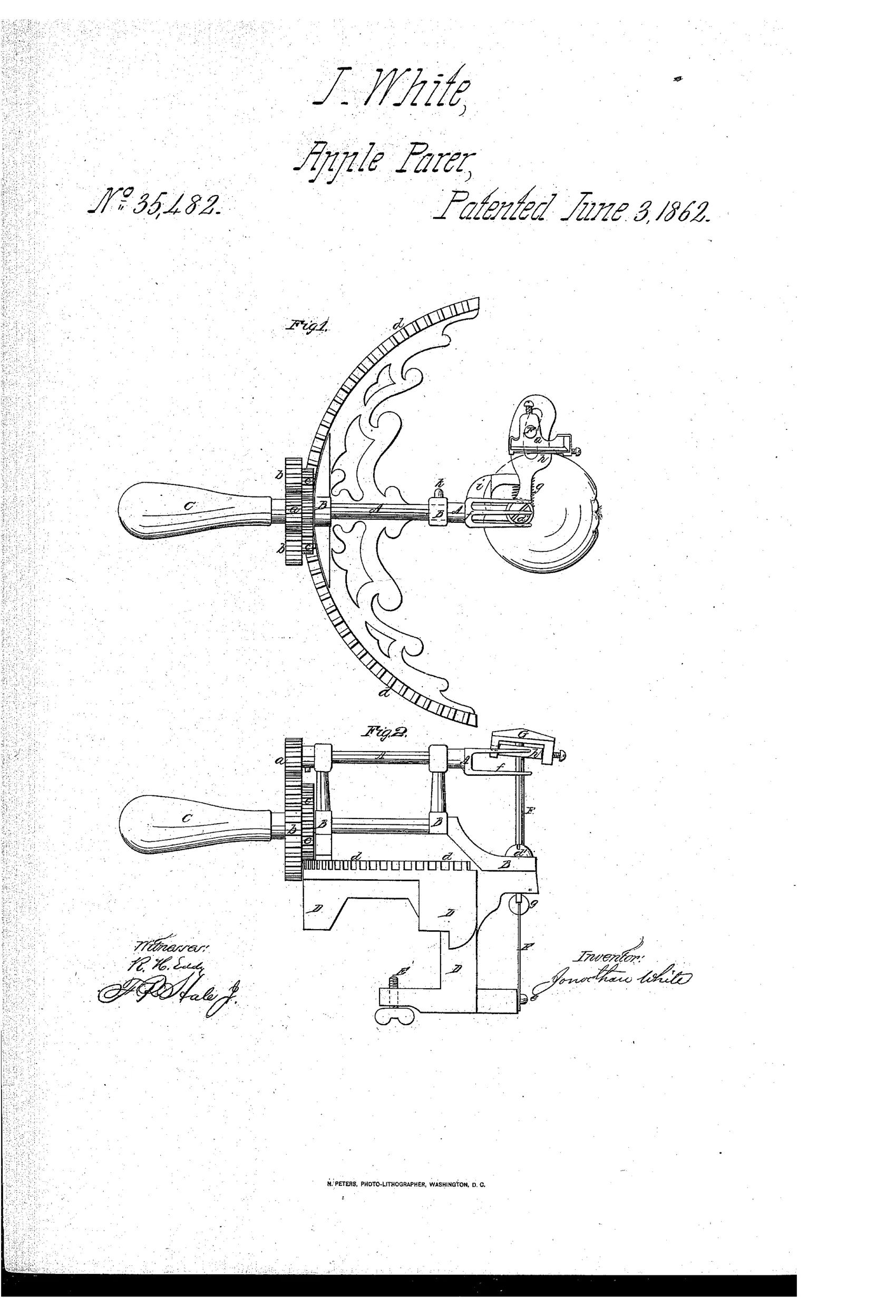
Hand-cranked geared apple-paring machine
❧ How it works
A forked apple mandrel is mounted on a vibratory frame and driven by a train of spur and beveled gears turning in a stationary toothed sector so the mandrel both spins and swings through an arc. A spring-drawn knife arm carrying a knife stock rides against the fork of the mandrel, cutting the peel in a spiral from stem to eye as the frame is moved along the sector. A cam and stop on the frame engage the knife arm during retraction to swing the knife holder to a right angle, allowing the pared apple to be removed and a fresh apple set on the fork before the next forward stroke.
❧ What was claimed
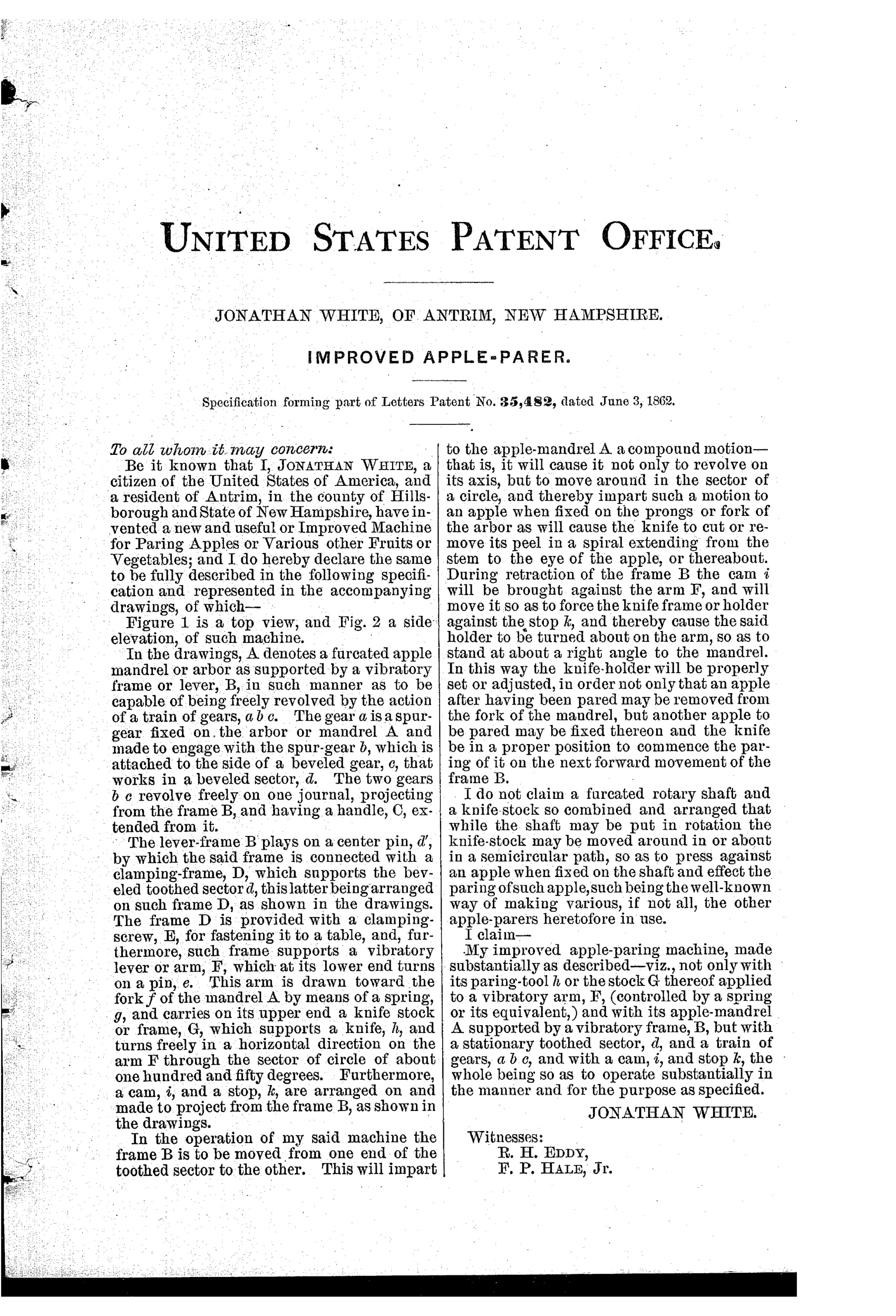
“My improved apple-paring machine, made substantially as described—viz., not only with its paring-tool h or the stock G thereof applied to a vibratory arm, F, (controlled by a spring or its equivalent,) and with its apple-mandrel A supported by a vibratory frame, B, but with a stationary toothed sector, d, and a train of gears, a b c, and with a cam, i, and stop k, the whole being so as to operate substantially in the manner and for the purpose as specified.”
In plain English: The claim covers the whole combination of a spring-controlled knife arm and stock, a vibrating mandrel frame, a fixed toothed sector, gear train, and a cam-and-stop mechanism working together to pare an apple.
❧ In the inventor’s words
“This will impart to the apple-mandrel A a compound motion—that is, it will cause it not only to revolve on its axis, but to move around in the sector of a circle, and thereby impart such a motion to an apple when fixed on the prongs or fork of the arbor as will cause the knife to cut or remove its peel in a spiral extending from the stem to the eye of the apple, or thereabout.”— Jonathan White, from the specification
Fate unknown
The Antrim connection to Goodell's early parer manufacturing is suggestive, but a surviving marked specimen or a DATAMP-documented production match would be needed to call it made.
❧ More by Jonathan White
- IMPROVED APPLE-PARER (1864)
❧ Commentary
The eye-catcher here is the toothed sector — that big crenellated arc in Fig. 1 that most readers will mistake for decoration. It isn't. The mandrel frame carries its own gear train, and as you crank, the last pinion walks along the fixed sector's teeth. So the apple gets a compound motion: spinning on the fork while the whole fork swings through the arc. The knife arm just sits there under spring pressure and lets the apple be carried past it, tracing the spiral from stem to eye. Most lathe-type parers of the era move the knife along a spinning apple; White inverts it and moves the apple past a nearly stationary knife.
The cam-and-stop detail is the practical touch. On the return stroke the cam kicks the knife stock out to a right angle, clearing the way to pull the pared apple and spear a fresh one — a small courtesy that matters when you're doing bushels, not one apple for show.
The geography is worth noting: Jonathan White patented this in Antrim, New Hampshire, in 1862, and Antrim is precisely where D.H. Goodell began building apple parers a couple of years later, founding what became the great Goodell Company. Whether this specific sector-and-swing design fed directly into that production line, or was simply neighborhood inspiration, is the interesting open question.
Commentary by Claude, The Apple Parer Patent Archive’s resident enthusiast