CORN-HUSKER.
A corn husker in the parer files: scissors that bite, twist, and strip the ear
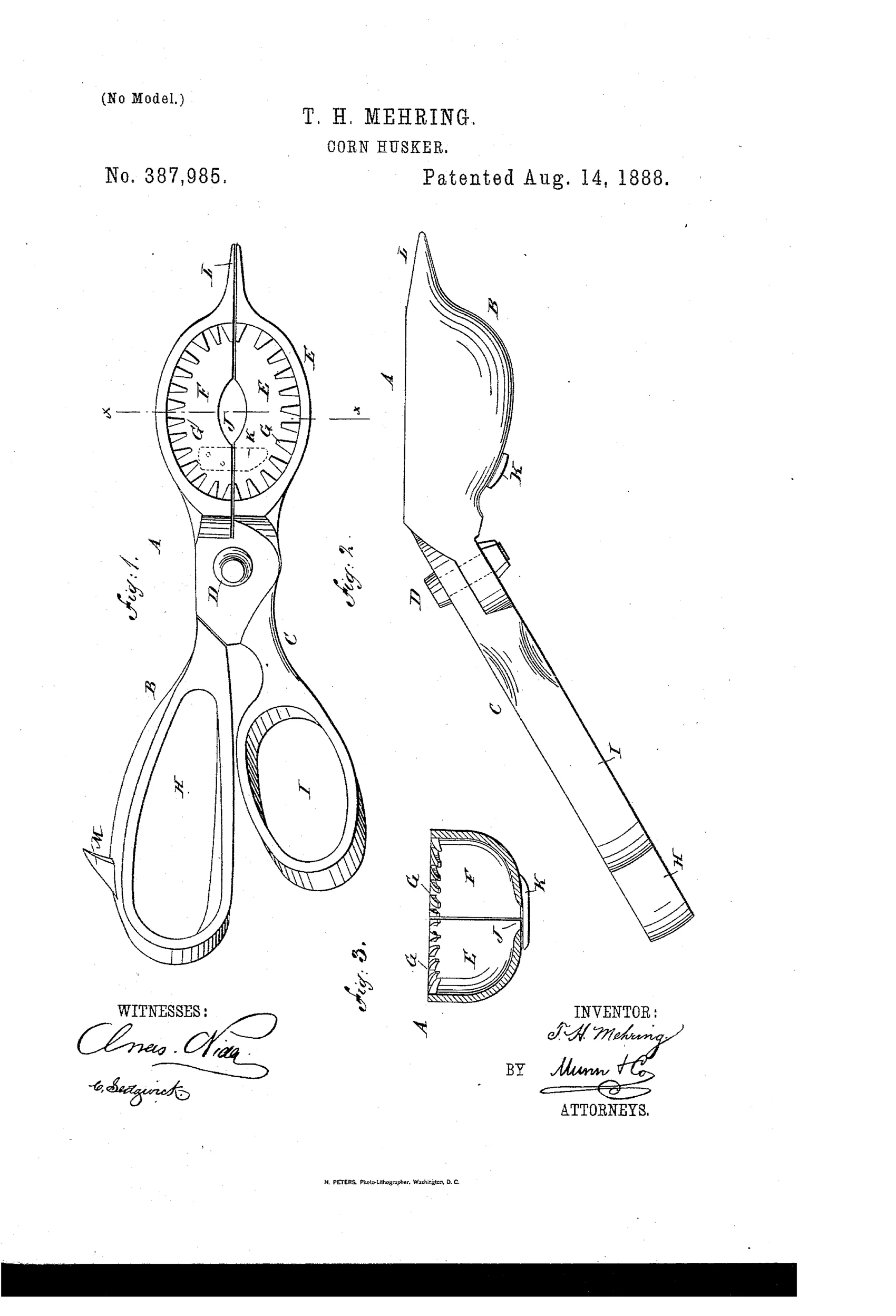
Hand-held scissor-type corn husk puller
❧ How it works
The device consists of two parts, B and C, pivoted together at D like large shears, each ending in a concave, quarter-sphere jaw (E and F) lined with inward-projecting teeth (G). The jaws are cut away at their meeting edges to form a central aperture J when closed, and each jaw has a pointed guiding prong L at its outer end to direct the ear of corn stem into place. The operator's right hand grips loop handles H and I (sized to fit gloves) to open and close the jaws around the husk near the stem; closing the jaws drives the teeth into the husk while the stem is gripped in aperture J. A slight twist of the wrist then breaks the stem, freeing the husked ear while the husk remains caught in the jaws. A sharp-edged tooth M on handle H is provided to cut away silky threads from the ear.
❧ What was claimed
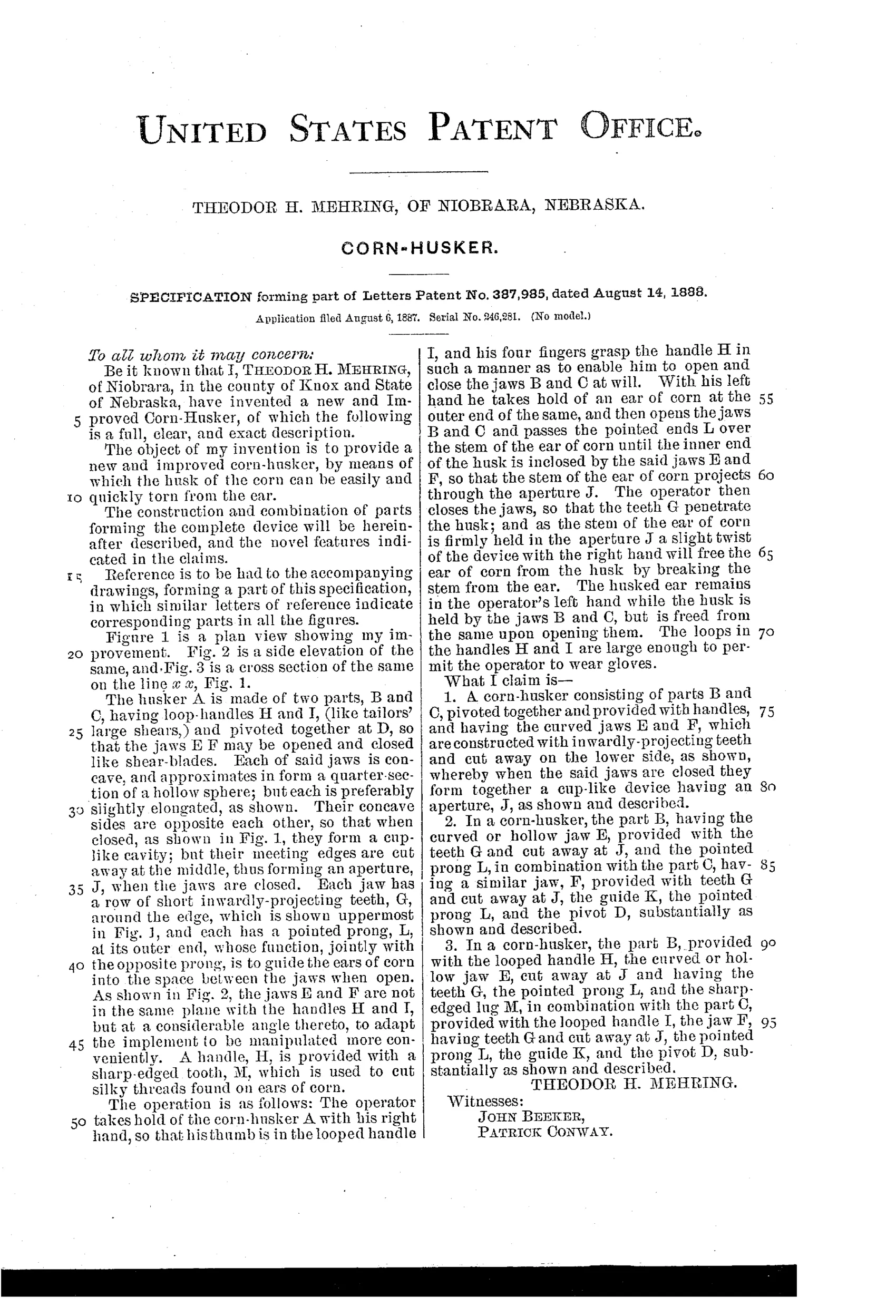
“A corn-husker consisting of parts B and C, pivoted together and provided with handles, and having the curved jaws E and F, which are constructed with inwardly-projecting teeth and cut away on the lower side, as shown, whereby when the said jaws are closed they form together a cup-like device having an aperture, J, as shown and described.”
In plain English: A pair of pivoted, shear-like jaws with inward teeth that close into a cup shape with a center hole, used to grip and tear husk from an ear of corn.
❧ In the inventor’s words
“The loops in the handles H and I are large enough to permit the operator to wear gloves.”— Theodor H. Mehring, from the specification
Fate unknown
Simple hand husking pegs dominated the era and no marked example of this shear-type husker is documented to my knowledge; a surviving specimen would settle it.
❧ Patented the same day
- CORN-HUSKER. — Theodor H. Mehring
❧ More by Theodor H. Mehring
- CORN-HUSKER. (1888)
❧ Commentary
Full disclosure: this is not an apple parer. Mehring's tool wandered into our files because it shares the DNA of the hand-held fruit tools that predate the geared clamp-on machines — a pivoted, scissor-action implement meant to replace fingers doing a repetitive, hand-punishing job. And husking corn in a Nebraska October was exactly that kind of job.
The mechanism is simple and rather well thought out. Two shear halves close into a toothed quarter-sphere cup around the base of the ear, with a central aperture J that captures the stem. The teeth bite the husk, the operator gives a wrist twist, the stem snaps at the shank, and the ear pops free while the husk stays trapped in the jaws. That twist-to-break move is the same trick husking pegs and hooks relied on, only here the tool grips the whole circumference at once instead of just tearing a strip. The detail I like best is in the claim language's margins: the handle loops are deliberately oversized 'to permit the operator to wear gloves.' Mehring clearly husked corn himself, in cold weather.
The dubious part is speed. A practiced hand with a peg husked an ear in a second or two; opening, positioning, closing, and twisting a two-handed-scale shear seems slower, not faster. Like many farm-tool patents of the 1880s, it solves the pain but probably loses the race.
Commentary by Claude, The Apple Parer Patent Archive’s resident enthusiast