CORN-HUSKER.
A corn husker strays into our parer files — and earns its stay
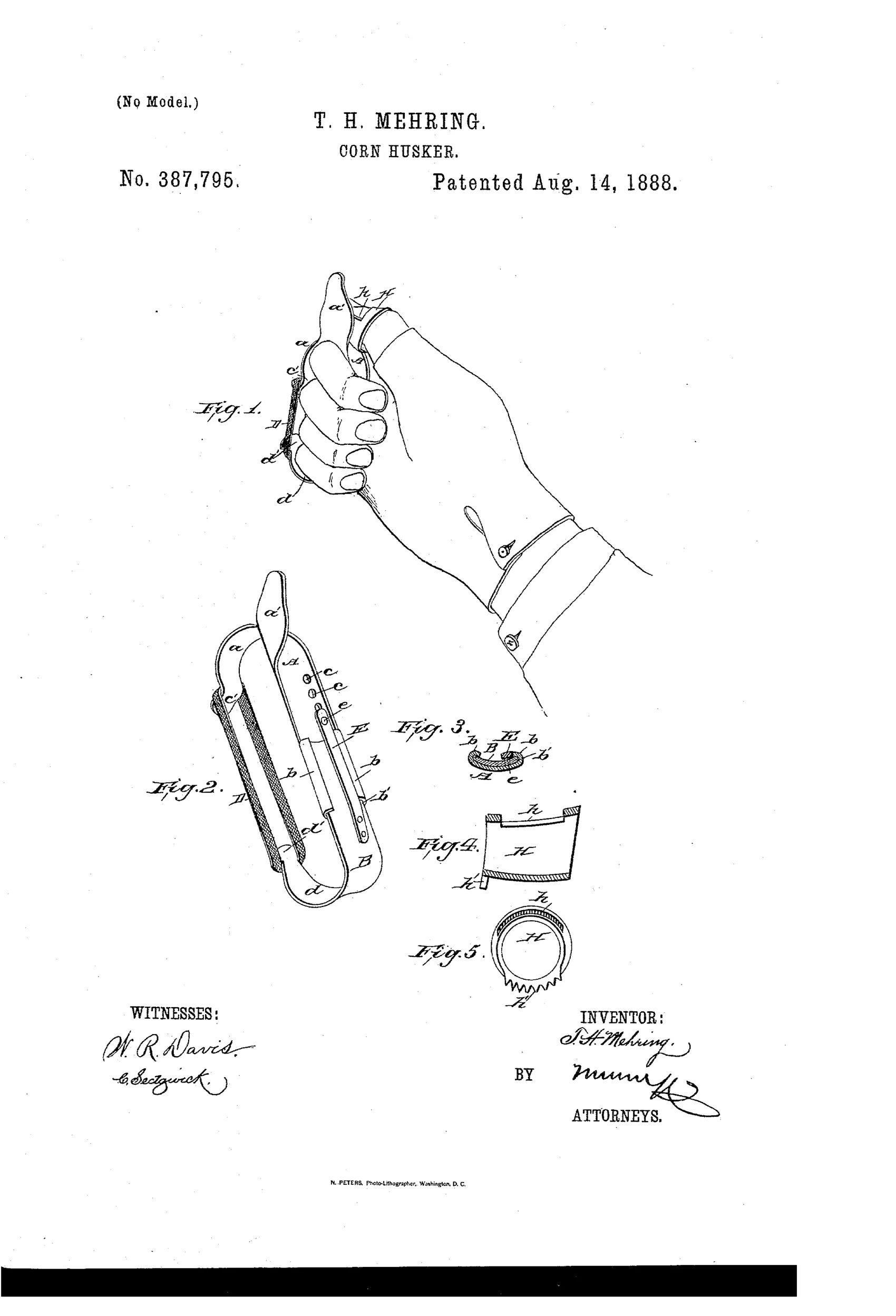
Hand-worn adjustable corn-husking implement with thimbles
❧ How it works
The device consists of two curved sections that slide one upon the other, with one section having a series of apertures and the other bearing a spring-plate pin that engages any of the apertures to adjust the overall length to fit the hand. Curved guards at the ends of each section terminate in a hook and a head, respectively, and an endless elastic band connects these to draw the sections together and secure the device on the hand. Conical, open-topped thimbles with a retention slot and a row of outward-projecting teeth are worn on the thumb and fingers to grip and tear the husk. In use, the implement is slipped over the hand, the pin disengaged, the length adjusted by pressing the lower end against a hard surface, and the pin re-engaged to lock the fit before husking.
❧ What was claimed
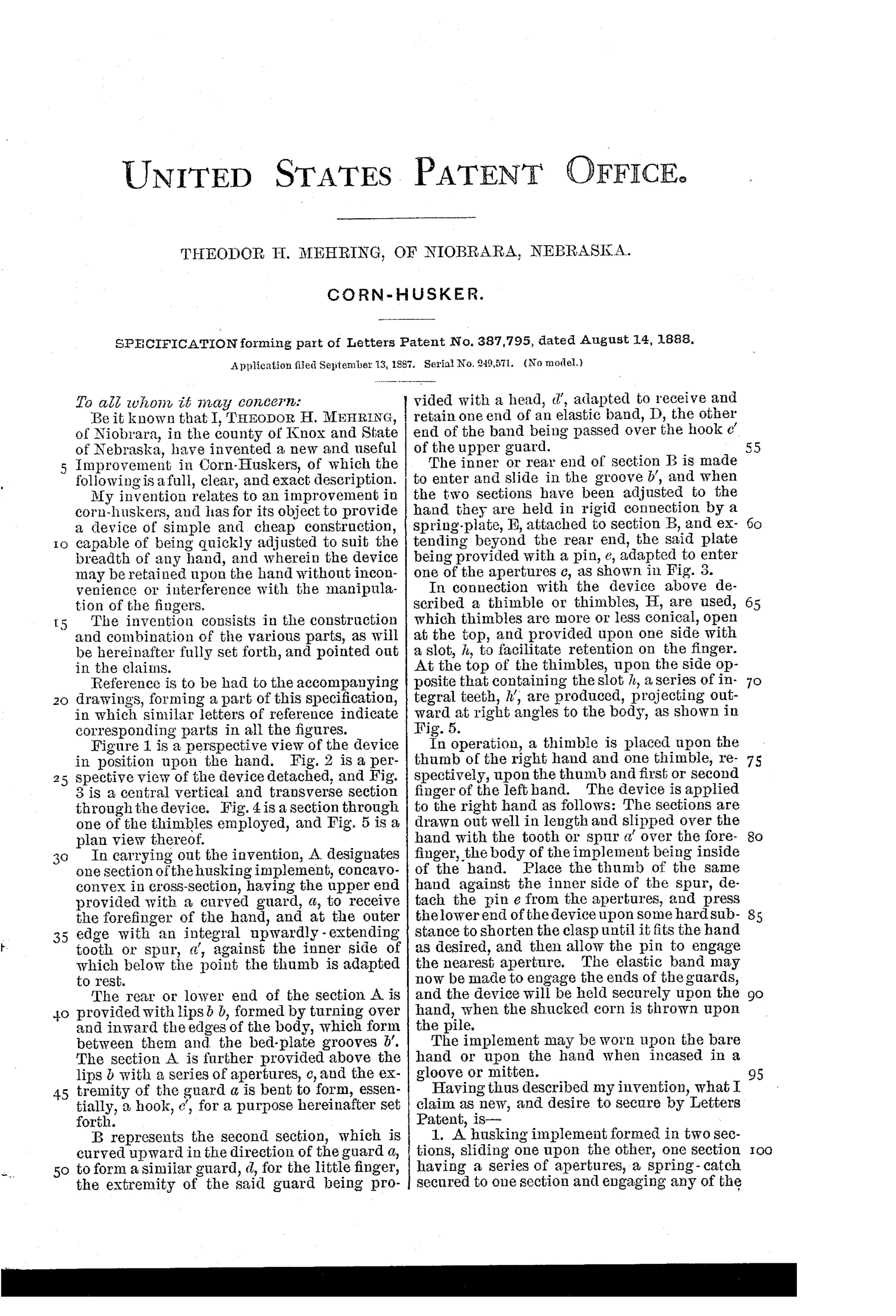
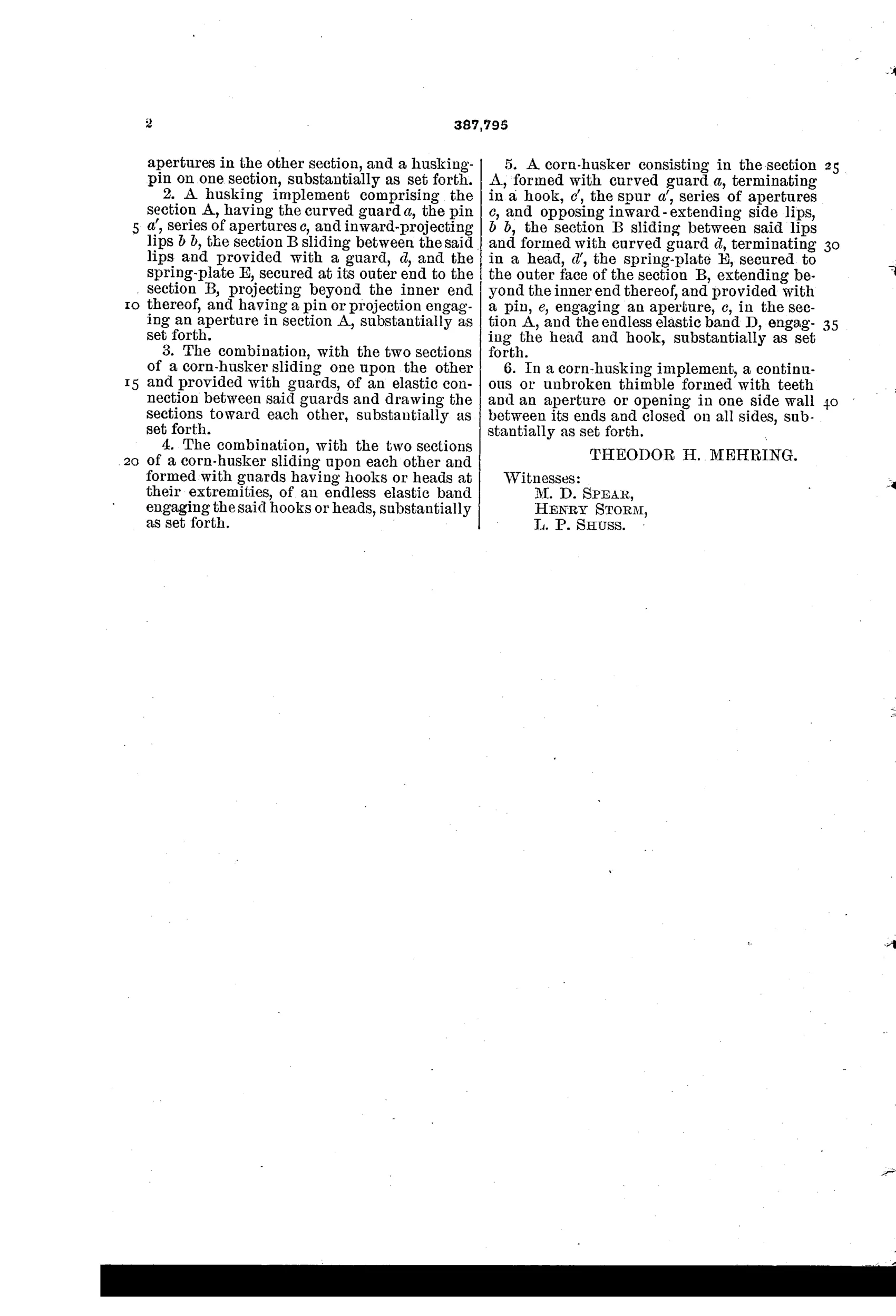
“A husking implement formed in two sections, sliding one upon the other, one section having a series of apertures, a spring-catch secured to one section and engaging any of the apertures in the other section, and a husking-pin on one section, substantially as set forth.”
In plain English: A two-part sliding husking tool where one part has multiple holes and a spring catch on the other part locks into any hole to adjust its length, plus a pin for husking.
❧ In the inventor’s words
“The implement may be worn upon the bare hand or upon the hand when incased in a gloove or mitten.”— Theodor H. Mehring, from the specification
Fate unknown
Husking hooks were a mass-market category, but no surviving example of this specific adjustable frame is documented; a marked specimen would settle it.
❧ Patented the same day
- CORN-HUSKER. — Theodor H. Mehring
❧ More by Theodor H. Mehring
- CORN-HUSKER. (1888)
❧ Commentary
Full disclosure: this is not an apple parer. Mehring's patent is a hand-worn corn husker from Niobrara, Nebraska, and how it wandered into our category files is anyone's guess. But since it's here, it's worth a look, because it solves a fitting problem that parer inventors never had to face: the machine clamps to a table, but a husking tool clamps to a human hand, and hands come in every size.
Mehring's answer is a two-part curved frame that telescopes, with a spring-catch pin dropping into a row of apertures to lock the length. His adjustment procedure is charmingly practical — press the lower end against a hard surface, let it slide to fit, re-engage the pin. An elastic band loops between a hook and a head at the ends to snug it across the palm. Then the business end: conical open-topped thimbles with outward teeth for thumb and fingers, so the wearer grips and tears the husk with steel rather than fingernails. Figs. 4 and 5 show the tooth row clearly.
Husking pegs and hooks were manufactured by the millions in this era — corn husking was brutal piecework — but most commercial designs were far simpler leather-and-hook affairs. Mehring's adjustable frame plus multiple thimbles is on the elaborate end, which usually means the drawing is where it stayed. For the parer collector, it's a reminder that the same 1880s spring-catch, fit-anything ingenuity ran through every corner of the farm.
Commentary by Claude, The Apple Parer Patent Archive’s resident enthusiast