ORANGE-PEELER.
No gears at all: a dull-tipped blade that peels oranges without spilling juice
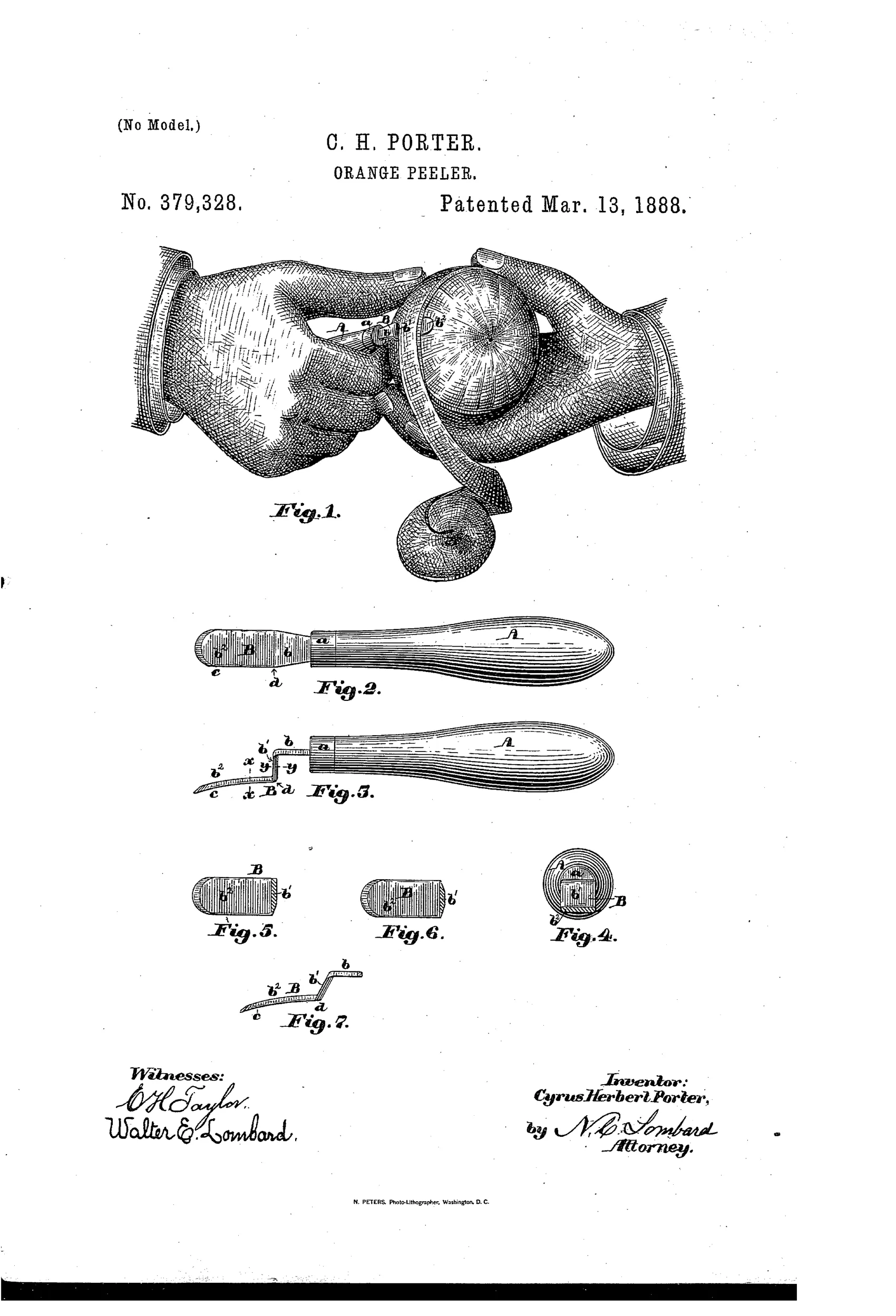
A hand-held knife for peeling oranges
❧ How it works
The blade is composed of a shank, a rind-cutting portion at right angles to the shank with a sharp knife-edge, and a curved rind-separating portion with a rounded, dull, beveled end. The rounded end is inserted between the peel and the inner skin near the blossom end of the orange until the rind-separating portion lies beneath the peel. The orange is then revolved by the fingers so the sharp rind-cutting edge slices the peel radially in a helical ribbon, while the dull rounded edge separates the peel from the inner skin without cutting it, preserving the juice. A modified version has two cutting edges so the tool suits either right- or left-handed users.
❧ What was claimed
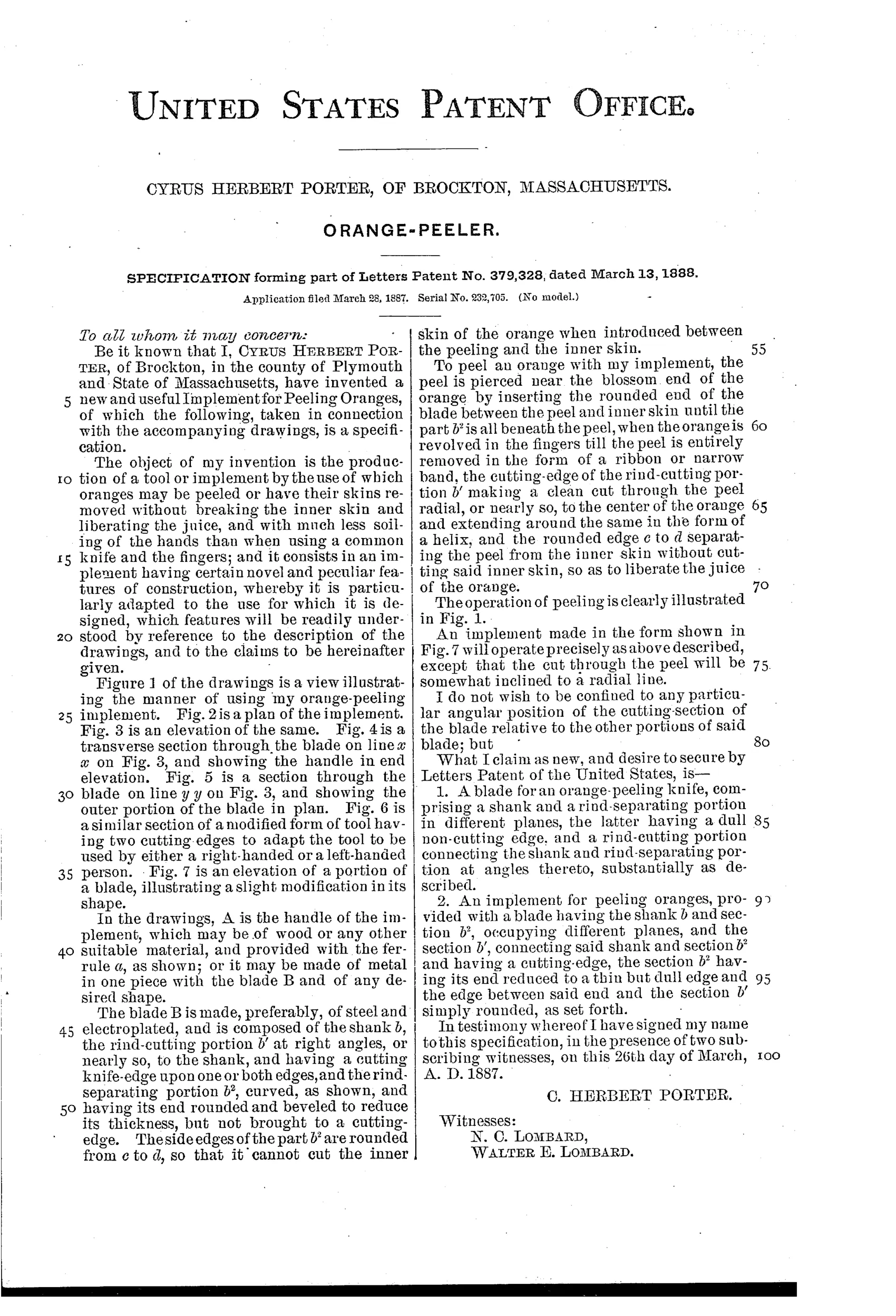
“An implement for peeling oranges, provided with a blade having the shank b and section b^2, occupying different planes, and the section b', connecting said shank and section b^2 and having a cutting-edge, the section b^2 having its end reduced to a thin but dull edge and the edge between said end and the section b' simply rounded, as set forth.”
In plain English: The peeler's blade has a shank, a sharp connecting cutting section, and a curved separating section whose tip is dull and rounded so it slides under the peel without cutting the fruit's inner skin.
❧ In the inventor’s words
“The object of my invention is the production of a tool or implement by the use of which oranges may be peeled or have their skins removed without breaking the inner skin and liberating the juice, and with much less soiling of the hands than when using a common knife and the fingers.”— Cyrus Herbert Porter, from the specification
Fate unknown
The tool is simple enough that small-scale production is plausible, but no marked example is documented; a surviving stamped specimen would settle it.
❧ Patented the same day
- FRUIT-KNIFE. — Luther C. McNeal
❧ Commentary
In a decade when the parer world was drunk on segment gears and cast-iron clamp frames, Cyrus Porter of Brockton went the other direction entirely: a small hand knife with no moving parts. The whole invention lives in one subtle distinction — his blade has two working edges doing opposite jobs. The connecting section is sharp and slices the rind radially; the curved section that rides beneath the peel ends in an edge deliberately made 'thin but dull,' so it wedges the peel away from the inner white skin without ever cutting into it. Keep the inner skin intact and the juice stays in the fruit and off your hands.
Fig. 1 is the tell: you insert the rounded tip at the blossom end, then rotate the orange with your fingers while the tool stays put — the fruit does the work, and the peel comes off in the continuous helical ribbon shown curling below the hands. Figs. 4 through 7 show how carefully Porter thought about the cross-section, including a two-edged variant so left-handers aren't stranded.
It sits outside the geared-parer arc but chases the same prize: a clean, continuous peel with minimal mess. As citrus gadgets go, this is honest, cheap to make, and would plausibly work — which is more than can be said for many of its heavily geared contemporaries.
Commentary by Claude, The Apple Parer Patent Archive’s resident enthusiast