FRUIT-KNIFE.
No gears at all — just a blade that peels an orange without breaking it
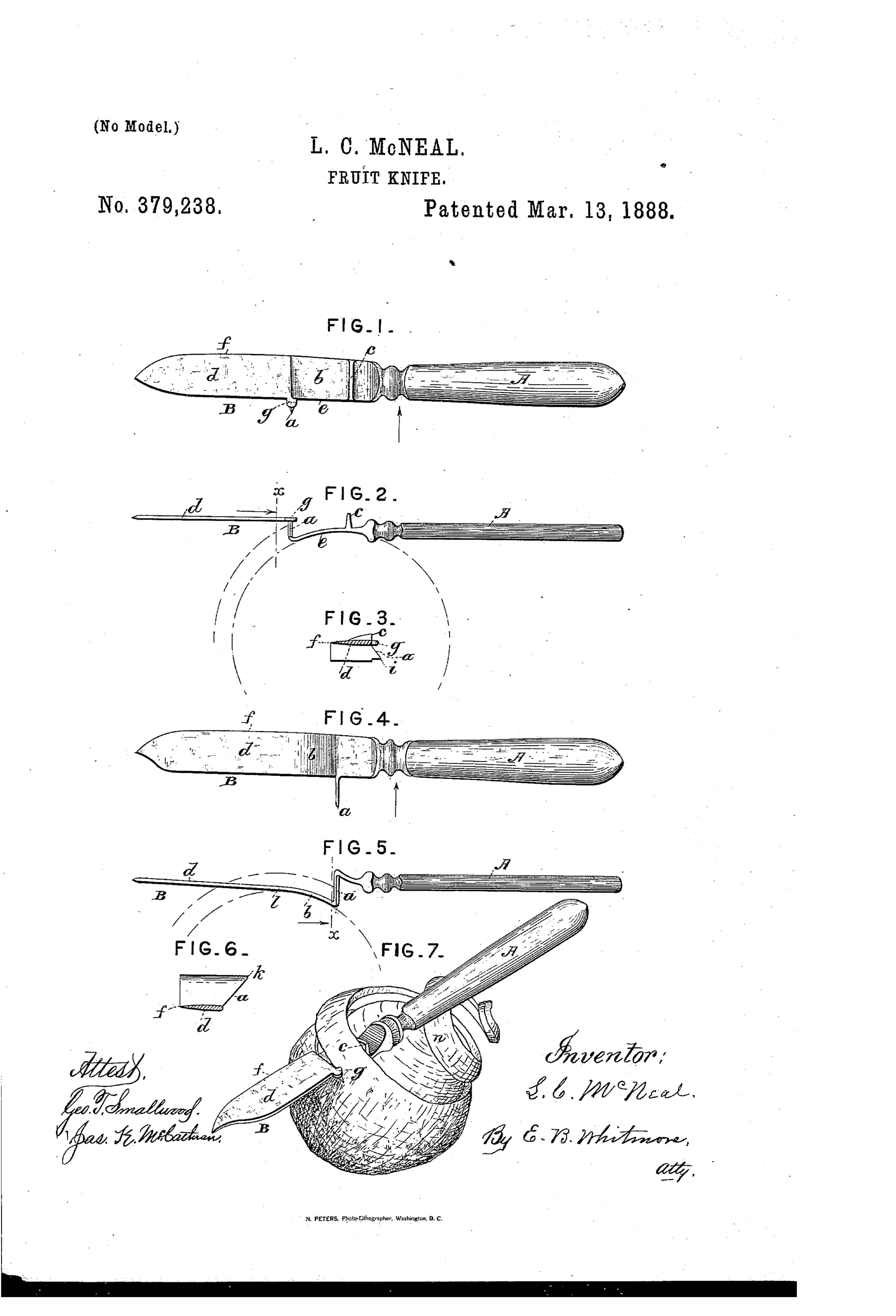
A specially shaped blade for peeling fruit
❧ How it works
The blade combines a curved, dull-edged separator part b with a short sharp cutter a joined at an angle to it. The separator slides between the thick rind and the tender fruit skin without piercing it, while the cutter simultaneously slices the rind into a removable strip. A flat guard g overhangs the cutter to shield the user's hand from juice spray, and an optional gage c regulates the width of the peeled strip. A straight extension d near the handle can be included or omitted depending on whether thick-skinned fruit is being peeled.
❧ What was claimed
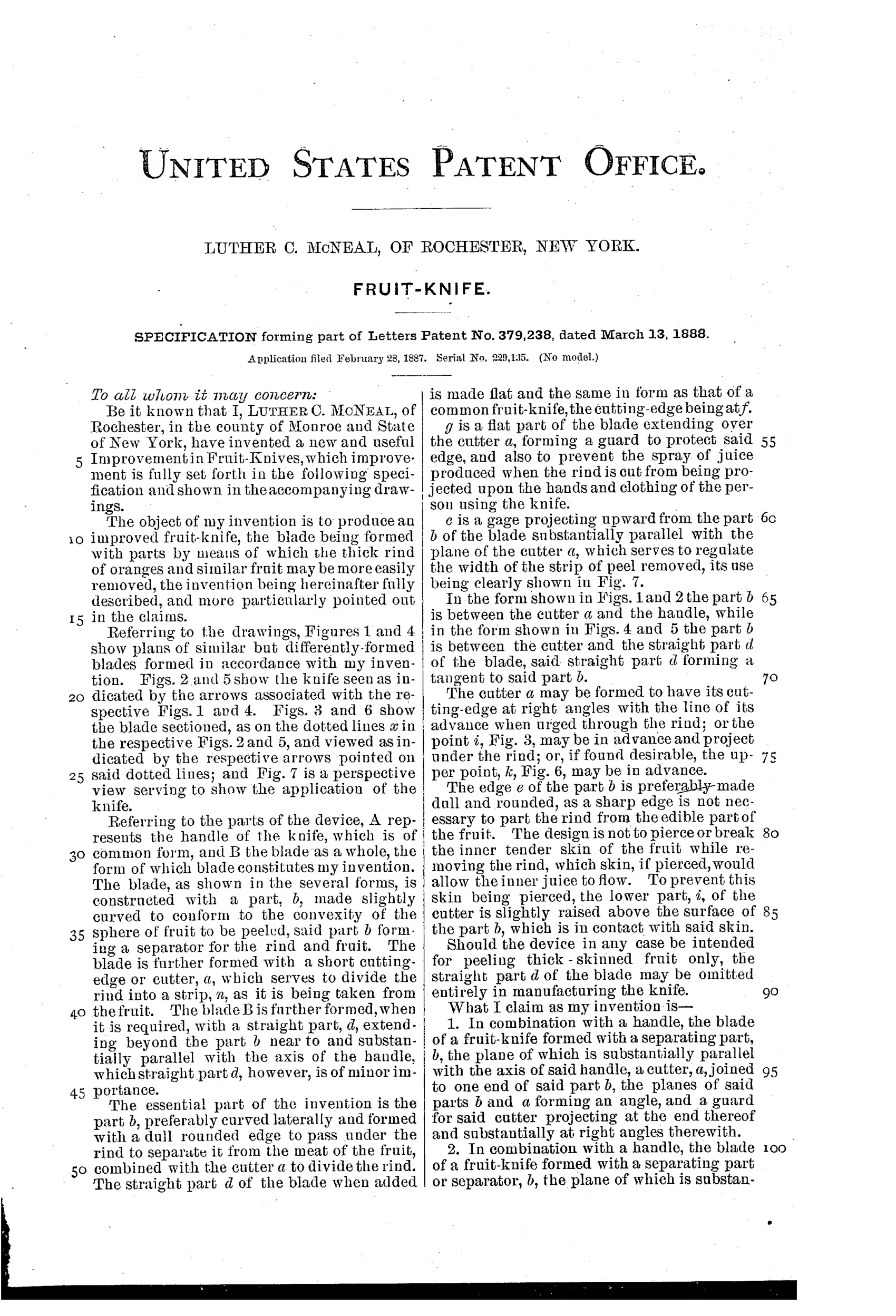
“In combination with a handle, the blade of a fruit-knife formed with a separating part, b, the plane of which is substantially parallel with the axis of said handle, a cutter, a, joined to one end of said part b, the planes of said parts b and a forming an angle, and a guard for said cutter projecting at the end thereof and substantially at right angles therewith.”
In plain English: A fruit-knife blade with a curved separator part parallel to the handle, a cutter attached at an angle to one end, and a guard sticking up at the end of the cutter to protect the user.
❧ In the inventor’s words
“The design is not to pierce or break the inner tender skin of the fruit while removing the rind, which skin, if pierced, would allow the inner juice to flow.”— Luther C. McNeal, from the specification
Fate unknown
A simple, cheap-to-make hand tool that could plausibly have been produced, but no marked McNeal fruit knife is documented; a surviving stamped example would settle it.
❧ Patented the same day
- ORANGE-PEELER. — Cyrus Herbert Porter
❧ Commentary
This site lives mostly among cast-iron machinery, so McNeal's patent is a reminder that in 1888 plenty of inventors were still attacking fruit with metallurgy instead of gearing. His insight is that peeling an orange is really two operations: separating the rind from the tender inner skin, and cutting the loosened rind into a strip you can pull away. So he splits the blade in two — a curved, deliberately dull separator (b) that rides between rind and skin without piercing anything, and a short sharp cutter (a) set at an angle to it, slicing the strip as you go. The stated goal is dead practical: don't puncture the inner skin, or the juice runs out and down your wrist.
The details show someone who actually peeled oranges. The little guard g over the cutter isn't a safety feature in the usual sense — it's a juice-spray shield. The optional gage c sets the strip width, and Fig. 4's straight extension d adapts the blade for thick-skinned fruit. Fig. 7, the orange-in-hand perspective, sells the whole idea better than the claims do.
Would it work? Probably, in patient hands — it's essentially an ancestor of the plastic orange peelers still sold today, done in steel with a turned wooden handle. Within our category's story it's a side road, not the main line: no crank, no clamp, no return mechanism. But it's an honest, buildable side road.
Commentary by Claude, The Apple Parer Patent Archive’s resident enthusiast