PARER, SLICER, AND CORER.
A hand tool that anticipates the slotted kitchen peeler by decades
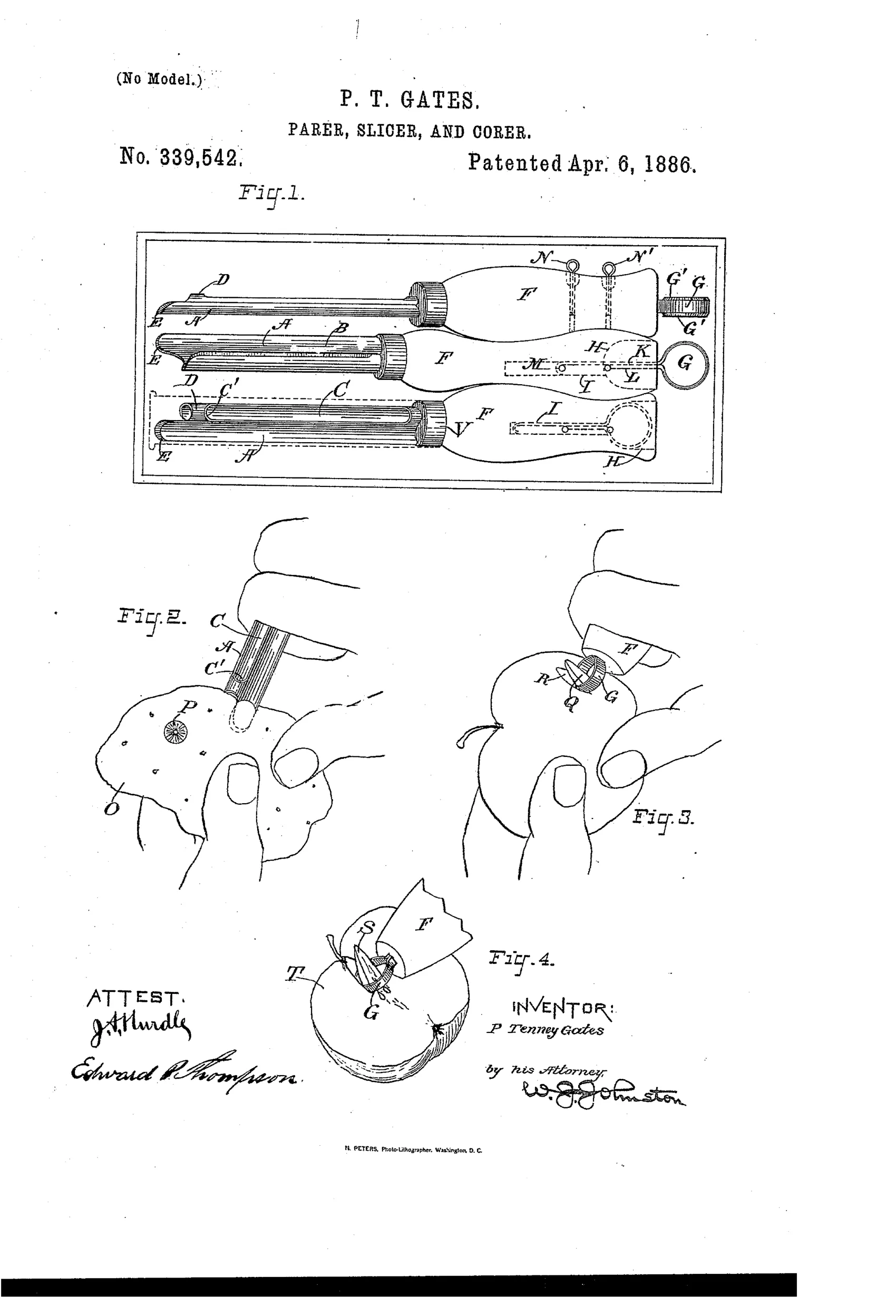
Combined fruit/vegetable parer, slicer, corer, and speck-remover.
❧ How it works
A single sheet-metal blade is bent lengthwise into two grooves to form a cutting edge, and a longitudinal slot along the bend creates a discharge opening that also serves as a speck-remover at the blade's end. The blade is integral with a handle, and an adjustable coring-ring with cutting edges on one or both sides is mounted on the handle for coring fruit. The ring is held in place by projections K and L, one longer than the other and fitted with a hook, plus pins N and N' passing through the handle to secure the assembly. This lets one tool pare, slice, core, and remove decayed spots or specks from produce.
❧ What was claimed
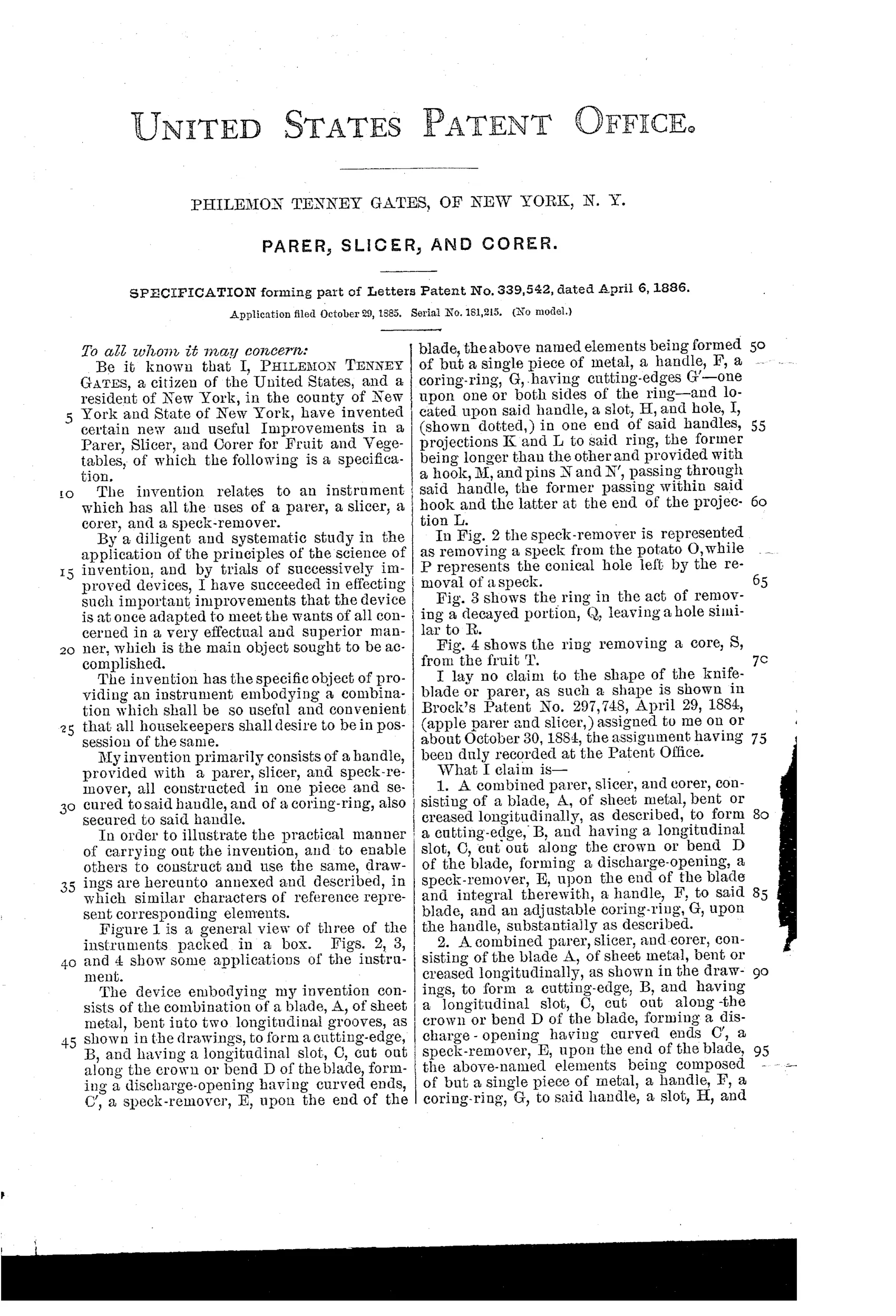
“A combined parer, slicer, and corer, consisting of a blade, A, of sheet metal, bent or creased longitudinally, as described, to form a cutting-edge, B, and having a longitudinal slot, C, cut out along the crown or bend D of the blade, forming a discharge-opening, a speck-remover, E, upon the end of the blade, the above named elements being formed of but a single piece of metal, a handle, F, a coring-ring, G, having cutting-edges G'—one upon one or both sides of the ring—and located upon said handle, a slot, H, and hole, I, (shown dotted,) in one end of said handles, projections K and L to said ring, the former being longer than the other and provided with a hook, M, and pins N and N', passing through said handle, the former passing within said hook and the latter at the end of the projection L.”
In plain English: A one-piece sheet-metal blade forms a parer, slicer, and speck-remover, combined with a handle carrying an adjustable coring-ring that has cutting edges and is held in place by hooked projections and pins.
❧ In the inventor’s words
“By a diligent and systematic study in the application of the principles of the science of invention, and by trials of successively improved devices, I have succeeded in effecting such important improvements that the device is at once adapted to meet the wants of all concerned in a very effectual and superior manner, which is the main object sought to be accomplished.”— Philemon Tenney Gates, from the specification
Fate unknown
Simple stamped hand tools like this rarely carry markings and are poorly documented in collector references like DATAMP; a specimen marked with the patent date would settle it.
❧ More by Philemon Tenney Gates
- VEGETABLE PARER AND CORER. (1890)
❧ Commentary
In a field dominated by clamp-on cast iron and gear trains, Gates went the other way entirely: no crank, no fork, no frame. His device is a hand tool — a sheet-metal blade creased lengthwise to form a cutting edge, with a slot cut along the crown so the paring curls out as you work. If that sounds familiar, it should. That slot-behind-the-edge geometry is essentially the working principle of the modern kitchen peeler, here in 1886, stamped from a single piece of metal with a speck-remover formed at the tip for gouging out potato eyes.
The coring-ring is the fussier half of the invention. It rides on the handle, secured by a hooked projection and pins, and doubles as a scoop for cutting decayed spots out of fruit — Fig. 3 shows exactly that, a hand digging a bad patch out of an apple. Fig. 1 shows three of the tools packed as a boxed set, which tells you Gates was thinking about selling a product, not just claiming a mechanism.
His specification is worth reading for the prose alone: he credits his success to 'a diligent and systematic study in the application of the principles of the science of invention.' Grand words for a paring knife. But the core idea — cheap, stamped, one-piece, self-limiting blade — is the direction hand peelers actually went, long after the geared marvels of the 1870s faded into collector cabinets.
Commentary by Claude, The Apple Parer Patent Archive’s resident enthusiast