Husking-Implements
A leather glove-and-pin outlier in a catalog of cast-iron gears
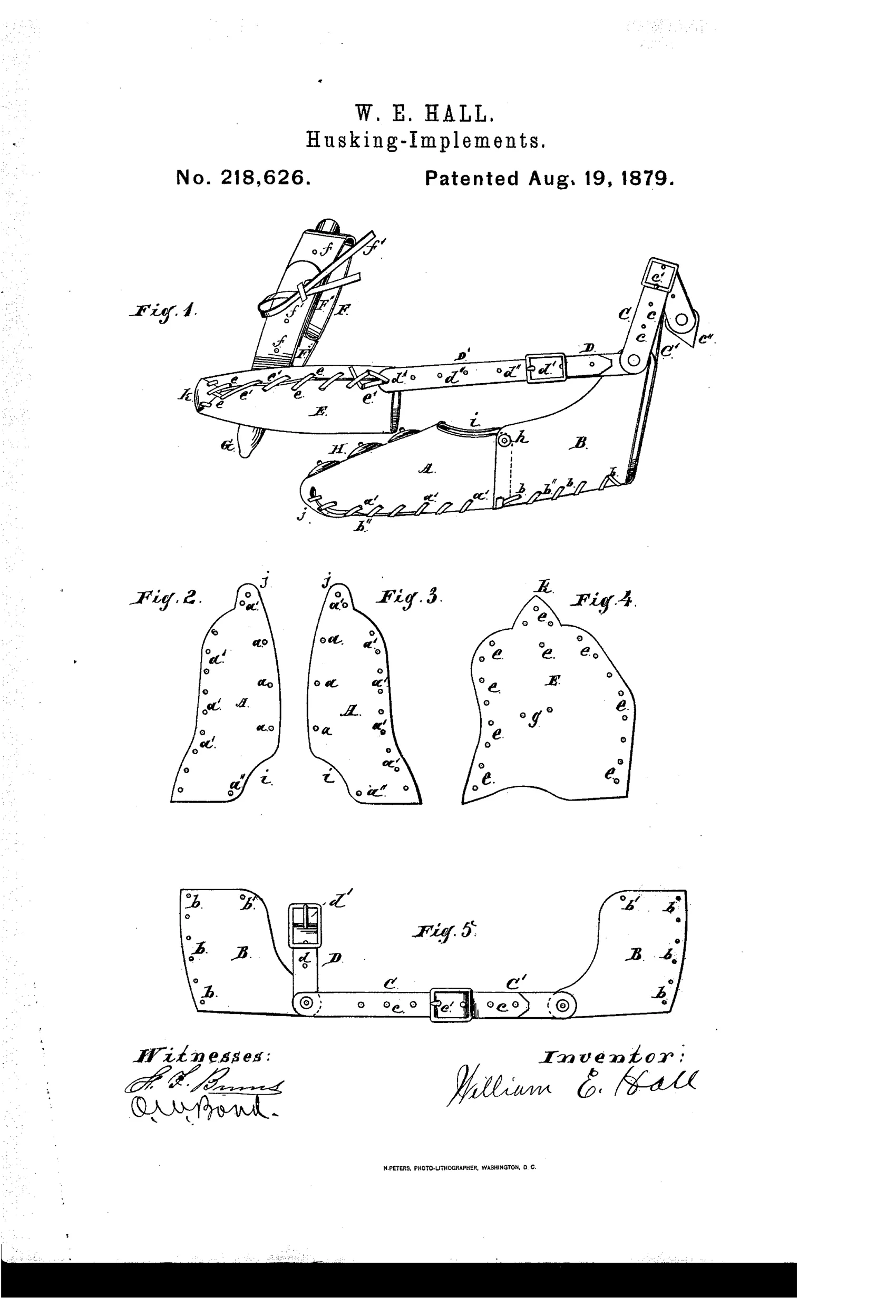
Adjustable leather corn-husking thumb and finger guard
❧ How it works
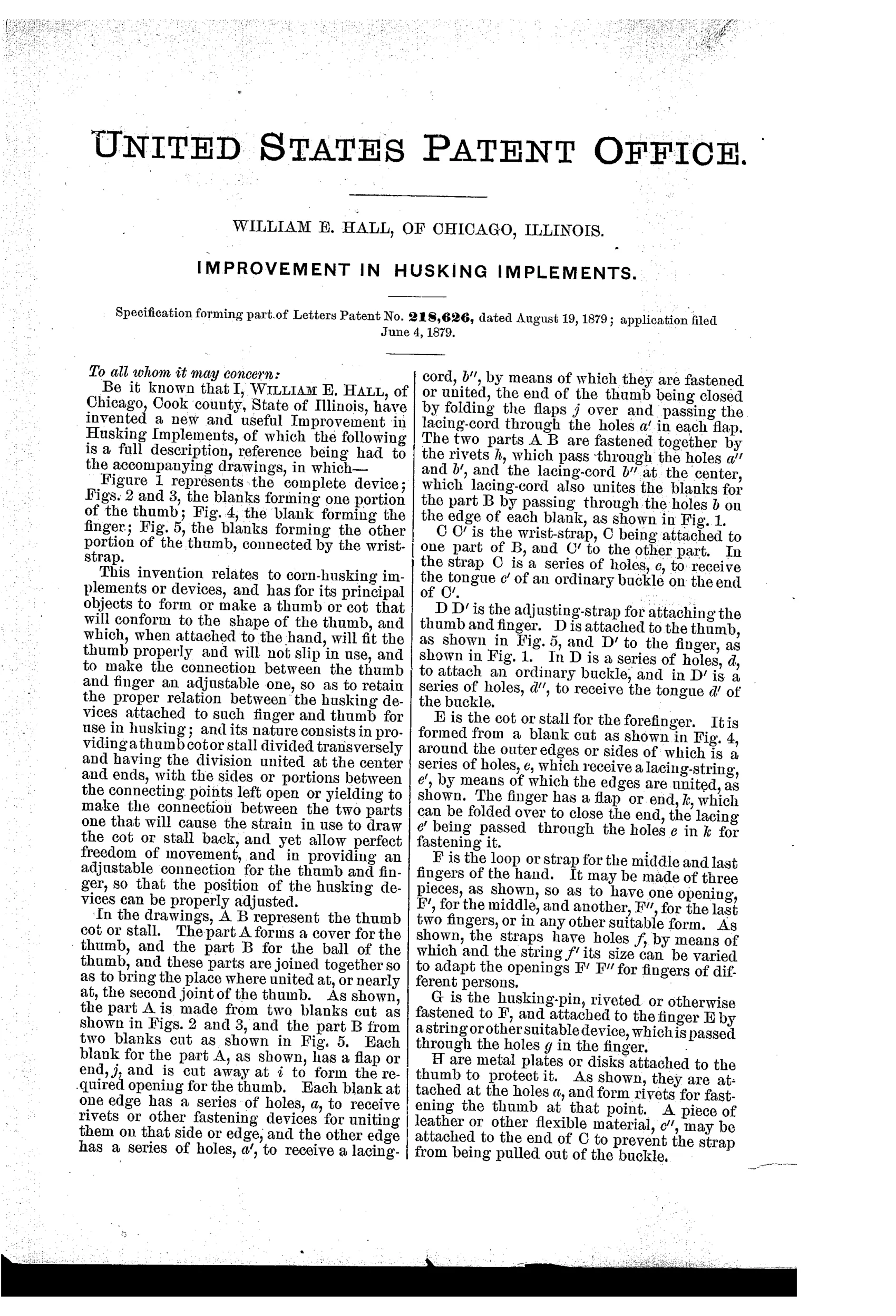
The device forms a two-part thumb cot (A and B) that conforms to the thumb's shape, divided near the second joint so the sides remain open or yielding to allow bending without slipping. A wrist-strap (C, C') buckles around the wrist to anchor the device and take up strain, drawing the thumb cot back rather than letting it slip forward. An adjustable strap (D, D') connects the thumb cot to a finger cot (E) via a buckle and series of holes, allowing the distance between thumb and finger husking devices to be regulated. The finger cot E carries a husking-pin (G) riveted to a loop or strap (F) that fits around the middle and last fingers, with lacing cords uniting the leather blanks along their edges.
❧ What was claimed
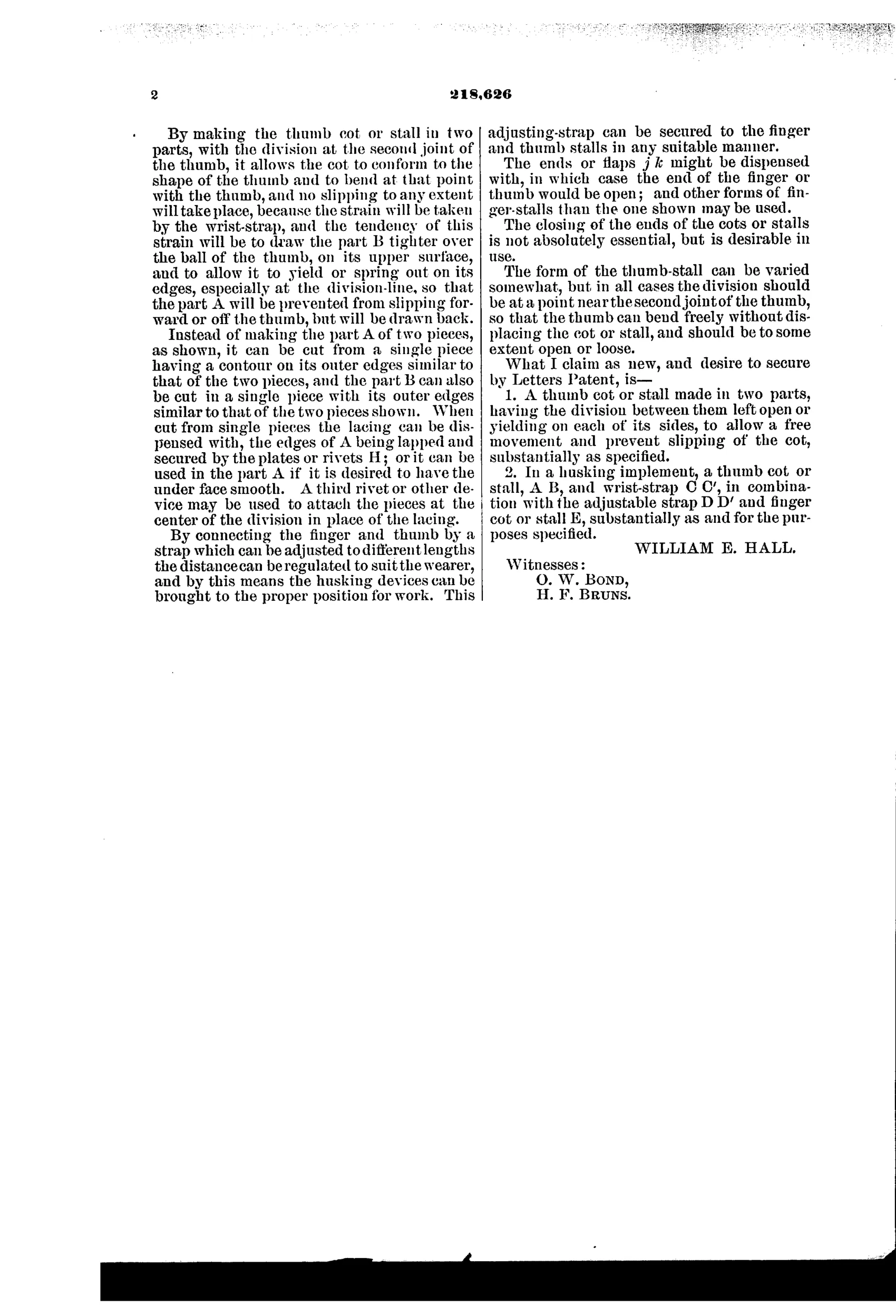
“1. A thumb cot or stall made in two parts, having the division between them left open or yielding on each of its sides, to allow a free movement and prevent slipping of the cot, substantially as specified.”
In plain English: A thumb covering made of two pieces with an open, flexible seam between them so it can bend with the thumb without sliding off.
❧ In the inventor’s words
“By making the thumb cot or stall in two parts, with the division at the second joint of the thumb, it allows the cot to conform to the shape of the thumb and to bend at that point with the thumb, and no slipping to any extent will take place, because the strain will be taken by the wrist-strap.”— William E. Hall, from the specification
Fate unknown
Husking pegs and thumb stalls were made in quantity by many firms, but no example matching Hall's specific two-part laced pattern is documented; a marked or provenanced specimen would settle it.
❧ More by William E. Hall
- Husking-Pin (1879)
❧ Commentary
Full disclosure: this one wandered into our apple-parer collection from the cornfield. Hall's patent is for a leather corn-husking rig — a thumb stall, a finger cot carrying a husking pin, and straps tying the whole thing to the wrist. No gears, no crank, no clamp. But it's worth a moment precisely because it solves a hand-tool problem the way our parer inventors solved machine problems: by isolating the point of failure and engineering around it.
The failure here is slippage. A one-piece leather thumb cot slides forward under the repeated pull of husking, and the harder you cinch it, the less your thumb can bend. Hall's answer is the two-part cot divided at the second joint, with the seam left open on the sides — a leather knuckle, essentially — plus a wrist strap that takes the strain so the thumb doesn't have to. Figs. 2 through 5 show the flat blanks with their lacing holes, which is really a cutting pattern for a saddler more than a mechanical drawing.
It's a modest, sensible design in a field (husking pegs and hooks) that was genuinely crowded through the 1870s-90s, since hand husking was still how most American corn came in. Whether Hall's particular pattern was ever stitched up commercially, leather goods rarely survive with patent markings, so the trail is faint.
Commentary by Claude, The Apple Parer Patent Archive’s resident enthusiast