Husking-Pin
A corn husker's finger rig — the flesh-and-leather cousin of our parers
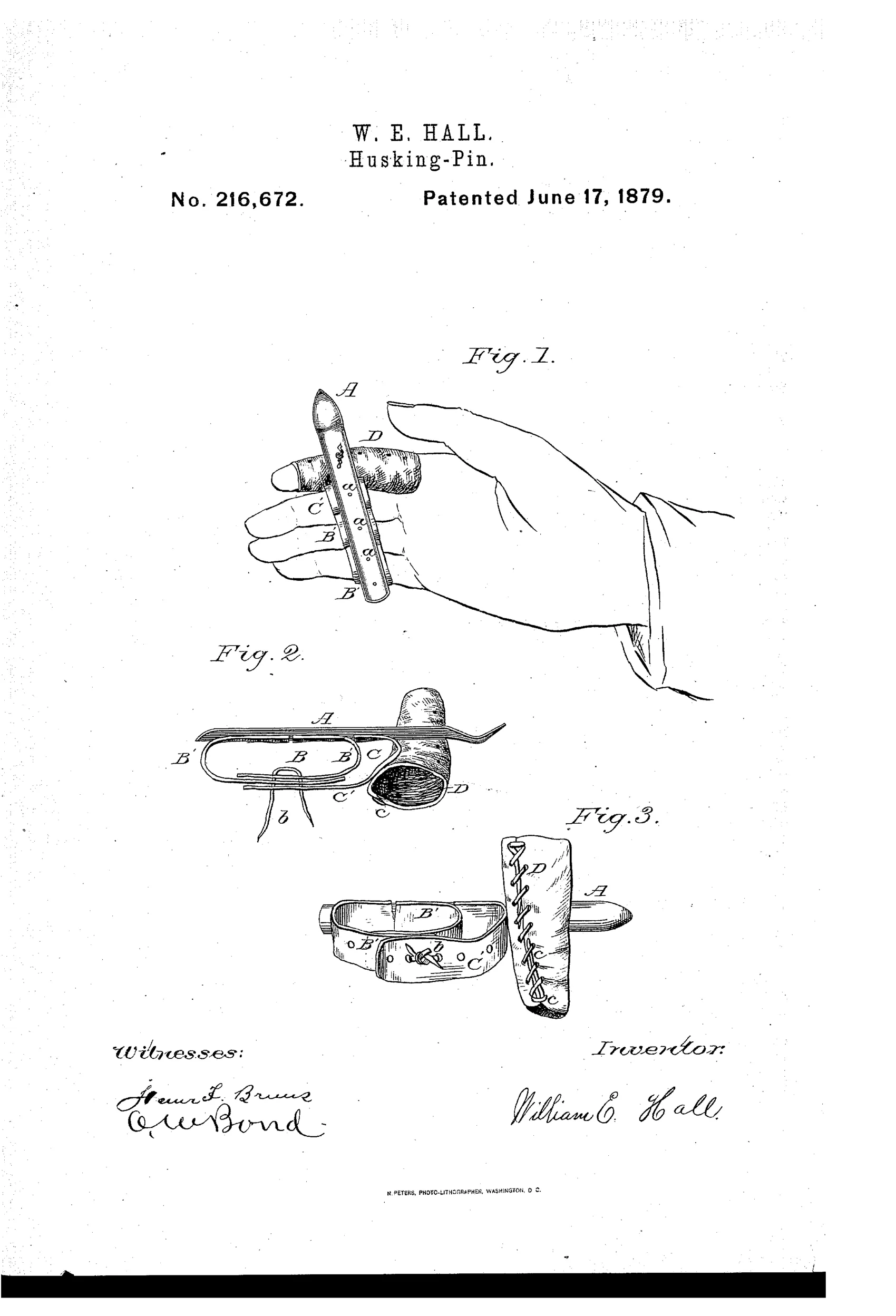
Hand-strap device for holding a corn-husking pin
❧ How it works
A pointed metal husking pin is riveted to two adjustable straps that form separate receptacles for the last two fingers and the middle finger. The straps' free ends carry a series of holes so a string can be laced through them, letting the wearer size the openings to fit different hands. A separate flexible forefinger cot, laced with string, is tied to the pin's shank so the forefinger can freely guide and operate the point without interfering with the thumb. By placing the last two fingers in one receptacle and the middle finger in the other, the pin's point is thrown farther out into a better working position.
❧ What was claimed
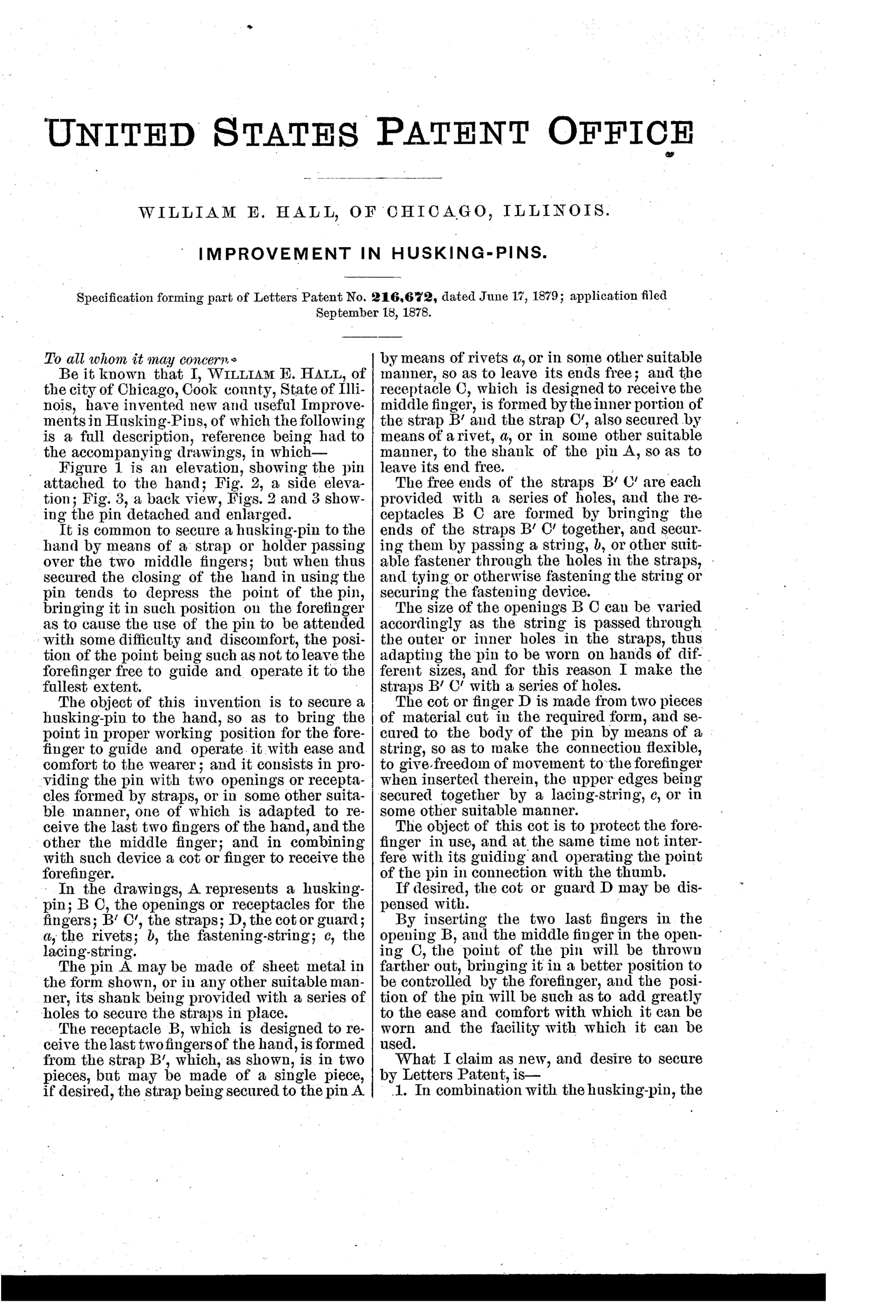
“In combination with the husking-pin, the straps B' C', riveted to the pin, and forming the finger-receptacles B C, and their ends adjustably connected together by a string or similar device, b, substantially as and for the purposes herein set forth.”
In plain English: The invention covers the husking pin combined with two riveted straps that form finger loops, whose ends are adjustably tied together with a string.
❧ In the inventor’s words
“The object of this invention is to secure a husking-pin to the hand, so as to bring the point in proper working position for the forefinger to guide and operate it with ease and comfort to the wearer.”— William E. Hall, from the specification
Fate unknown
Husking pins were made by the thousands, but no example matching Hall's laced two-loop design is documented to my knowledge; a marked or provenance specimen would settle it.
❧ More by William E. Hall
- Husking-Implements (1879)
❧ Commentary
Full disclosure: this is not an apple parer. It's a corn husking pin, and it wandered into our files because it lives in the same 19th-century world of getting produce out of its wrapper faster. Where our cast-iron machines took the apple to the tool, Hall took the tool to the hand — a pointed pin riveted to leather straps that lash it across the fingers, with a laced cot for the forefinger so the point can be guided freely without fouling the thumb.
The detail worth a second look is the fit system. The strap ends carry rows of holes laced together with string, like a boot, so one size adjusts to any hand — a real concern for a tool worn ten hours a day at harvest. Hall's other trick is the finger split: last two fingers in one loop, middle finger in the other, which cantilevers the point farther forward into working position. That's genuine ergonomic thinking in 1878, decades before the word existed.
Husking pins and hooks were a crowded field with dozens of patents, because hand husking was brutal, repetitive work and every farmer had opinions about grip. Whether Hall's particular lacing arrangement was ever stamped out in quantity, I can't say. It would work — leather, string, and a pin are cheap — but so would fifty rival designs, and the market didn't record which strap won.
Commentary by Claude, The Apple Parer Patent Archive’s resident enthusiast