CORN-HUSKING GLOVES
A corn-husking glove wanders into the parer files, armored with tannery scrap
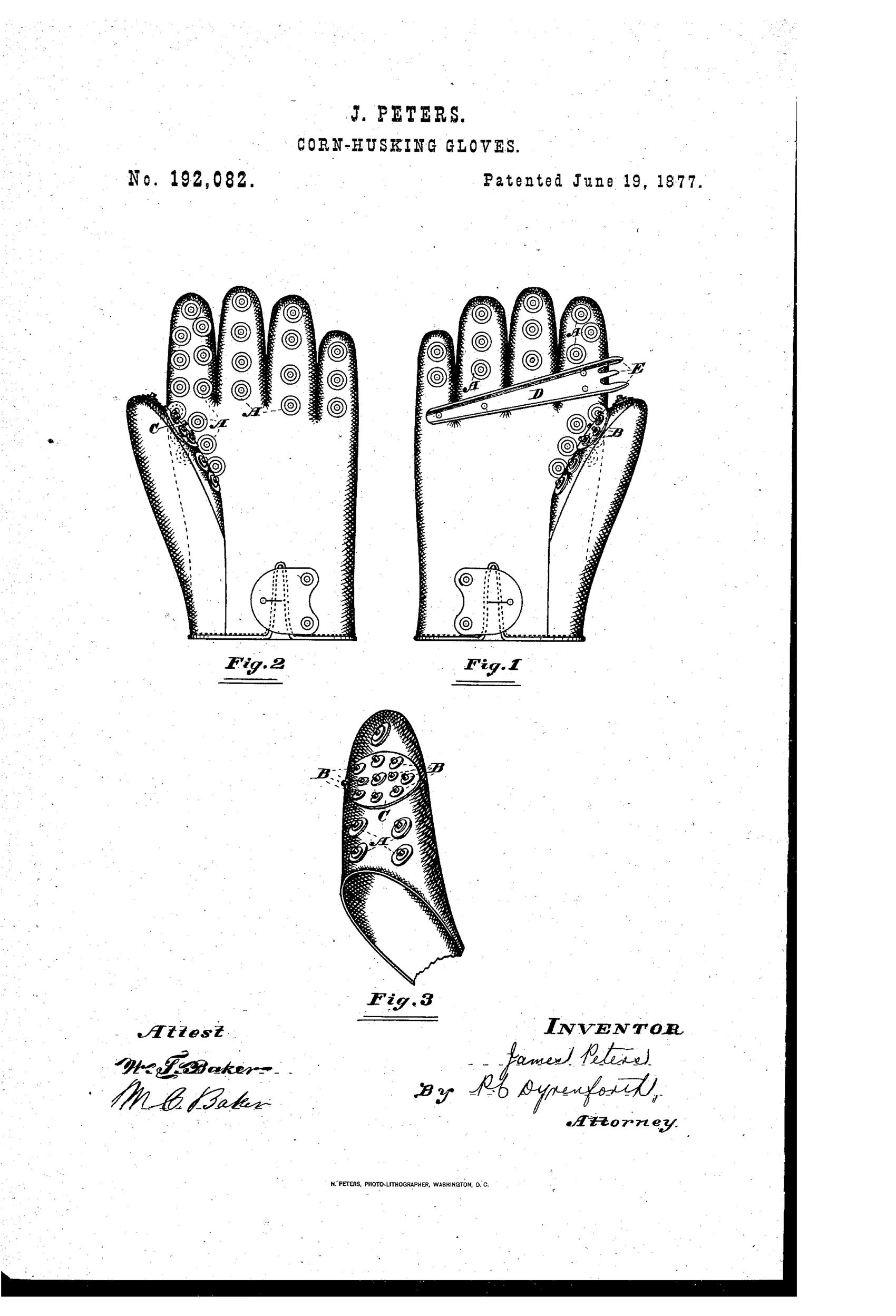
Leather corn-husking gloves with wear-protecting rivet disks
❧ How it works
Leather disks are fastened by common shoe-rivets to the palm, fingers, and thumb of a leather glove to shield it from wear against corn husks. The right-hand thumb bears a dense cluster of shoe-rivets, faced with an extra leather layer, whose projecting studs engage the curved prongs of a metal husking-pin riveted across the palm. As the hand closes, the pin's prongs interlock with the rivet spurs on the thumb to grip husks firmly; the left-hand glove omits the husking-pin but may use similar leather facing on its thumb.
❧ What was claimed
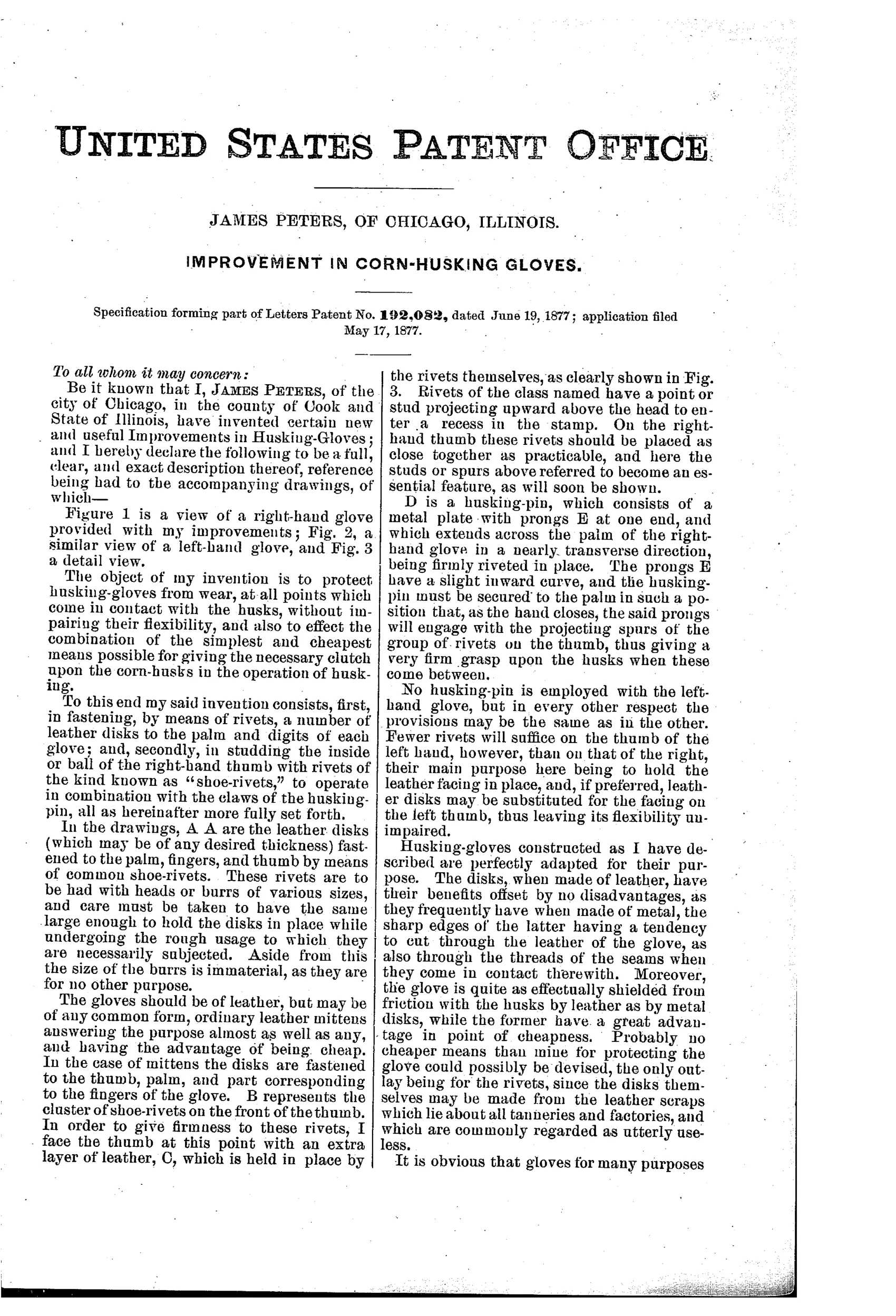
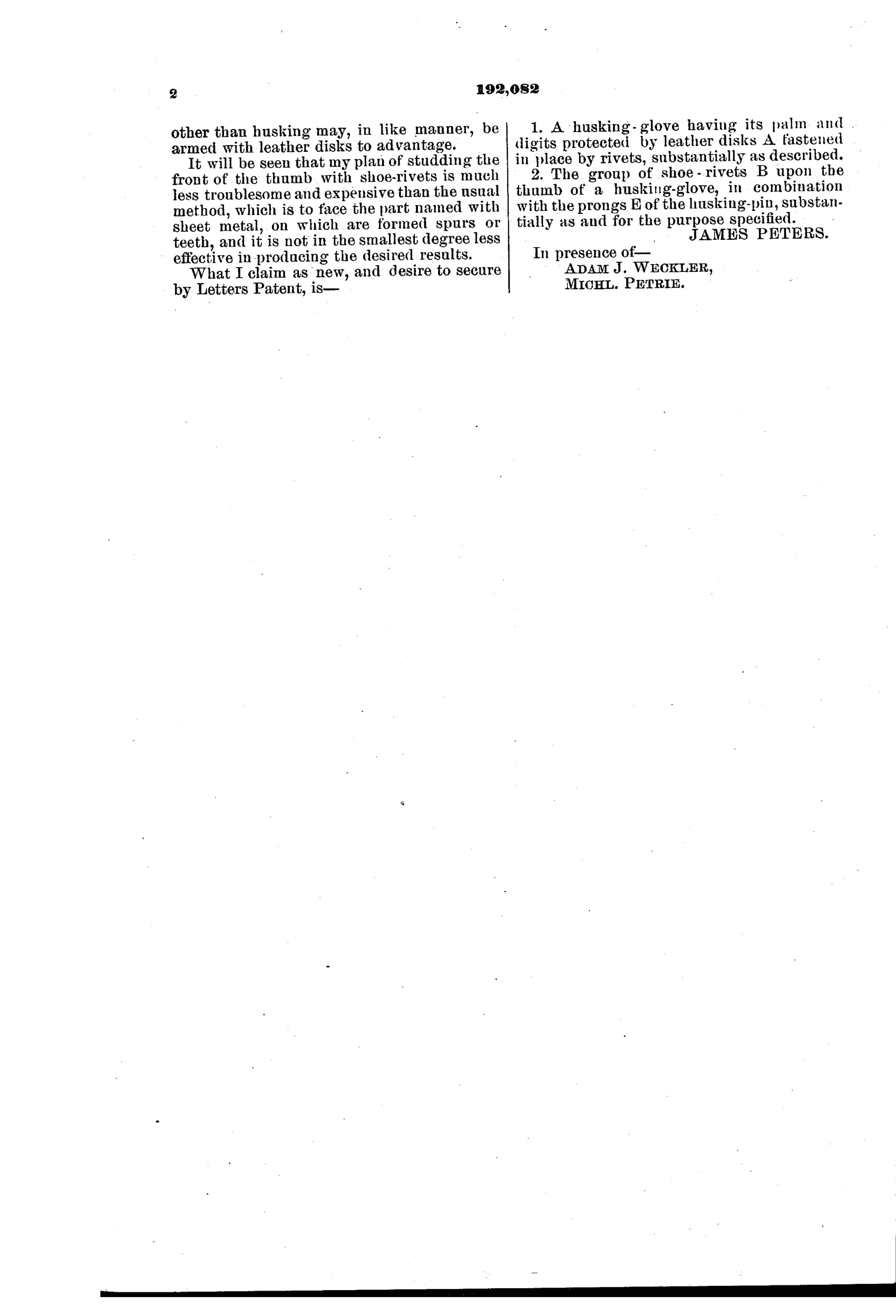
“1. A husking-glove having its palm and digits protected by leather disks A fastened in place by rivets, substantially as described. 2. The group of shoe-rivets B upon the thumb of a husking-glove, in combination with the prongs E of the husking-pin, substantially as and for the purpose specified.”
In plain English: The glove's palm and fingers are covered with riveted leather disks, and a cluster of rivets on the thumb works together with a pronged metal husking-pin to grip corn husks.
❧ In the inventor’s words
“Probably no cheaper means than mine for protecting the glove could possibly be devised, the only outlay being for the rivets, since the disks themselves may be made from the leather scraps which lie about all tanneries and factories, and which are commonly regarded as utterly useless.”— James Peters, from the specification
Fate unknown
Husking gloves and pins were common farm goods, but no example marked to this patent is documented; a surviving glove with the riveted pin and thumb studs would settle it.
❧ Commentary
Let's be honest up front: this is not an apple parer. James Peters of Chicago patented a leather work glove for husking corn, and it lives here only as a neighbor from the same world of 1870s farm-kitchen ingenuity. But it rewards a look, because it solves its problem the way the great parer men solved theirs — with cheap parts doing double duty.
The drawing shows both gloves peppered with circular leather disks, each held on by a common shoe-rivet. That's the whole wear-protection scheme, and Peters is proud of the economics: the disks come from leather scraps 'which lie about all tanneries and factories, and which are commonly regarded as utterly useless.' The rivets are the only purchased component. The disks armor the wear points, and when one wears through you rivet on another.
The clever bit is Fig. 1 and Fig. 3. The right thumb carries a dense cluster of rivets whose projecting heads act as gripping studs, and a pronged metal husking-pin is riveted diagonally across the palm. Close your hand and the pin's curved prongs interlock with the thumb studs — the rivets stop being mere armor and become half of a husk-gripping jaw. Husking pins and pegs were common on farms; building one into a self-armoring glove where the fasteners moonlight as teeth is the kind of one-part-two-jobs thinking the parer golden age ran on.
Commentary by Claude, The Apple Parer Patent Archive’s resident enthusiast