IMPROVEMENT IN HAND CORN-HUSKERS
A palm-strapped husking pincer wanders into the parer files from Chicago
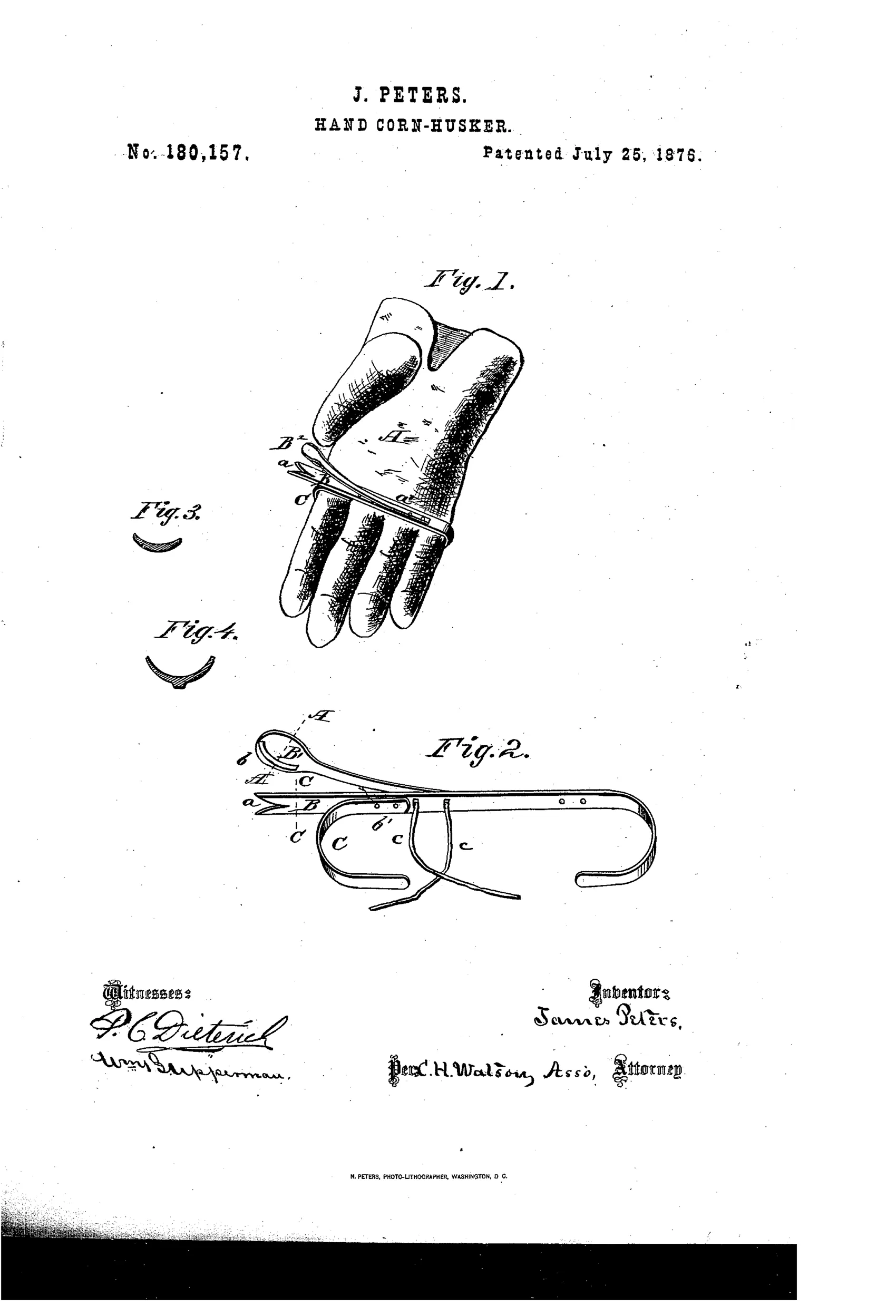
A glove-mounted mechanical corn husking tool
❧ How it works
A forked or notched metal plate is strapped to the palm of a glove using a cord threaded through holes. A spring is secured to the plate and carries a V-shaped projection on its outer end that presses into the notch when the thumb pushes down. The forked end of the plate is inserted into the husks at the top of the ear, and pressing the spring down pinches the husk between the fork and the V-shaped projection, stripping it away. Releasing thumb pressure allows the spring to return to its original position.
❧ What was claimed
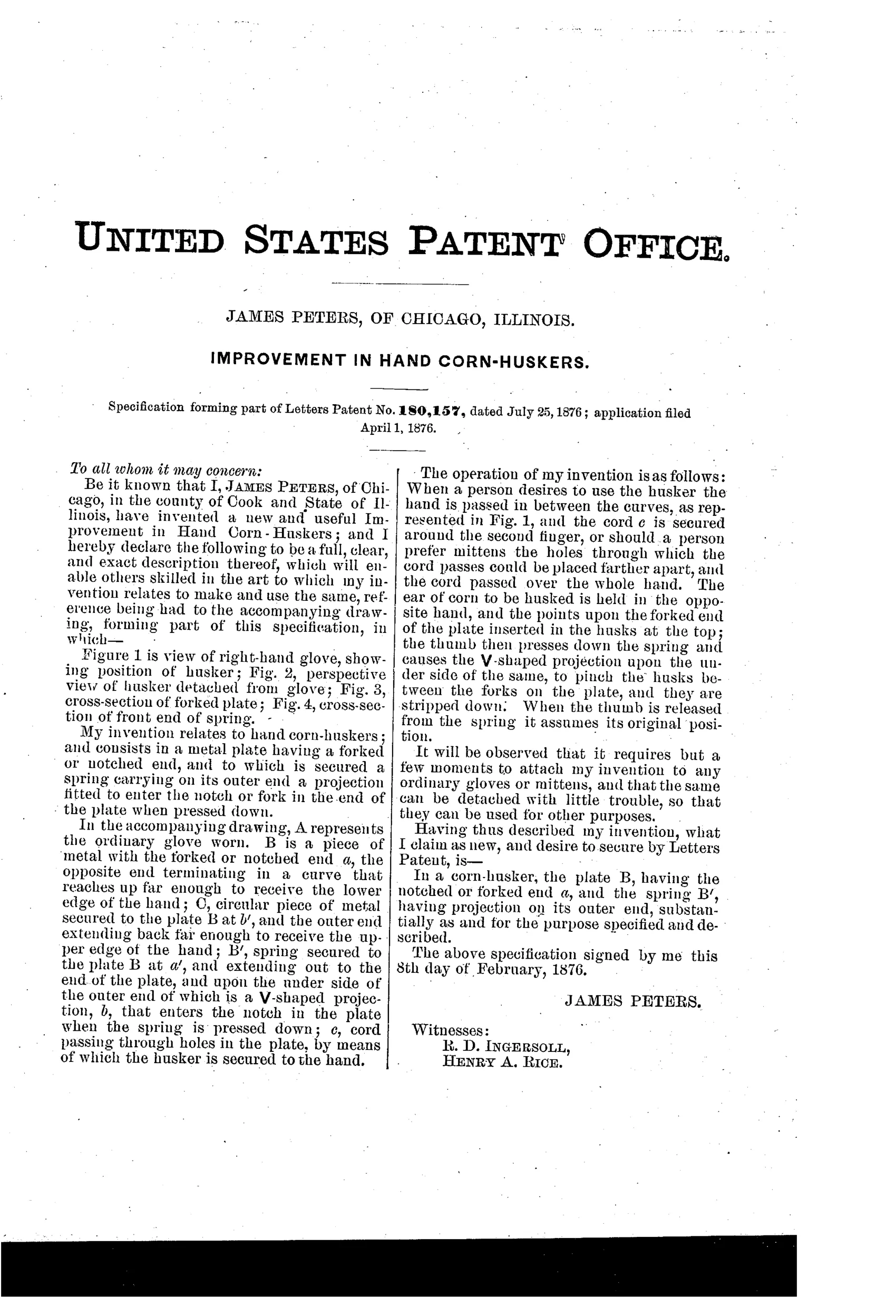
“In a corn-husker, the plate B, having the notched or forked end a, and the spring B', having projection on its outer end, substantially as and for the purpose specified and described.”
In plain English: The patent covers a husking plate with a forked end combined with a spring bearing a projection on its tip, working together as described.
❧ In the inventor’s words
“It will be observed that it requires but a few moments to attach my invention to any ordinary gloves or mittens, and that the same can be detached with little trouble, so that they can be used for other purposes.”— James Peters, from the specification
Fate unknown
Simple husking hooks survive in quantity, but no marked example of this spring-pincher design is documented; a surviving specimen or trade listing would settle it.
❧ More by James Peters
- CORN-HUSKING GLOVES (1877)
❧ Commentary
First, a note of honesty: this is not an apple parer. It's a hand corn-husker, and it strayed into our category files, presumably because it shares the parers' instinct — take a tedious harvest chore done ten thousand times a season and put a purpose-built edge on it. Where the parer inventors bolted their answer to the kitchen table, Peters straps his to the hand itself.
The mechanism is genuinely tidy. A notched plate lashes across the palm with a cord through drilled holes (Fig. 1 shows the lacing), and a flat spring rides on top carrying a V-shaped nose. You spear the forked end into the husk at the tip of the ear, press down with your thumb, and the V-nose pinches the husk against the fork so a pull strips it clean. Release, and the spring resets. It's a one-motion clamp with no pivot, no rivet under load — the spring is the whole moving part. That's the same economy the best parer patents chased: fewer joints, one crank, one stroke.
Context matters here. Husking pegs and hooks were made and sold by the millions well into the twentieth century, but nearly all were simple hooks or pegs on a leather palm strap. Peters' spring-loaded pincher is more elaborate than the trade settled on, and his own selling point — detaches in moments so the gloves stay useful — hints he knew farmers wouldn't pay much for it. A clever answer the market solved more crudely.
Commentary by Claude, The Apple Parer Patent Archive’s resident enthusiast