IMPROVEMENT IN CORN-HUSKING GLOVES
A corn-husking glove wanders into the parer files — teeth on leather, not gears
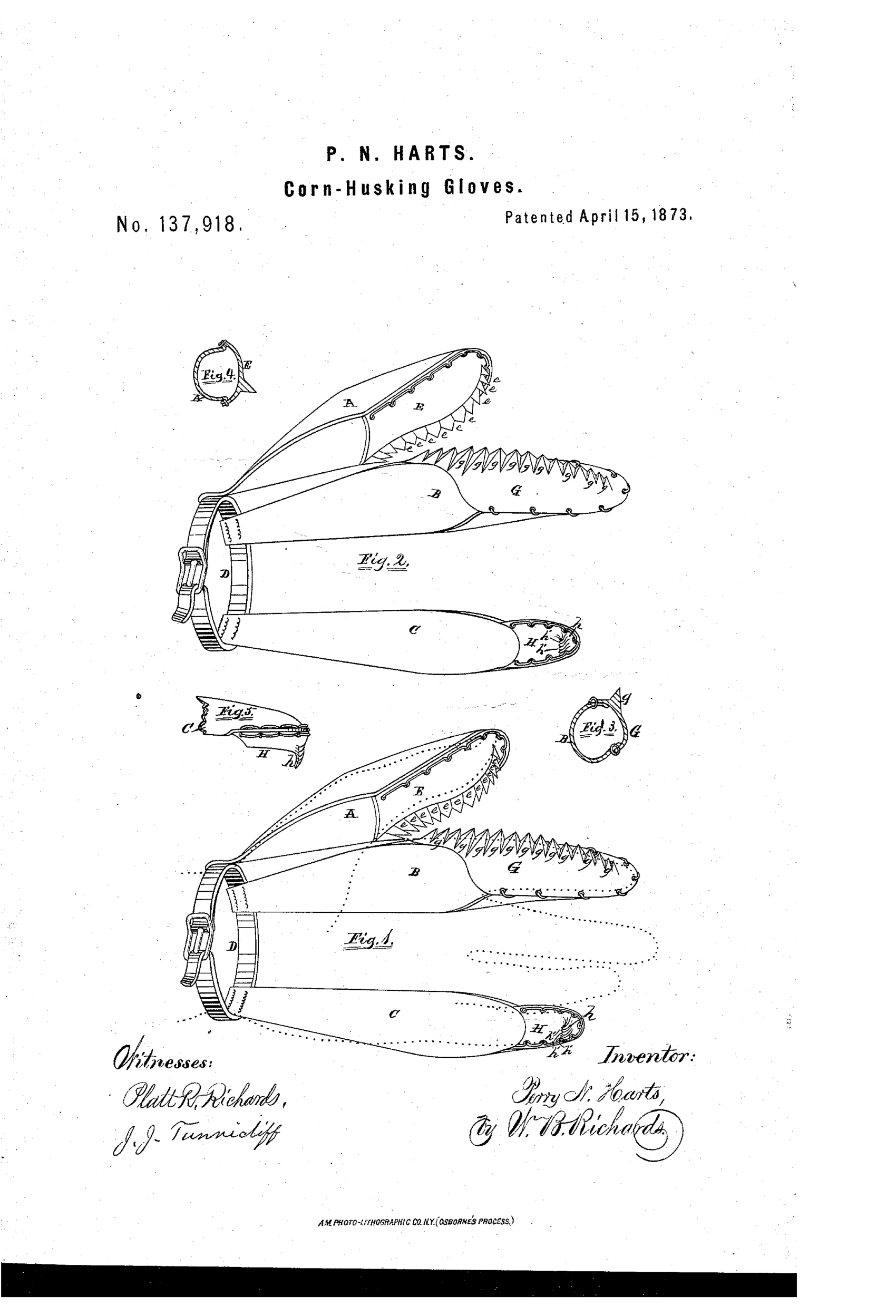
Metal-toothed leather glove for husking corn.
❧ How it works
Leather shields cover the back of the thumb, fore-finger, and little finger, joined by a wrist strap fastened with a buckle. Metallic plates with rows of teeth are fixed to the thumb and fore-finger straps, while a short metallic plate with a curved, toothed pin is secured to the little-finger shield. In use, the husked ear is gripped so the teeth and pin tear and strip the husk from the corn while shielding the hand. An ordinary husking-peg may still be used in the right hand for conventional operation.
❧ What was claimed
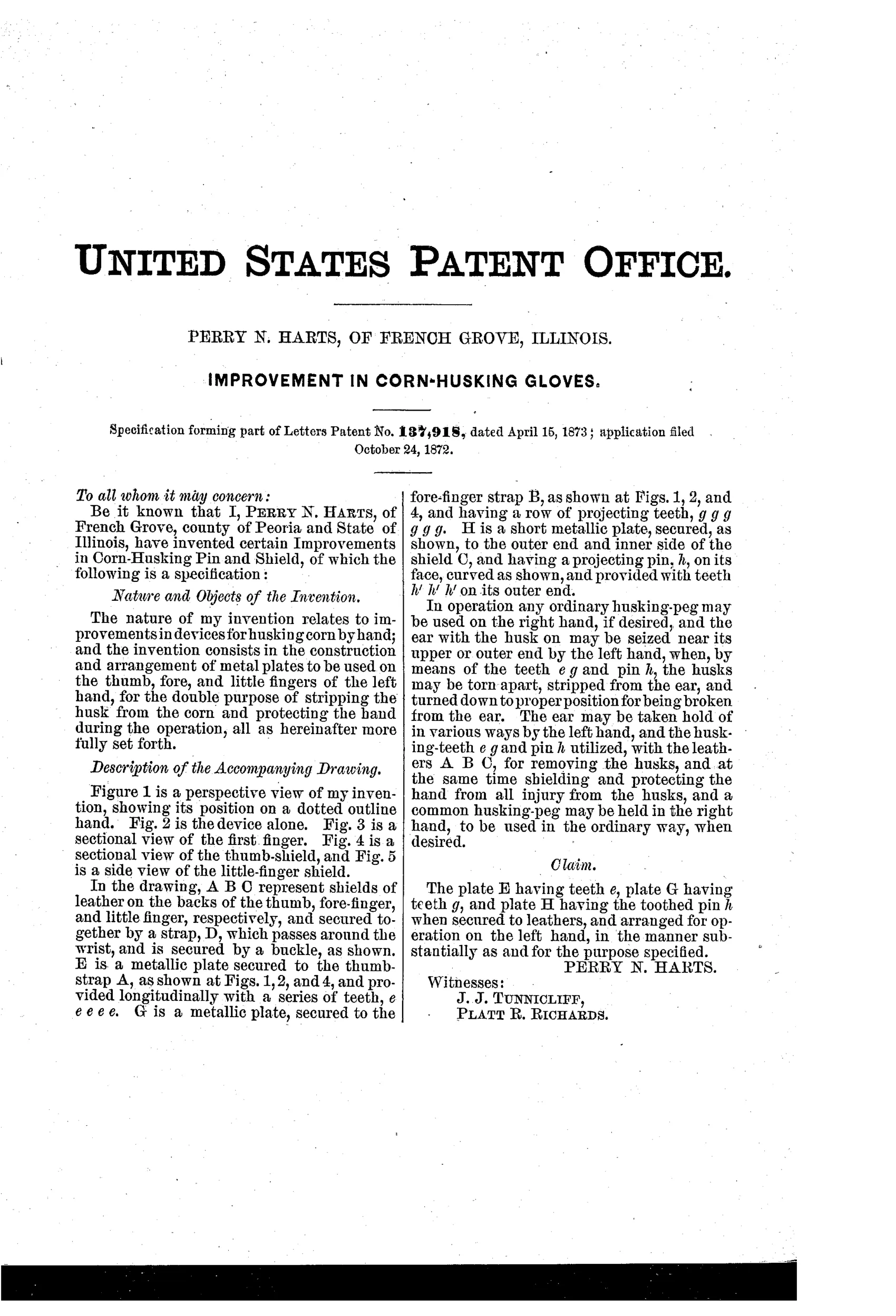
“The plate E having teeth e, plate G having teeth g, and plate H having the toothed pin h when secured to leathers, and arranged for operation on the left hand, in the manner substantially as and for the purpose specified.”
In plain English: The claim covers three toothed metal plates mounted on leather finger-shields, arranged to work together on the left hand for husking corn.
❧ In the inventor’s words
“In operation any ordinary husking-peg may be used on the right hand, if desired, and the ear with the husk on may be seized near its upper or outer end by the left hand, when, by means of the teeth e g and pin h, the husks may be torn apart, stripped from the ear, and turned down to proper position for being broken from the ear.”— Perry N. Harts, from the specification
Fate unknown
Husking pegs and hooks were widely manufactured, but no marked example of Harts's three-plate glove is documented; a surviving specimen would settle it.
❧ Patented the same day
- IMPROVEMENT IN CORN-HUSKING THIMBLES — George W. Gash and Charles L. Owens
❧ Commentary
Let's be upfront: this is not an apple parer. Perry N. Harts of French Grove, Illinois patented a left-hand husking glove — three leather shields over the thumb, forefinger, and little finger, tied together by a buckled wrist strap, each carrying a toothed metal plate. It solves a hand-tool problem the way our category never does: no crank, no frame, no cast-iron gearing. The blade comes to the fruit — or here, the ear — on the worker's own fingers.
Still, there's a reason it's worth two minutes. The drawing rewards a close look: the thumb and forefinger plates carry rows of saw teeth for tearing the husk open, while the little finger gets something different — a short plate with a curved, toothed pin, essentially a built-in husking peg positioned to strip and turn the husk down in one motion. The spec even concedes you can keep an ordinary peg in your right hand, which tells you Harts designed this as an accessory to existing practice, not a replacement for it.
That's the honest 1870s farm-patent pattern: take a motion a worker repeats ten thousand times a season and shave a fraction of a second off it. Husking hooks and pegs did become a huge manufactured class later in the century; whether this three-plate arrangement specifically ever left the drawing is another matter.
Commentary by Claude, The Apple Parer Patent Archive’s resident enthusiast