IMPROVEMENT IN CORN-HUSKING THIMBLES
Not a parer at all — armored fingertips for the husking bee.
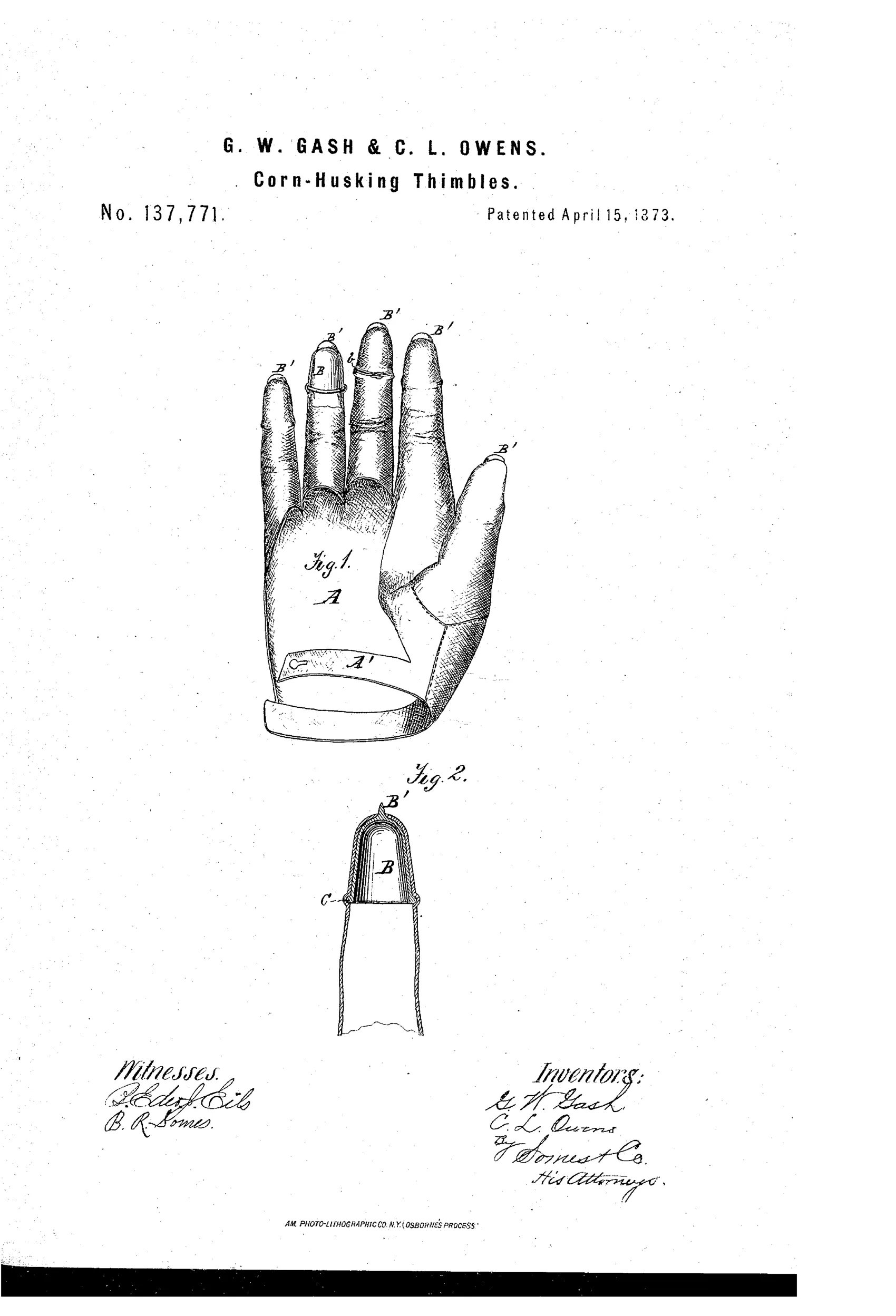
A blade-fitted metal thimble for husking gloves.
❧ How it works
A metallic thimble B is fitted to the fingertip of a glove and held in place by a bead or flange formed around its lower edge. A projecting knife-edge or blade on the point of the thimble extends through the tip of the glove finger to cut and loosen corn husks. Optionally, a short wire b is fastened to the thimble and forced through the glove material, then wound around the outside to permanently secure the thimble. The thimbles are made in various sizes to fit each finger and thumb.
❧ What was claimed
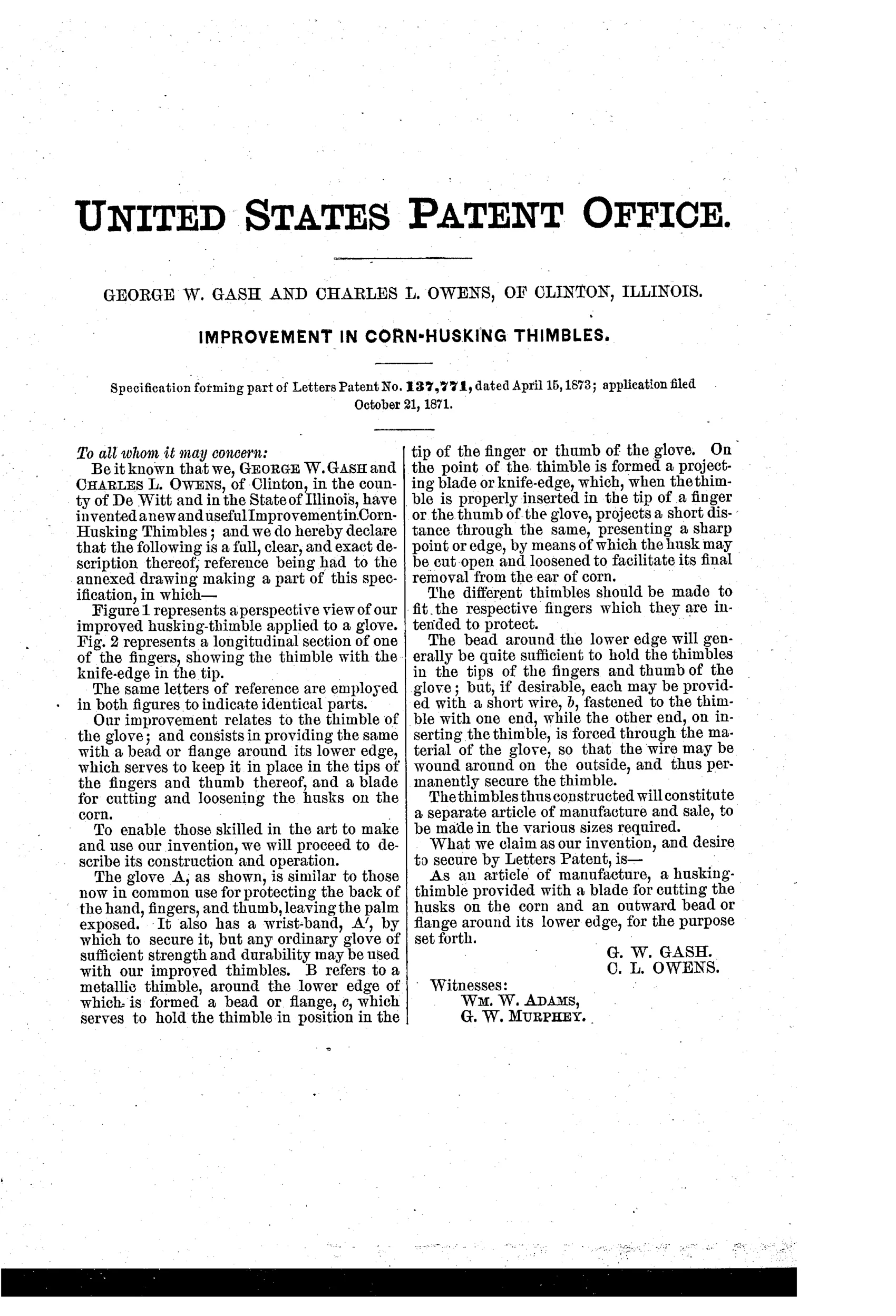
“As an article of manufacture, a husking-thimble provided with a blade for cutting the husks on the corn and an outward bead or flange around its lower edge, for the purpose set forth.”
In plain English: The invention is a husking thimble that has both a cutting blade and an outward bead or flange around its bottom edge.
❧ In the inventor’s words
“On the point of the thimble is formed a projecting blade or knife-edge, which, when the thimble is properly inserted in the tip of a finger or the thumb of the glove, projects a short distance through the same, presenting a sharp point or edge, by means of which the husk may be cut open and loosened to facilitate its final removal from the ear of corn.”— George W. Gash and Charles L. Owens, from the specification
Fate unknown
Husking gloves and pegs were mass-produced for decades, but no example marked to Gash & Owens or matching this flanged thimble is documented; a surviving specimen would settle it.
❧ Patented the same day
- IMPROVEMENT IN CORN-HUSKING GLOVES — Perry N. Harts
❧ Commentary
A confession up front: this one wandered into our collection from the cornfield, not the orchard. Gash and Owens of Clinton, Illinois, weren't spinning apples on a fork — they were arming the human hand itself. Each glove finger gets a fitted metal thimble with a short knife-edge poking through the leather at the tip, so a husker could slit and strip the shuck in one grabbing motion without picking up a separate tool.
The mechanically interesting bit is the retention. Anyone who has worn a loose thimble knows it flies off the moment work gets vigorous, and husking is nothing but vigorous. Their answer is the bead or flange rolled around the thimble's lower edge — that's the actual claim, note, not the blade — plus an optional wire pushed through the glove and wound around outside to lock the thimble in for good. Fig. 2 shows the section clearly: blade at the point, bead C anchoring below. Sizes graded to each finger and thumb, which tells you they were thinking about it as a manufactured article, not a one-off.
Where the apple-parer world went toward machines that removed the hand from the work, husking hardware went the opposite way: wearable cutters. Husking pegs, pins, and hooks were made by the thousands into the 1900s. Whether this particular flanged-thimble variant was among them, we can't say.
Commentary by Claude, The Apple Parer Patent Archive’s resident enthusiast