Improvement in Corn-Huskers and Pickers.
A corn husker wandered into the parer files — a hinged jaw worn like a glove
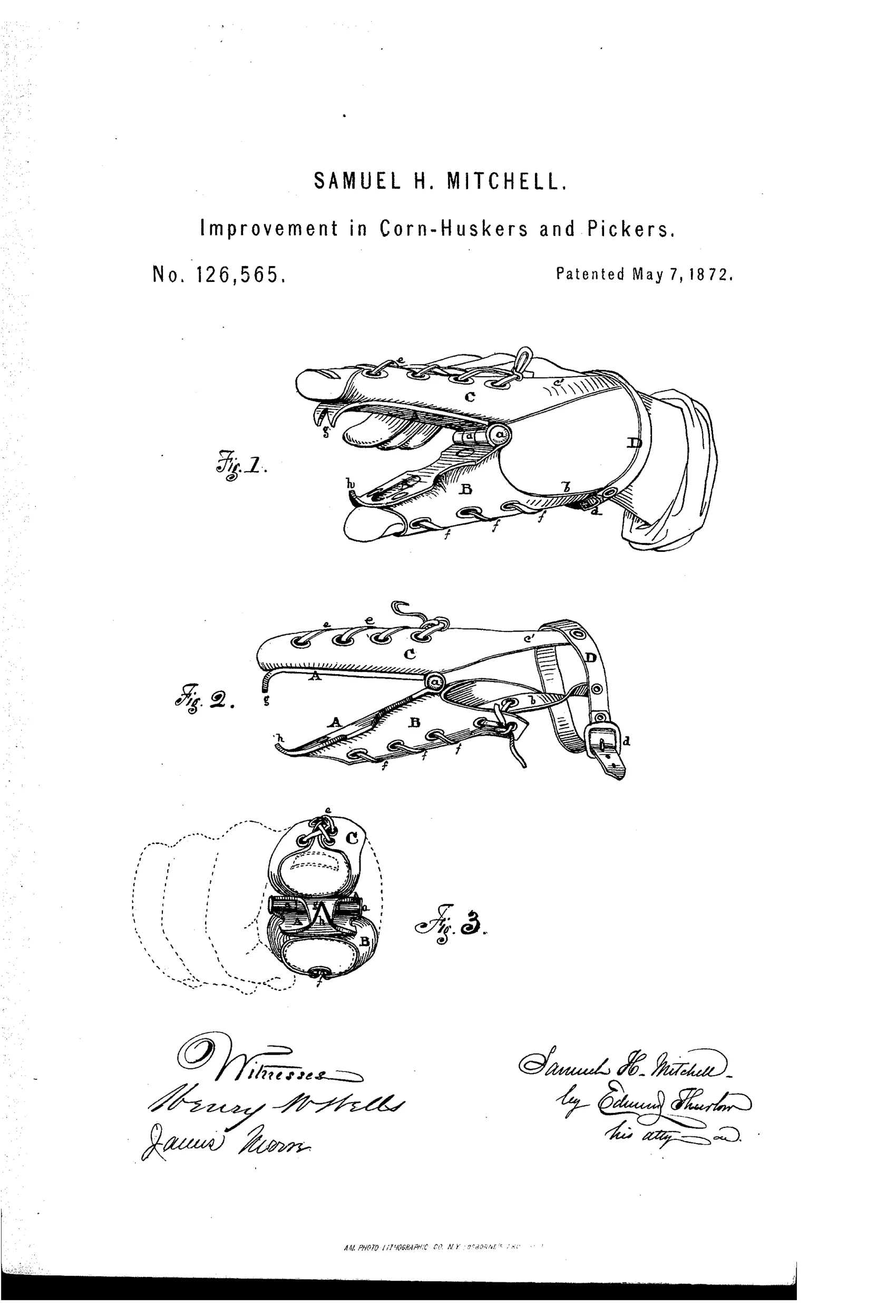
Hand-worn hinged metal corn-husking glove device
❧ How it works
Two nearly parallel metal plates are joined at one end by a hinge that sits in the angle between the thumb and forefinger. The plates are each fastened to a leather thumb-stall and finger-stall, which are laced closed and terminate at the wrist in straps buckled to a wrist-strap. The bent outer ends of the plates form interlocking triangular teeth that lock together like a jaw. The wearer closes the plates around an ear of corn, using the teeth to grip and break the ear from the stalk without abrading the hand.
❧ What was claimed
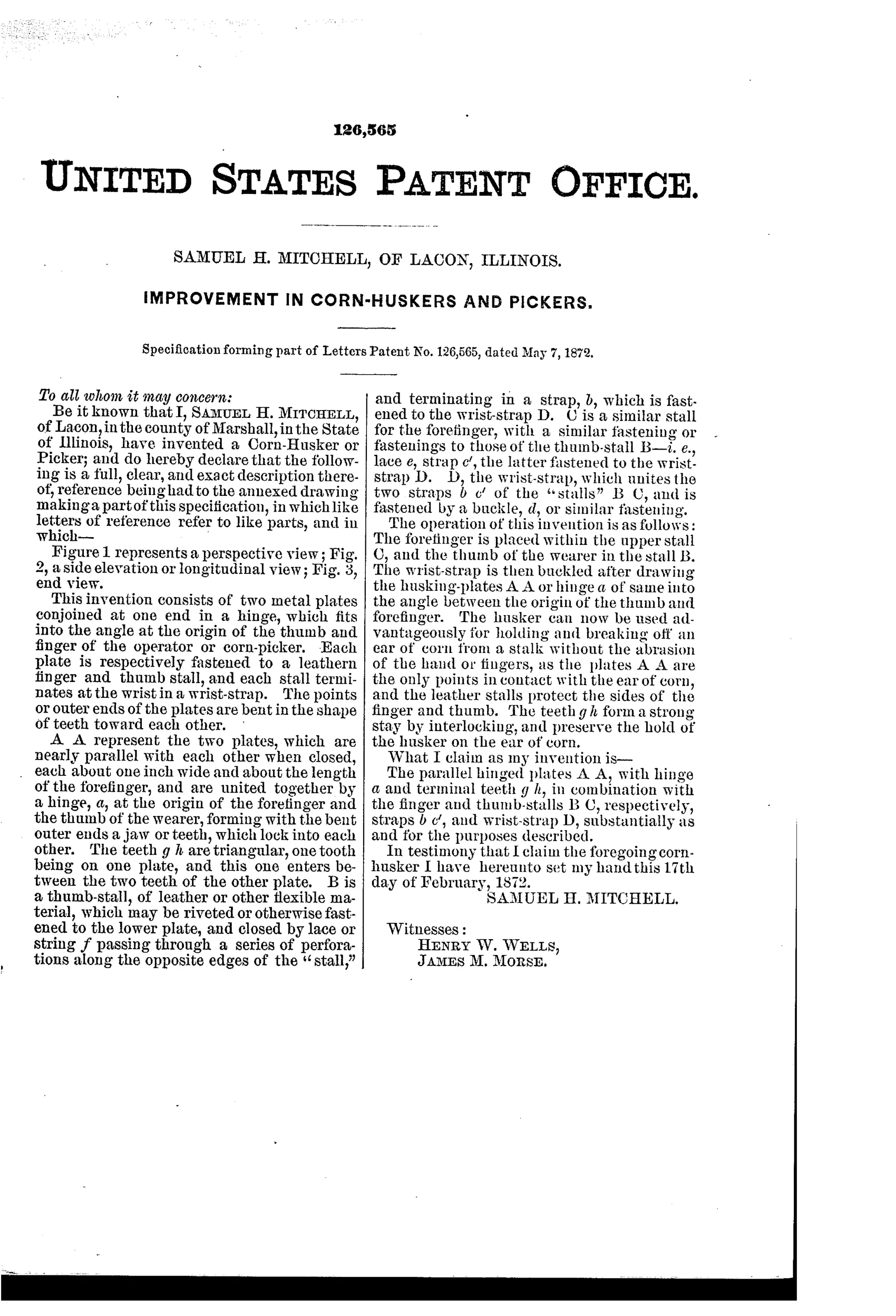
“The parallel hinged plates A A, with hinge a and terminal teeth g h, in combination with the finger and thumb-stalls B C, respectively, straps b c', and wrist-strap D, substantially as and for the purposes described.”
In plain English: A pair of hinged metal plates with interlocking teeth, worn on leather thumb and finger stalls strapped to the wrist, used together to grip and husk corn.
❧ In the inventor’s words
“The husker can now be used advantageously for holding and breaking off an ear of corn from a stalk without the abrasion of the hand or fingers, as the plates A A are the only points in contact with the ear of corn, and the leather stalls protect the sides of the finger and thumb.”— Samuel H. Mitchell, from the specification
Fate unknown
Simple husking pegs survive in quantity, but I know of no documented example of this hinged two-plate design; a marked specimen would settle it.
❧ Commentary
First, honesty: this is not an apple parer. Mitchell's patent is a corn husker, and it landed in our collection by way of a classification hiccup. But since it's here, it earns a look, because it makes an instructive contrast with the machines we usually cover.
While the parer world of 1872 was racing toward more gearing — cams, segment gears, automatic push-offs — Mitchell went the opposite direction: no crank, no frame, no clamp. Just two metal plates hinged at the web of the thumb, laced onto leather thumb and finger stalls, buckled to the wrist. Fig. 3 is the drawing to study: the plates' bent ends carry interlocking triangular teeth, so squeezing thumb against forefinger closes a serrated jaw on the ear. The hand supplies all the motion; the metal supplies grip and takes the abrasion that shredded huskers' fingers over a long harvest.
Husking pegs and hooks were a crowded field in this era, and most surviving examples are far simpler — a single palm peg on a strap. Mitchell's two-plate articulated version is more ambitious and more expensive to make, which usually means it lost to the cheap peg. It would work; whether farmers would pay for laced stalls and a buckled wrist strap is another matter. A reminder that not every mechanization problem wanted gears — some wanted armor.
Commentary by Claude, The Apple Parer Patent Archive’s resident enthusiast