IMPROVED KNIFE-GUARD
Two thumbscrews turn any pocket-knife into a depth-limited paring blade
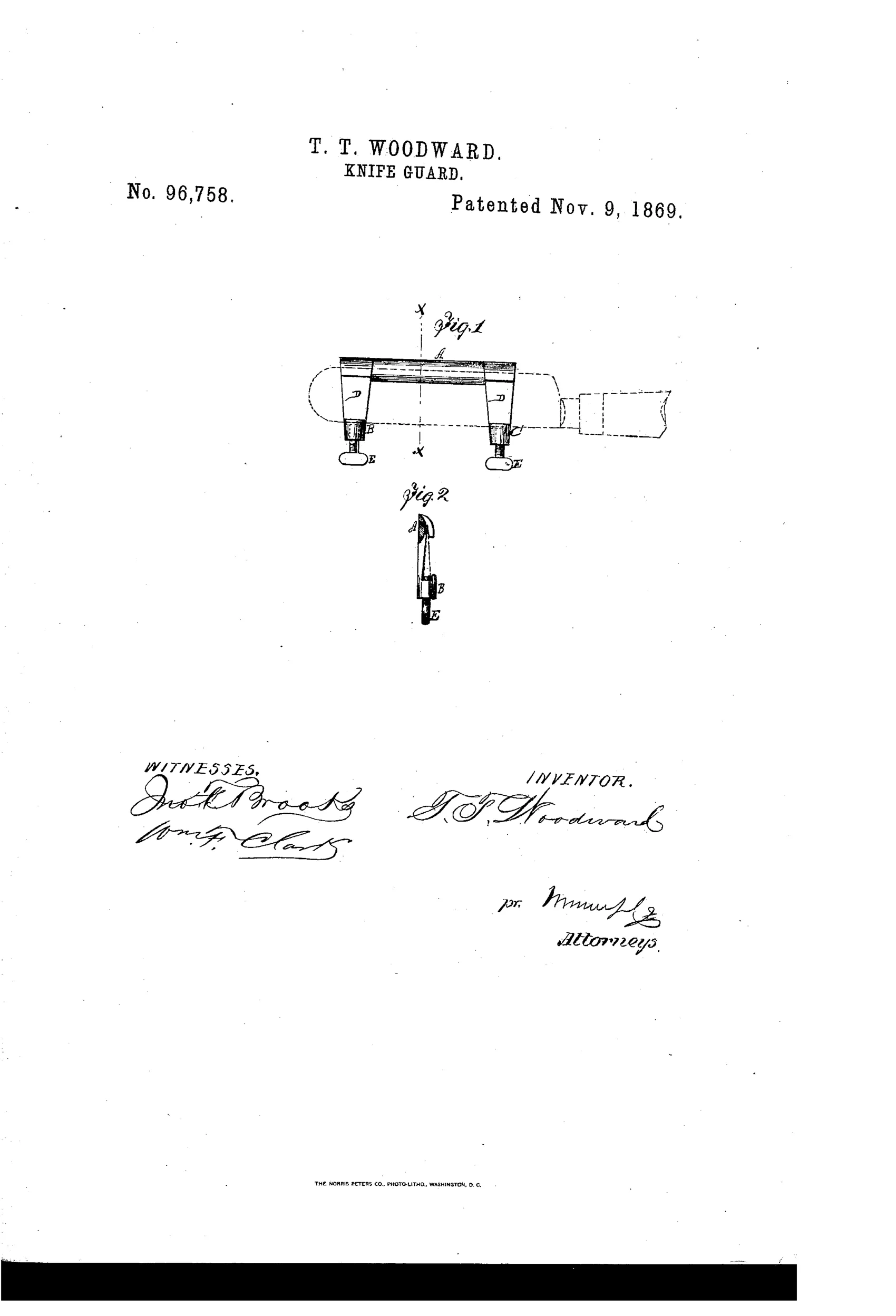
Detachable metal guard for knife blades
❧ How it works
The guard is a square or oblong bar A with arms B and C at each end. Each arm has a grooved recess D that receives both the back and edge of the blade. Thumb-screws E fasten the guard to the blade. A narrow gap between the blade's cutting edge and bar A governs the thickness of the shaving cut, working like the edge and back of a spoke-shave.
❧ What was claimed
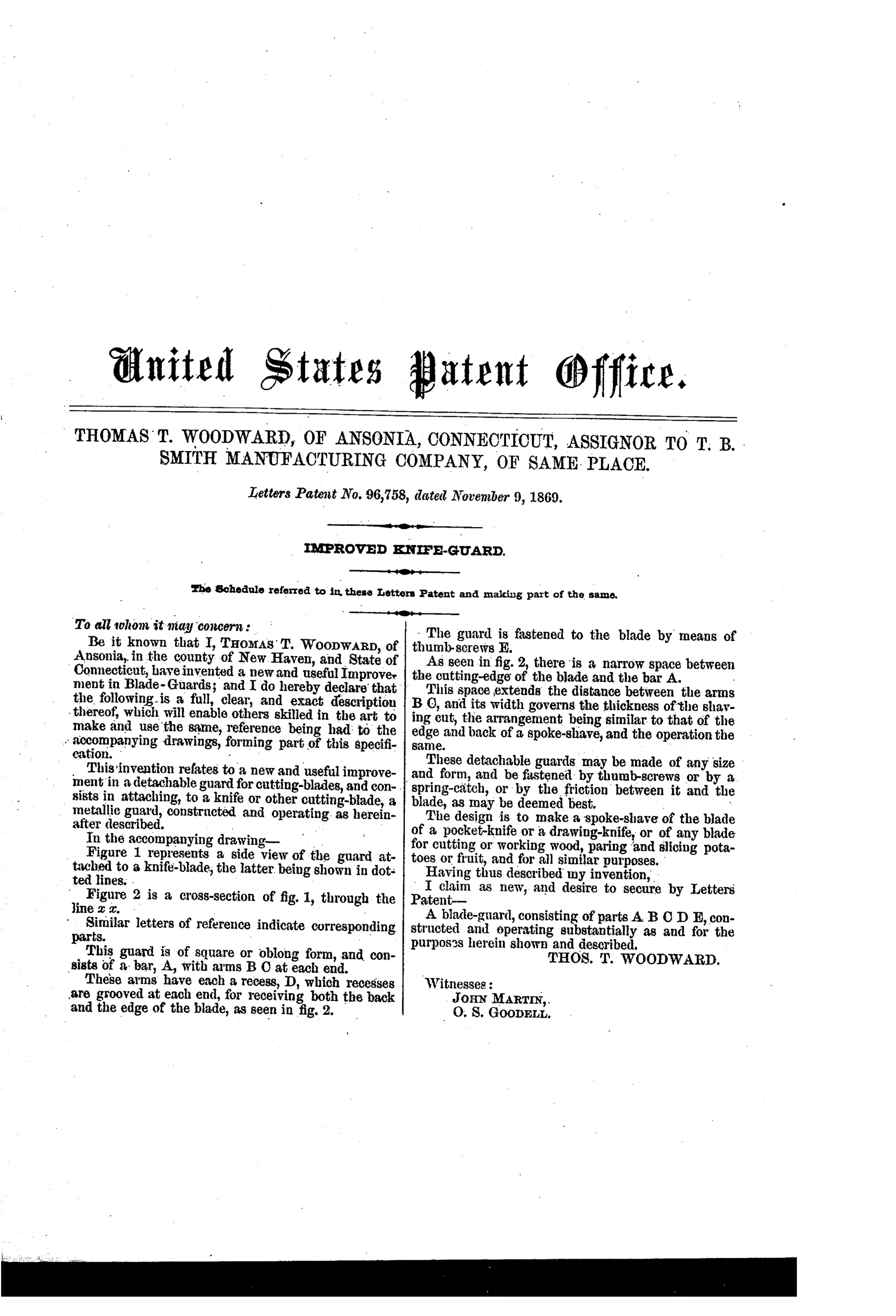
“A blade-guard, consisting of parts A B C D E, constructed and operating substantially as and for the purposes herein shown and described.”
In plain English: The claim covers the specific blade-guard made of parts A, B, C, D, and E, built and used as described.
❧ In the inventor’s words
“The design is to make a spoke-shave of the blade of a pocket-knife or a drawing-knife, or of any blade for cutting or working wood, paring and slicing potatoes or fruit, and for all similar purposes.”— Thomas T. Woodward, from the specification
Fate unknown
The assignment to T. B. Smith Manufacturing suggests commercial intent, but no marked example or catalog listing is documented; a surviving guard would settle it.
This drawing is free.
It is a work of the United States government, published November 9, 1869, and has been in
the public domain since the day it was printed. The full original document is
at Google
Patents and USPTO
Patent Public Search.
❧ Commentary
This is the parer category stripped to its absolute minimum: no gears, no fork, no crank — just a bar that clamps over a knife blade and holds a fixed gap between the cutting edge and the bar. Woodward says it plainly: the goal is to "make a spoke-shave of the blade of a pocket-knife," and the same depth-stop logic that keeps a spoke-shave from digging into an oak spoke keeps a paring from going deeper than the skin. Every lathe-type apple parer relies on exactly this principle at its blade holder; Woodward just detached it from the machine and sold it as a fitting.
The mechanically thoughtful detail is in the cross-section, Fig. 2: the grooved recesses D capture both the back and the edge of the blade, so the guard registers off the whole blade section rather than pinching one face. That means the shaving gap stays true even as the thumbscrews are cinched down, and one guard fits blades of different widths.
Where does it sit in the story? It's the hand-tool road not taken. By 1869 the cast-iron clamp-on machines were winning because they held the apple as well as the blade. A guard that governs only cut depth still leaves all the skill of following the fruit's contour in the user's hand. Cheap, sensible, and probably useful — but it solved the smaller half of the problem.
Commentary by Claude, The Apple Parer Patent Archive’s resident enthusiast