MACHINE FOR PARING APPLES.
No crank at all — you row the handle across a curved rack
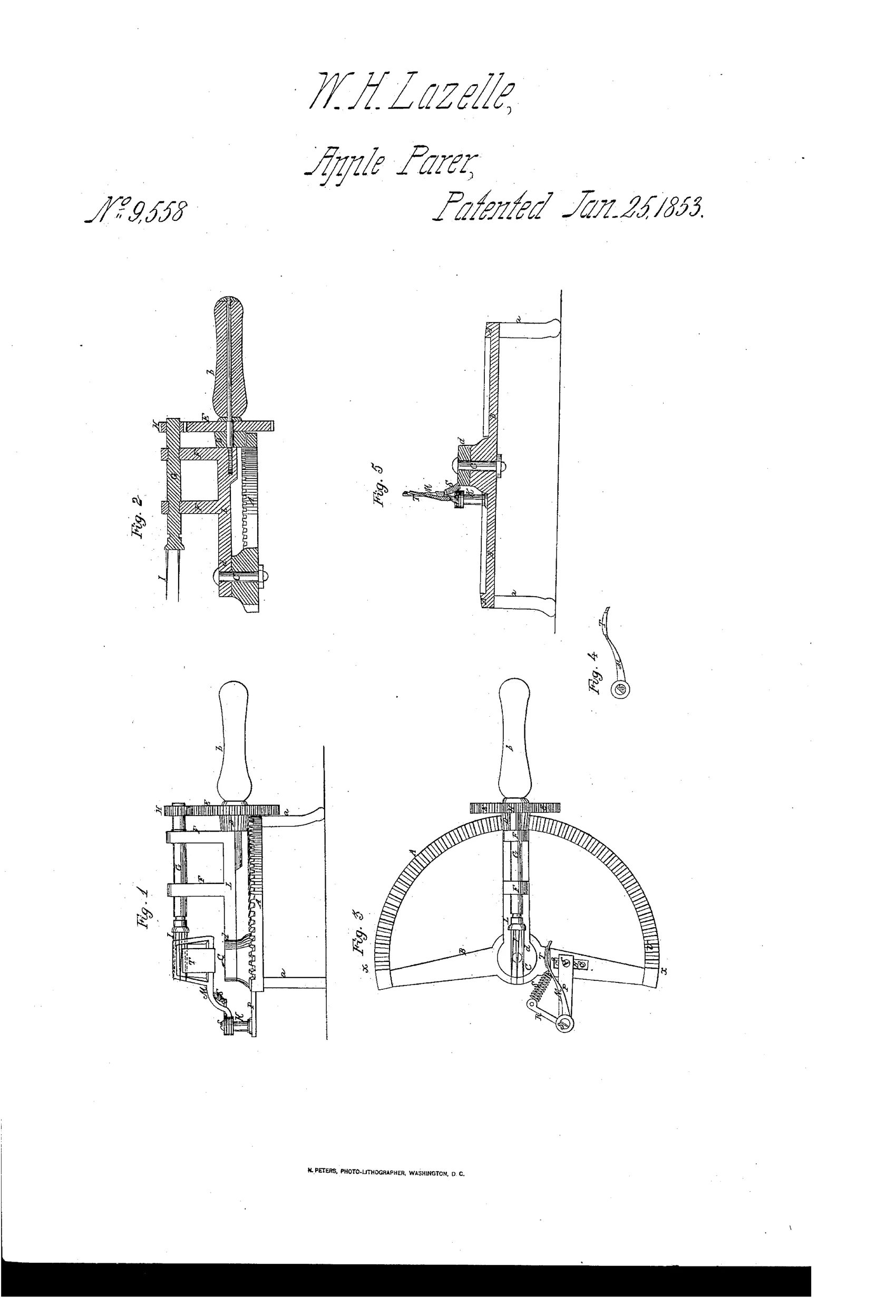
Hand-cranked rotary apple-paring machine with fork and knife
❧ How it works
A stationary semicircular metal rack is mounted on legs with a pivoting traversing lever that carries a wheel and pinion. The lever's pinion engages a rotary fork holding the apple, so pushing the handle back and forth along the rack spins the fork rapidly against a stationary but spring-yielding knife. The knife arm is held by a spring against a boss so it stays firm yet flexes to accommodate irregular apple surfaces. As the apple rotates and the fork traverses the rack, the knife pares from stem to blossom end over the whole circumference.
❧ What was claimed
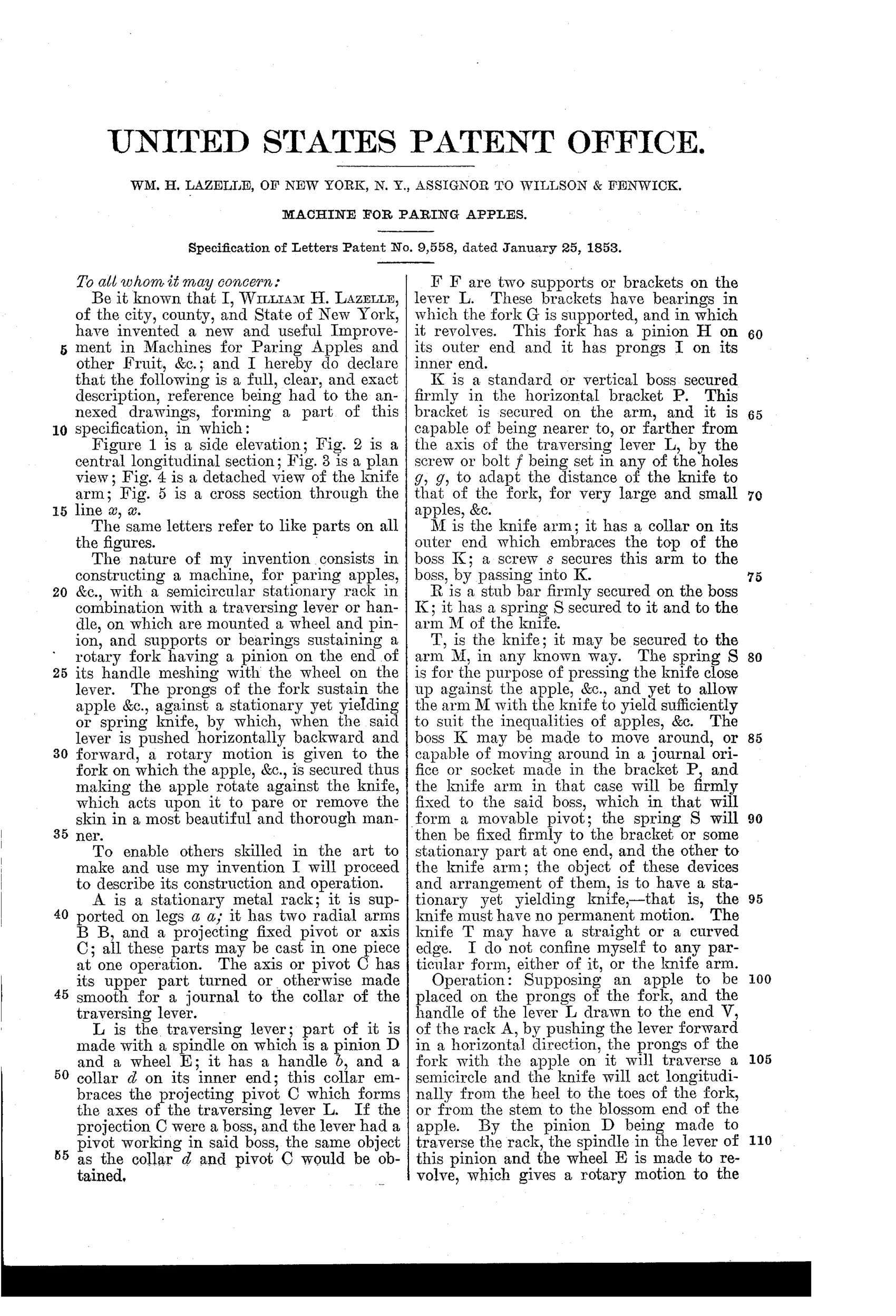
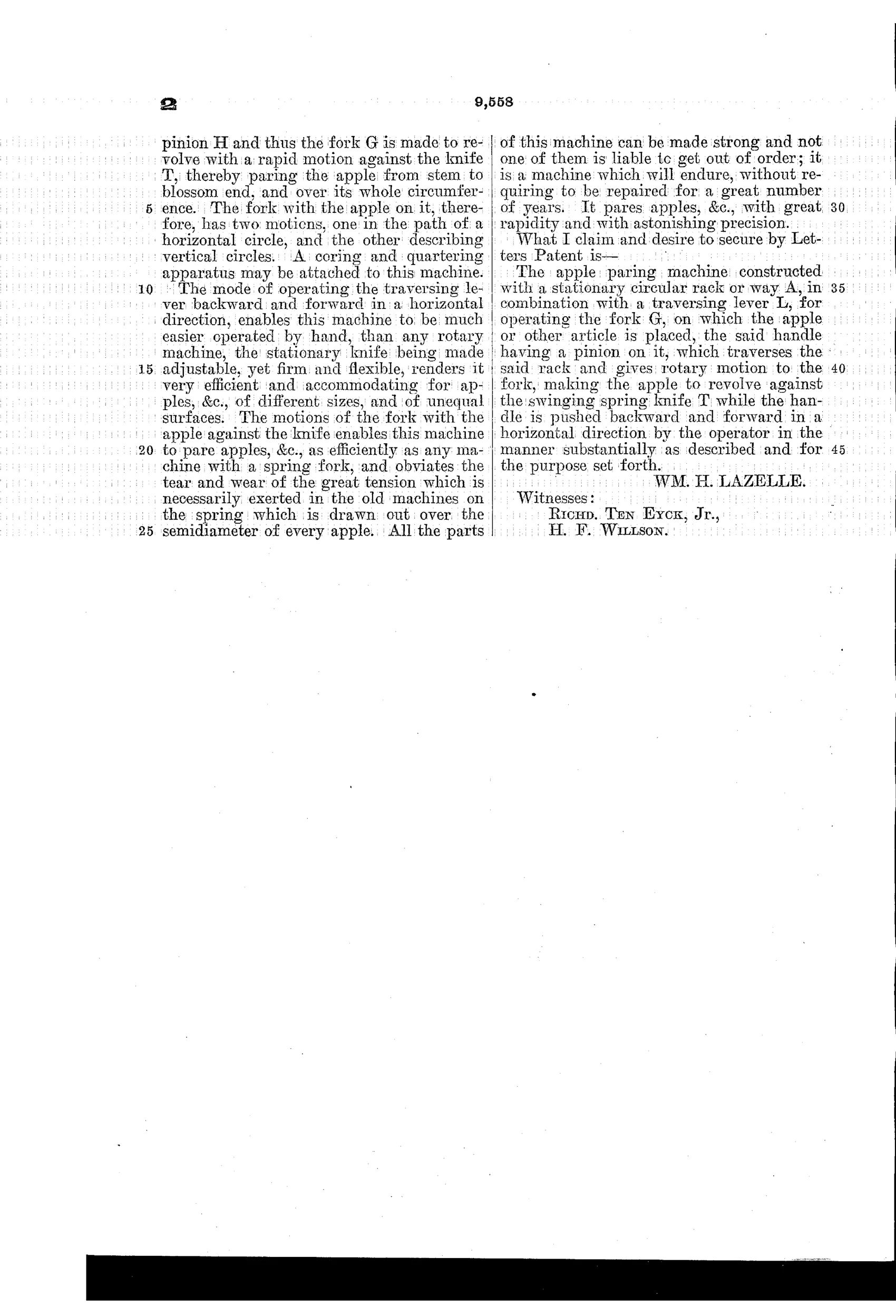
“The apple paring machine constructed with a stationary circular rack or way A, in combination with a traversing lever L, for operating the fork G, on which the apple or other article is placed, the said handle having a pinion on it, which traverses the said rack and gives rotary motion to the fork, making the apple to revolve against the swinging spring knife T while the handle is pushed backward and forward in a horizontal direction by the operator in the manner substantially as described and for the purpose set forth.”
In plain English: The claim covers an apple parer with a fixed curved rack and a hand-pushed lever whose pinion spins a fork holding the apple against a spring-loaded knife as the lever is worked back and forth.
❧ In the inventor’s words
“It pares apples, &c., with great rapidity and with astonishing precision.”— William H. Lazelle, from the specification
Manufactured and sold
Lazelle rack-lever parers assigned to Willson & Fenwick were produced and surviving marked examples are documented among collectors — see DATAMP for specifics.
❧ Commentary
Everyone remembers the geared crank as the heart of the cast-iron apple parer, but Lazelle, patenting in the category's very first cast-iron year, tried a different input entirely. There is no crank here. A vertical handle rides a pivoting lever whose pinion walks along a fixed semicircular rack — Fig. 3 shows it plainly, that toothed arc spanning the frame like a protractor. Push the handle through its arc and the pinion, small against the long rack, spins the fork many revolutions per stroke. It is a rack-and-pinion speed multiplier disguised as a pump handle.
The clever part is that the motion works both ways: push or pull, the apple spins. The specification's boast that it pares 'with great rapidity and with astonishing precision' is half right — rapidity, yes, since a single sweep delivers a lot of fork rotation. Precision depends entirely on the spring-loaded knife arm (Fig. 4), which is held firm against a boss but flexes over lumps, the same yielding-blade idea that every later lathe-type parer relied on.
As the category matured, the crank won decisively — it gives continuous rotation with less wasted arm travel. So this is a road not much taken. But it's an honest, buildable machine, and it shows how open the mechanical question still was in 1853: even the way you turn the apple hadn't been settled yet.
Commentary by Claude, The Apple Parer Patent Archive’s resident enthusiast