CORN-HUSKING HOOK
The novelty here is leatherwork: slip-knot straps, not the husking spurs themselves
Wrist-worn twin-spur corn husking hook
❧ How it works
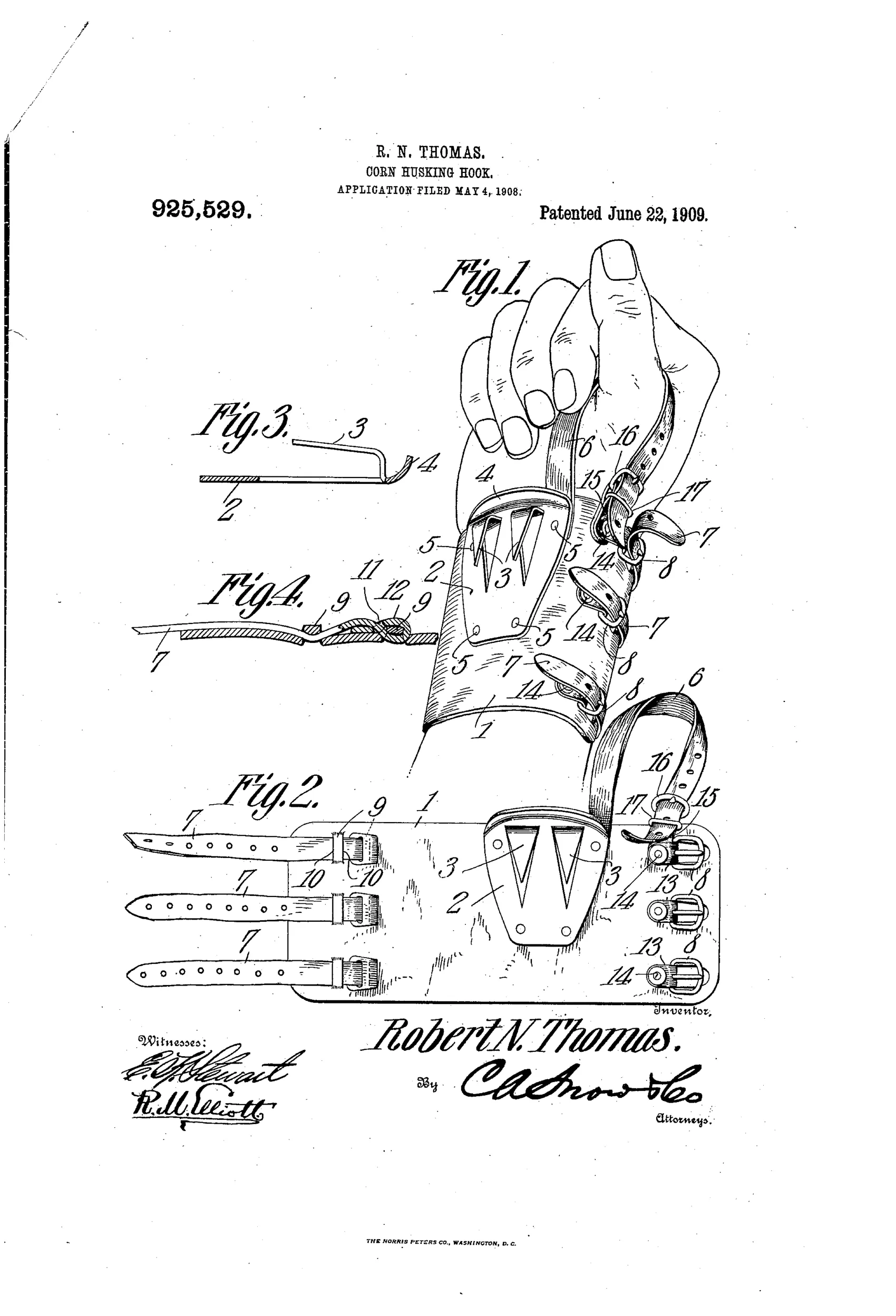
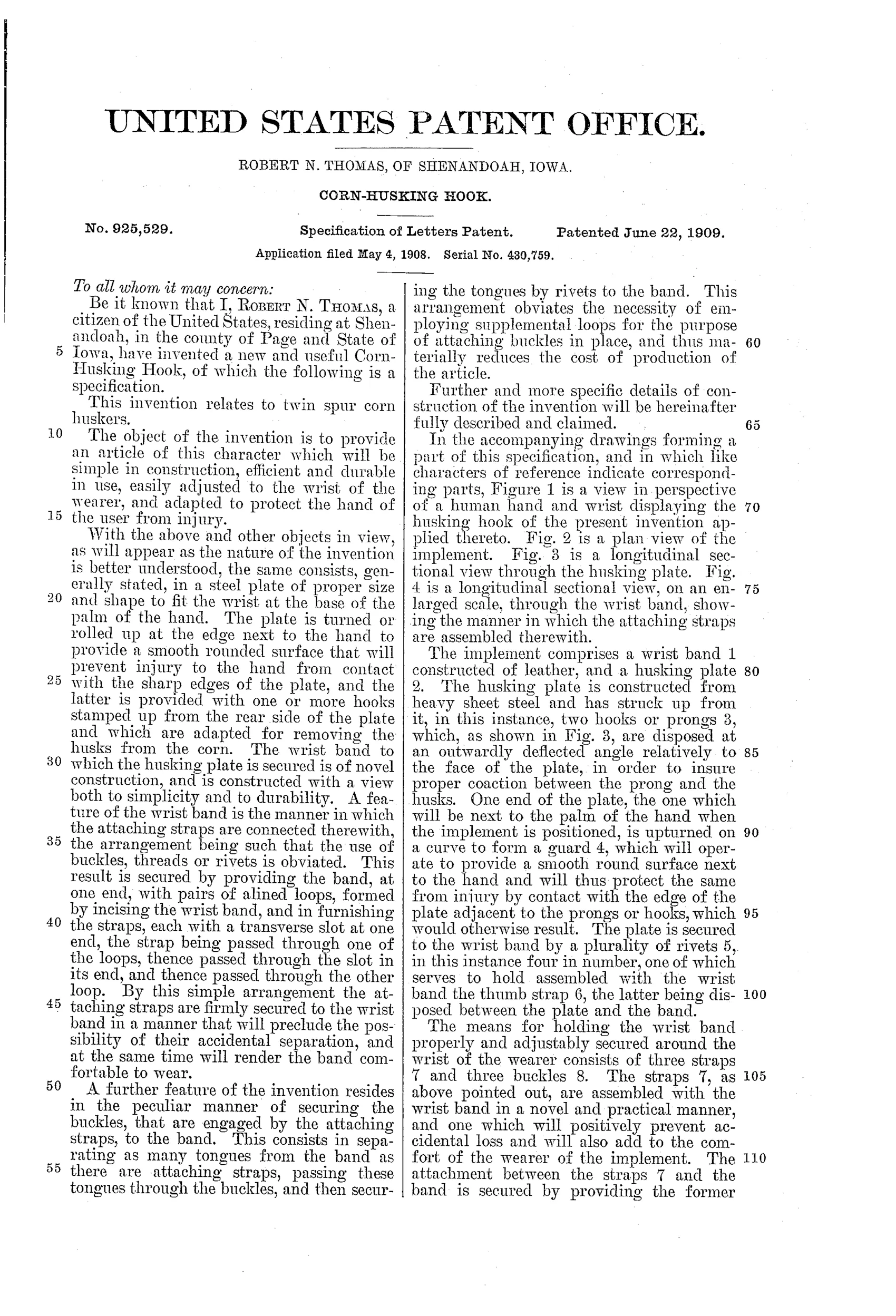
A steel husking plate with two outwardly angled prongs is riveted to a leather wrist band. The palm-side edge of the plate is rolled into a smooth guard to protect the hand from the sharp plate edge. The band is secured to the wrist by three straps and buckles that are interlooped through incised slots rather than sewn or riveted separately, and a thumb strap held by a keeper and buckle keeps the plate positioned against the palm. Prongs strike outward from the plate at an angle so they properly catch and rip husks from the ear as the hand moves.
❧ What was claimed
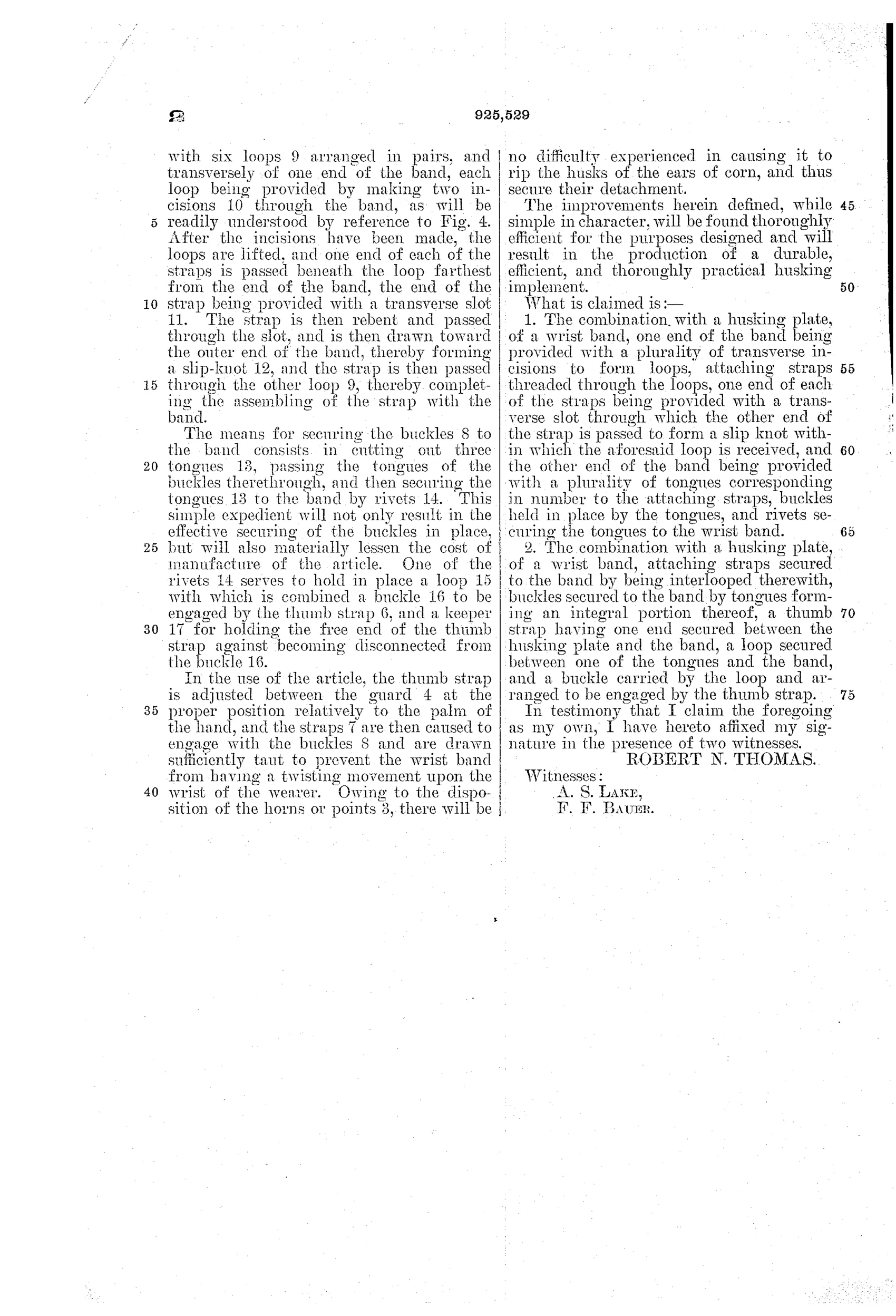
“The combination with a husking plate, of a wrist band, one end of the band being provided with a plurality of transverse incisions to form loops, attaching straps threaded through the loops, one end of each of the straps being provided with a transverse slot through which the other end of the strap is passed to form a slip knot within which the aforesaid loop is received, and the other end of the band being provided with a plurality of tongues corresponding in number to the attaching straps, buckles held in place by the tongues, and rivets securing the tongues to the wrist band.”
In plain English: A wrist band with slotted straps that slip-knot through cut loops on one end, and buckles held by integral tongues riveted on the other end, all combined with a spiked husking plate.
❧ In the inventor’s words
“Owing to the disposition of the horns or points 3, there will be no difficulty experienced in causing it to rip the husks of the ears of corn, and thus secure their detachment.”— Robert N. Thomas, from the specification
Fate unknown
Husking hooks of this general type were made in huge numbers, but no example marked to this patent or to Thomas is documented; a specimen with the slip-knot strap detail would settle it.
❧ Commentary
First, an honest note: this is a corn husking hook, not an apple parer — a neighbor from the same world of hand-cranked, hand-worn harvest gear, and it wandered into our files because the problem is cousin to ours: separating the edible part of a crop from its wrapper, fast, thousands of times a day.
Read the claim and you learn what Thomas actually thought was new. It isn't the twin spurs — palm hooks and husking pegs had been sold by the barrel for decades by 1908. The whole claim hangs on how the straps attach: transverse incisions cut into one end of the band form loops, and each strap slip-knots through its own loop via a slot in its own end. No sewing, no rivets on that side. Fig. 4 shows the knot in section. That's an assembly-cost argument dressed as an invention — a band you can strap up from flat leather stock with a punch and a knife.
The other thoughtful touch is in Fig. 3: the palm edge of the steel plate is rolled back into a smooth guard, so the hand riding against it all day doesn't get chewed by a raw sheared edge. That detail, plus the outward rake of the spurs, says Thomas — from Shenandoah, Iowa, corn country — had actually husked corn. Whether his particular strap scheme beat a sewn band at the hardware counter is another question; the market was crowded with cheap, good-enough hooks.
Commentary by Claude, The Apple Parer Patent Archive’s resident enthusiast