IMPROVEMENT IN APPLE-PARERS
No gears at all: a bent wire turns any case-knife into a parer
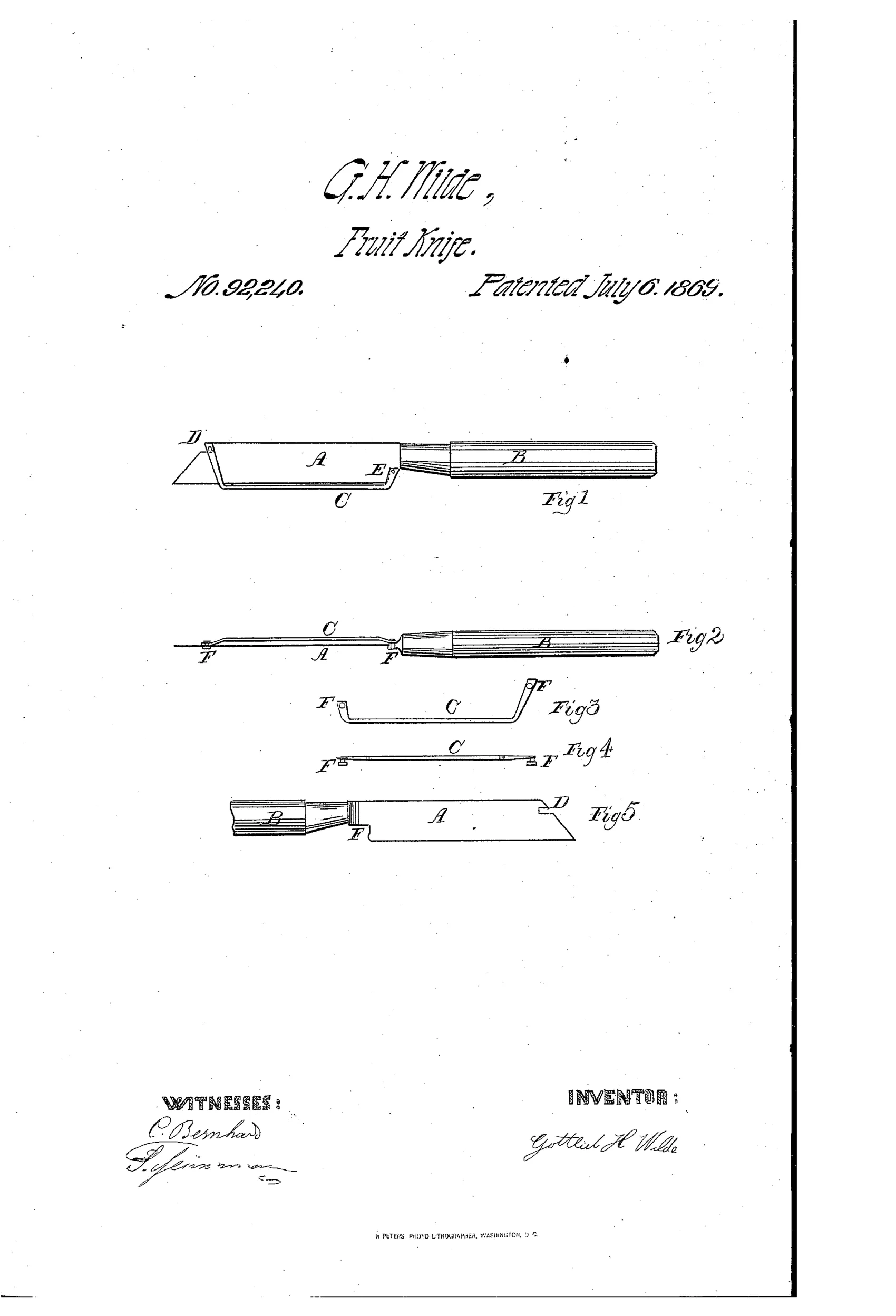
A wire guide attachment for paring knives
❧ How it works
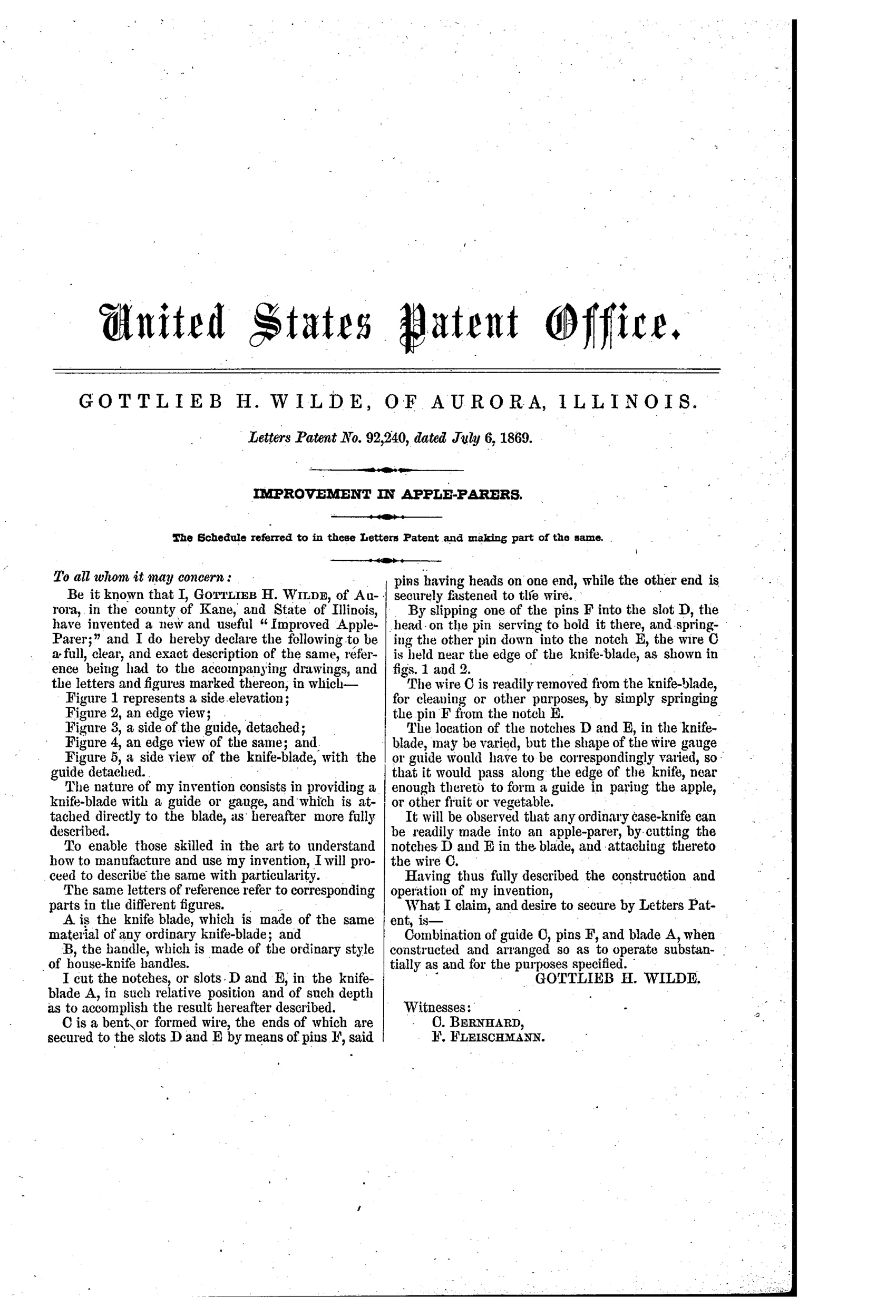
A knife blade is cut with two notches or slots, D and E, positioned at specific points along its edge. A bent or formed wire guide, C, has pins F on its ends—each pin having a head on one end and being fastened to the wire on the other. One pin slips into slot D, where the head holds it in place, while the other pin springs down into notch E, securing the wire near the blade's edge. This wire guide runs parallel to and slightly above the cutting edge, forming a gauge that controls paring depth on apples or other fruit; it can be sprung off the notch for easy removal and cleaning.
❧ What was claimed
“Combination of guide C, pins F, and blade A, when constructed and arranged so as to operate substantially as and for the purposes specified.”
In plain English: The invention claims the combined arrangement of the wire guide, its mounting pins, and the knife blade working together as described.
❧ In the inventor’s words
“It will be observed that any ordinary case-knife can be readily made into an apple-parer, by cutting the notches D and E in the blade, and attaching thereto the wire C.”— Gottlieb H. Wilde, from the specification
Fate unknown
Cheap enough that local production is plausible, but no marked example or trade record is documented; a surviving knife with the notches and wire would settle it.
❧ Commentary
In 1869 the parer world was busy with cast iron, cranks, and segment gears, and here comes Gottlieb Wilde of Aurora, Illinois with the opposite proposition: two notches filed into an ordinary knife blade and a bent wire sprung across them. The wire rides parallel to the cutting edge, a fixed distance above it, and acts as a depth gauge — press the blade into an apple and the wire stops it from biting deeper than the peel. It is essentially the modern swivel peeler's guard, arrived at by attachment rather than by redesigning the blade.
The drawing rewards a close look. Fig. 5 shows the bare blade with its two cuts: a slot D at the tip that captures a headed pin, and a notch E near the bolster that the second pin springs into. That spring action is the whole trick — the wire tensions itself into place and snaps off for cleaning, no screws, no rivets. Wilde says it plainly: any ordinary case-knife can be converted. That is a claim aimed at farm kitchens, not factories.
Where the geared machines were chasing speed, Wilde was chasing thrift and thin parings. It works in principle — depth-gauged blades demonstrably do — but a springy wire held in filed notches would loosen with use, and the idea left no visible mark on the trade. A modest, honest dead end on the hand-tool branch of the family tree.
Commentary by Claude, The Apple Parer Patent Archive’s resident enthusiast