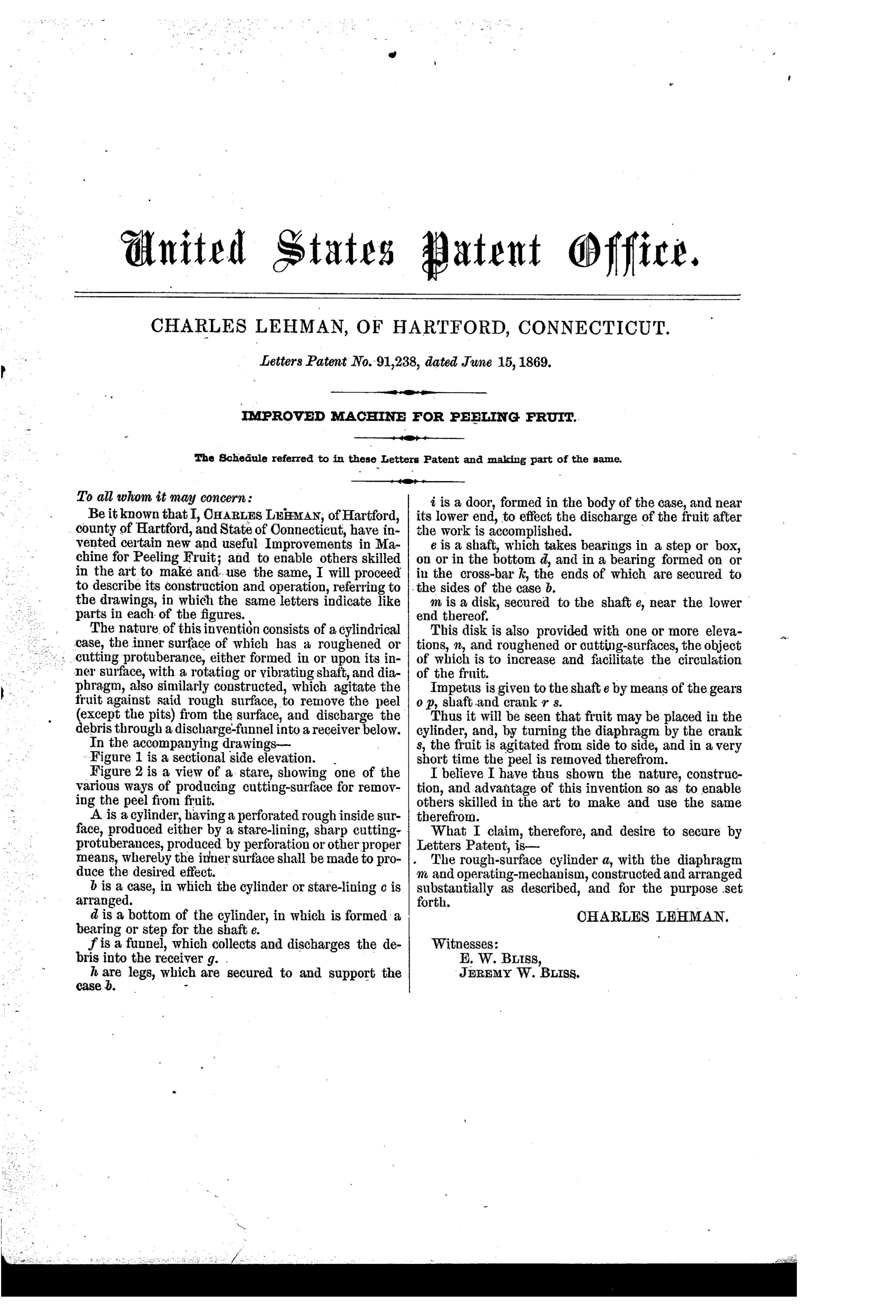
IMPROVED MACHINE FOR PEELING FRUIT.
No blade at all: Lehman peels fruit by tumbling it against sandpaper walls
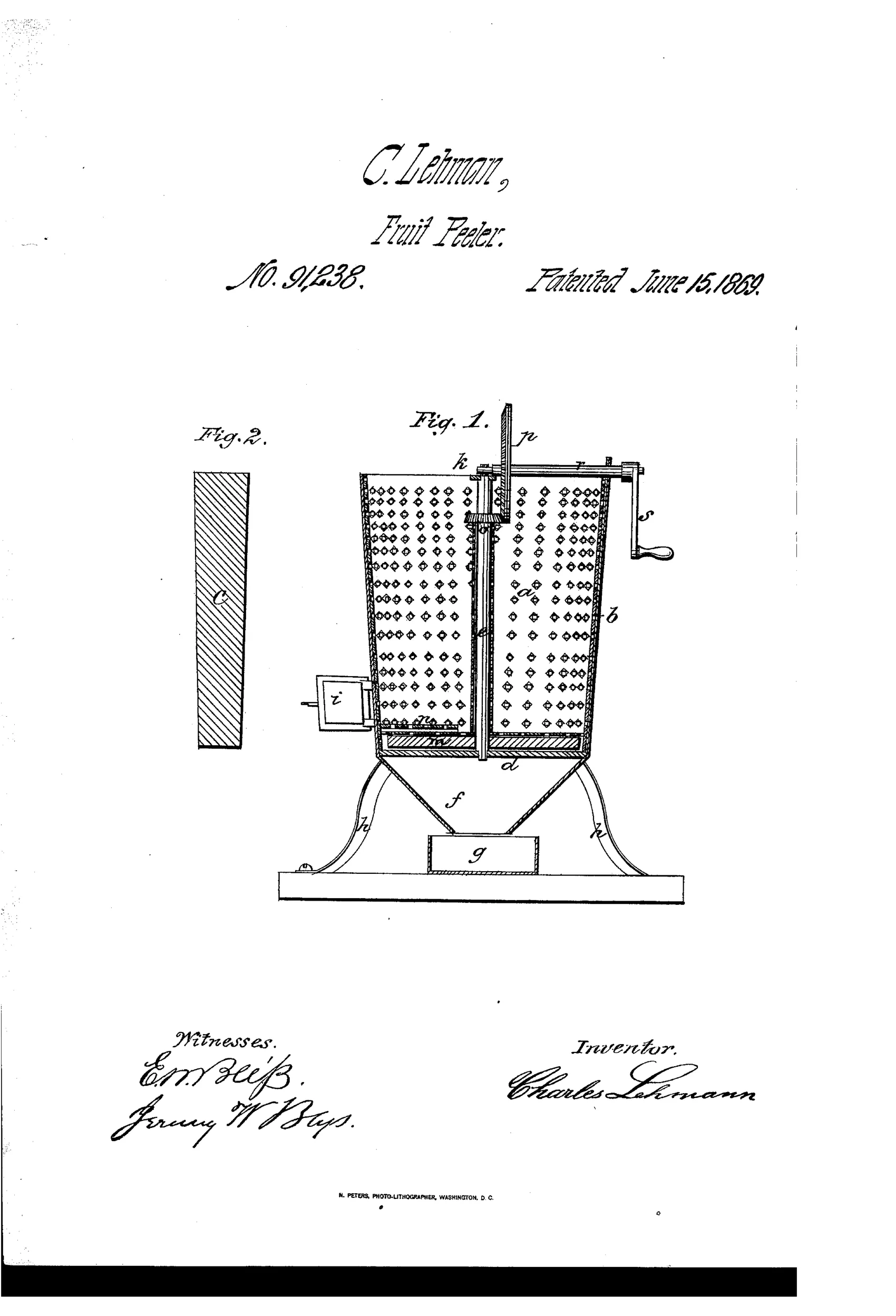
Rotating cylindrical machine for peeling fruit by abrasion.
❧ How it works
A perforated, roughened cylinder holds the fruit while a geared crank turns an internal shaft fitted with a diaphragm disk bearing raised cutting or roughened surfaces. As the diaphragm rotates, it agitates the fruit from side to side against the rough inner wall of the cylinder, abrading away the peel. Peeled debris and skins fall through a discharge funnel into a receiver below, while a side door allows removal of the finished fruit. Impetus is supplied to the shaft by meshing gears connected to a hand-turned crank.
❧ What was claimed
“The rough-surface cylinder a, with the diaphragm m and operating-mechanism, constructed and arranged substantially as described, and for the purpose set forth.”
In plain English: The claim covers a rough-surfaced cylinder combined with a rotating diaphragm and its driving mechanism, used together to peel fruit as described.
❧ In the inventor’s words
“Thus it will be seen that fruit may be placed in the cylinder, and, by turning the diaphragm by the crank s, the fruit is agitated from side to side, and in a very short time the peel is removed therefrom.”— Charles Lehman, from the specification
Fate unknown
No production example or DATAMP listing is known to me; a marked surviving drum machine would settle it, though the abrasion approach makes commercial fruit use doubtful.
❧ Commentary
In 1869 the apple parer field was racing toward gear ingenuity — segment gears, tracking blade arms, push-off cams. Charles Lehman of Hartford walked in a completely different direction: no blade, no fork, no profile-following knife. He simply lines a cylinder with roughened staves (Fig. 2 shows the abrasive lining in detail), drops the fruit in, and cranks a central diaphragm disk that knocks the fruit side to side against the walls until the skin is scoured away. Skins fall through the perforations and the funnel into the box below; a side door lets the peeled fruit out.
It is, in effect, an abrasion peeler — the same principle later commercial potato peelers used with great success, water jets and all. So the idea isn't foolish. The problem is the target. Abrasion suits a hard, forgiving tuber; a ripe apple, pear, or peach tumbled against rough surfaces bruises and pulps long before it peels cleanly, and there is no coring or slicing to follow. Yield of usable flesh would be poor and uneven compared to a lathe-type parer that shaves a thin, consistent ribbon.
As a piece of the category's story, this is a dead-end branch worth seeing precisely because it shows what the blade-and-fork machines were competing against — and why they won for fruit, even as the same drum idea eventually earned its living in the potato line.
Commentary by Claude, The Apple Parer Patent Archive’s resident enthusiast