HUSKING IMPLEMENT.
A corn husking peg with chained wrist straps — a stranger to our parer shelf
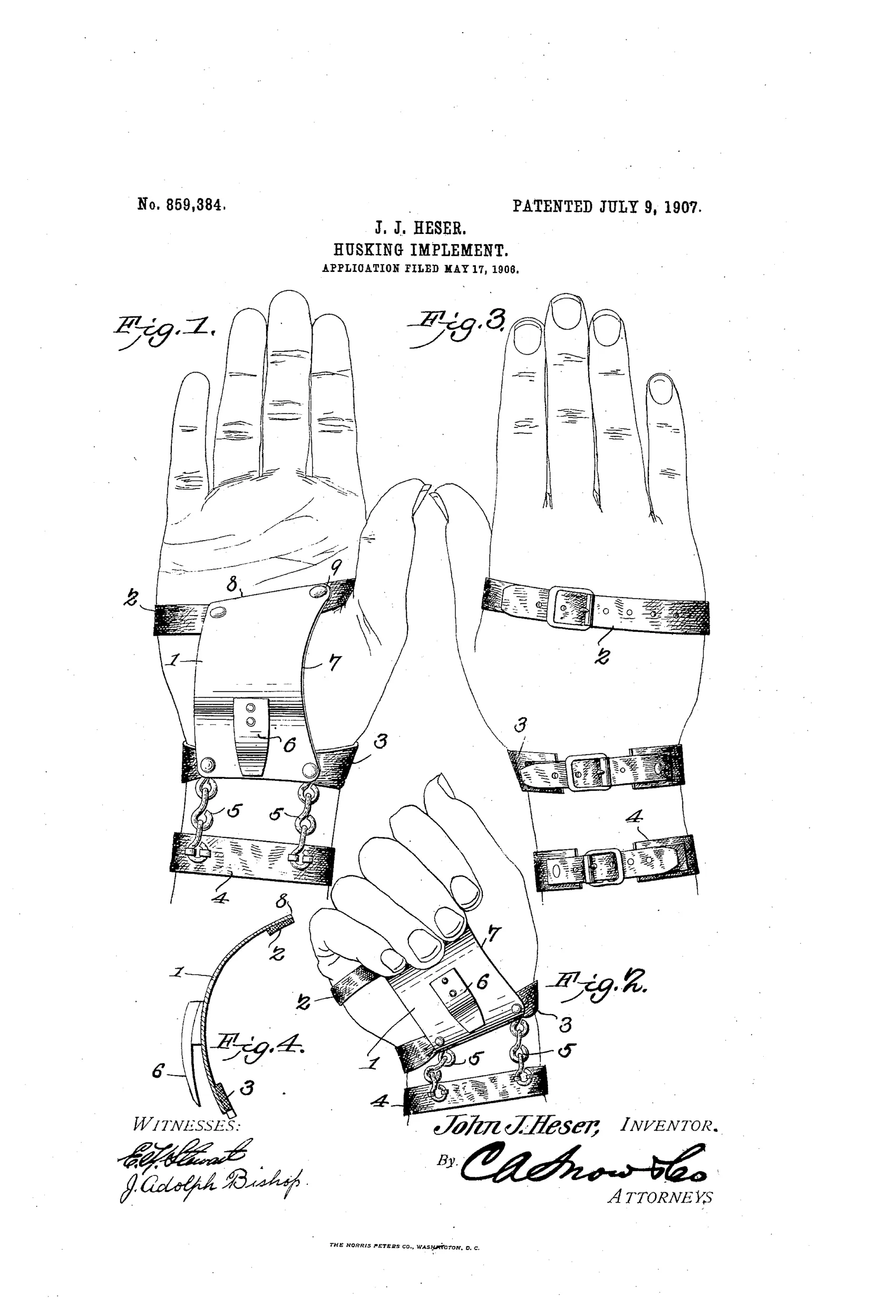
Wrist-mounted corn husking hand implement
❧ How it works
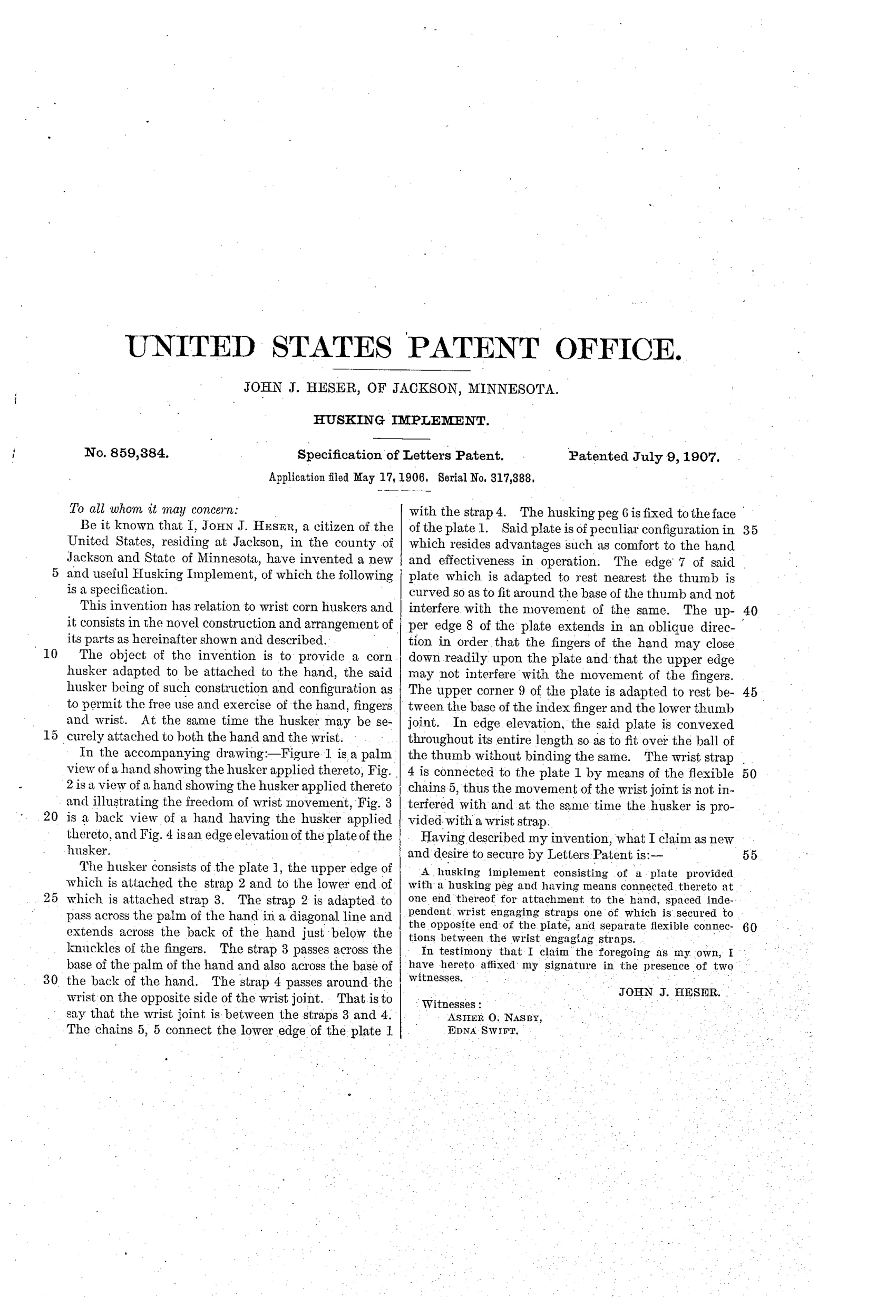
A curved plate with a fixed husking peg is strapped to the back of the hand across the palm and wrist. A diagonal strap crosses the palm and back of the hand below the knuckles, while another strap wraps the base of the hand, and a separate wrist strap encircles the wrist on the opposite side of the joint. Flexible chains connect the lower edge of the plate to the wrist strap, allowing full wrist articulation while keeping the husking peg firmly attached to the hand.
❧ What was claimed
“A husking implement consisting of a plate provided with a husking peg and having means connected thereto at one end thereof for attachment to the hand, spaced independent wrist engaging straps one of which is secured to the opposite end of the plate, and separate flexible connections between the wrist engaging straps.”
In plain English: A hand plate with a husking peg is strapped to the hand at one end and connected by flexible links to a separate wrist strap at the other end.
❧ In the inventor’s words
“Said plate is of peculiar configuration in which resides advantages such as comfort to the hand and effectiveness in operation.”— John J. Heser, from the specification
Fate unknown
Husking pegs were mass-produced in many strap patterns, but no example matching this chained two-strap design is documented to me; a marked specimen would settle it.
❧ Commentary
Full disclosure: this is not an apple parer. It's a corn husking implement, and how it wandered into our collection I leave to the archivists. But since it's here, it deserves a fair reading — and it turns out to be a nice little study in the opposite problem our geared machines solve. The parer inventors of the 1870s wanted to take the hand out of the work entirely; Heser wants to arm the hand and get out of its way.
The mechanical point is the chains. Every husking peg has to be strapped on tight enough not to shift under the ripping stroke, but a rigid strap running from hand plate to wrist locks the wrist joint — miserable over a ten-hour day in the field. Heser splits the anchorage: one strap system grips the hand and palm, an independent strap circles the wrist, and short flexible chains bridge the two. The peg stays put; the wrist flexes freely. Fig. 2 shows exactly this, the hand curled with the chains taking up the angle.
Husking pegs and hooks were made by the millions in this era, in endless strap variations, and most patent versions blur into the commercial crowd. Whether Heser's particular chain-linked layout was ever stamped out in Jackson, Minnesota or anywhere else, I can't say. His claim that the plate's 'peculiar configuration' yields comfort is at least mechanically honest — the comfort really is in the linkage.
Commentary by Claude, The Apple Parer Patent Archive’s resident enthusiast