IMPROVEMENT IN CORN-HUSKER
Not a parer at all: a pivoted thumb-and-finger armor for corn husking
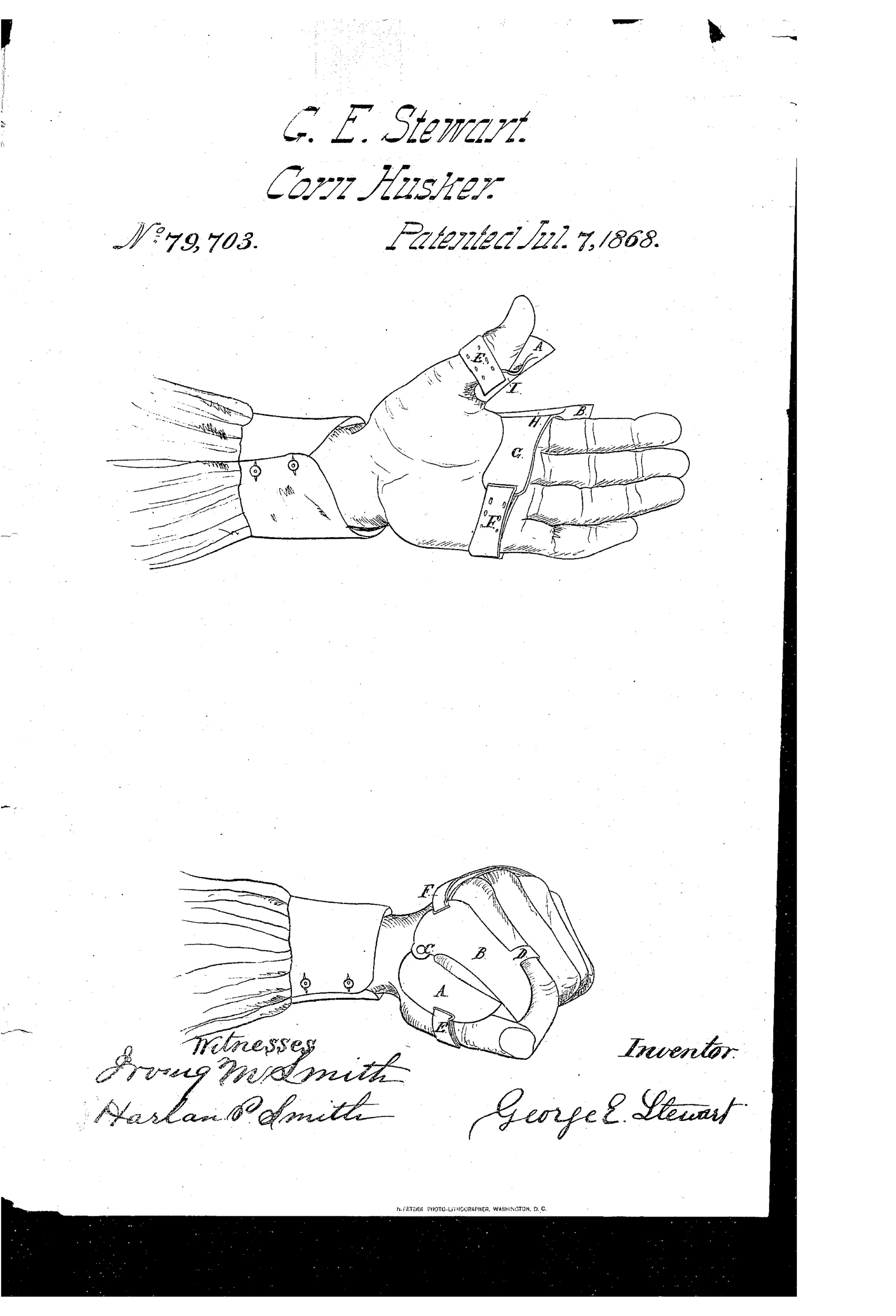
Hand-worn hinged metal corn-husking protector
❧ How it works
Two metal plates with sharpened edges are pivoted together at their inner ends, one plate fastened over the thumb and the other over the index finger. Curved metallic strips and leather straps secure the plates to the hand, allowing them to open and close naturally with the hand's motion. When the wearer grasps the cornstalk and bends the ear over to break it off, the sharp edges of the plates help cut through the stalk while shielding the hand from injury. The device is not rigid but flexes with the fingers, keeping the plates functional during the husking motion.
❧ What was claimed
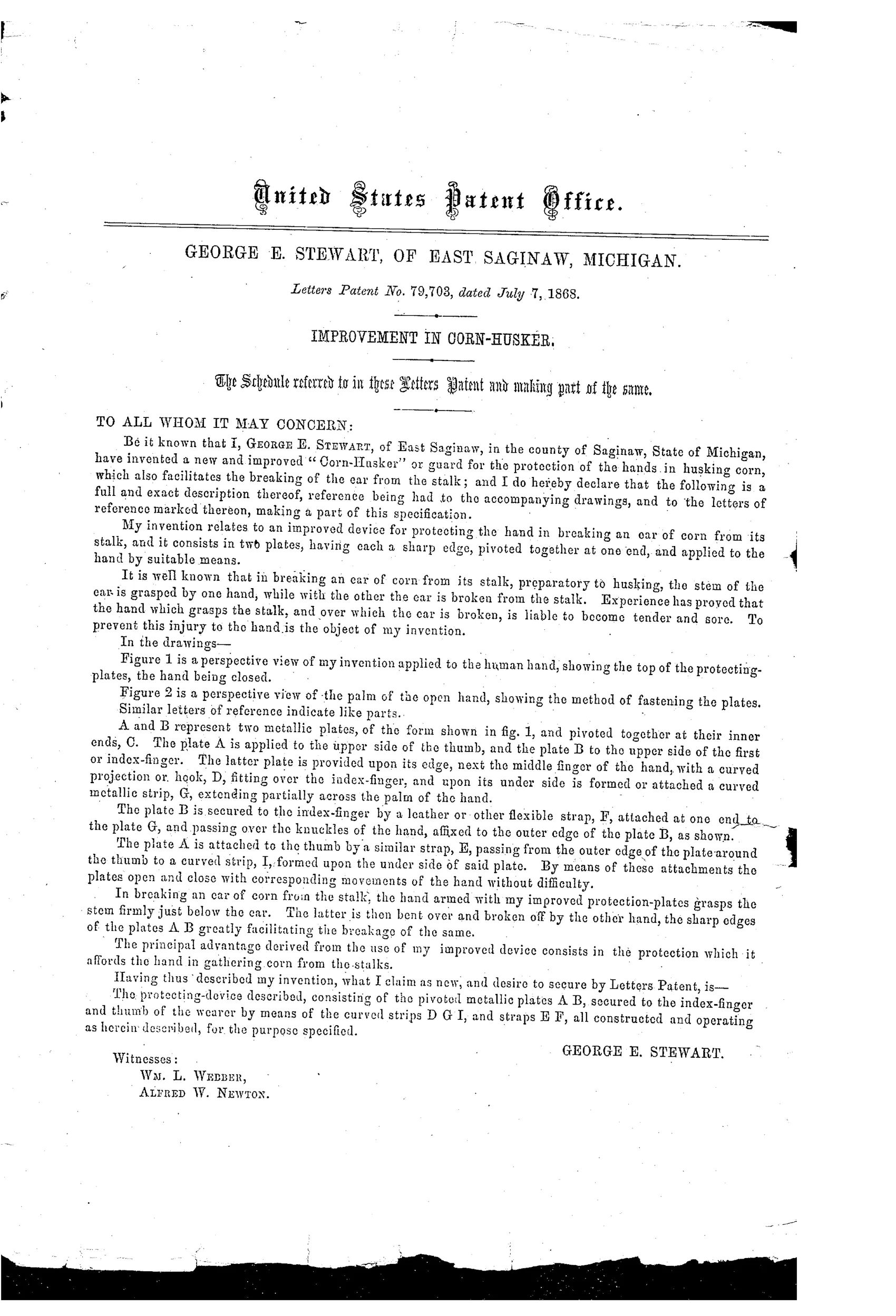
“The protecting-device described, consisting of the pivoted metallic plates A B, secured to the index-finger and thumb of the wearer by means of the curved strips D G I, and straps E F, all constructed and operating as herein described, for the purpose specified.”
In plain English: A hand-worn device with two pivoting sharp-edged metal plates strapped to the thumb and index finger to protect the hand while husking corn.
❧ In the inventor’s words
“Experience has proved that the hand which grasps the stalk, and over which the ear is broken, is liable to become tender and sore.”— George E. Stewart, from the specification
Fate unknown
Husking pegs and hooks were made by the thousands, but no marked example of Stewart's specific pivoted two-plate design is documented; a surviving specimen would settle it.
❧ Commentary
Full disclosure before anything else: this is not an apple parer. Stewart's 1868 patent is a corn husker — a hand-worn protector — and it wandered into our files the way agricultural hand tools sometimes do. But it's worth a look anyway, because it sits at the opposite pole from everything else on this site. While the parer men of the 1860s were bolting cast-iron gear trains to kitchen tables to take the hand out of the work entirely, Stewart went the other way: he armored the hand itself.
The mechanism is honestly clever in its restraint. Two sharpened metal plates, one over the thumb and one over the index finger, pivoted together at their inner ends so they open and close as the hand does. The drawing's two views make the point — Fig. 1 shows the fist closed around an imaginary stalk, Fig. 2 the open palm with the strap work exposed. The pivot is the whole invention: a rigid guard would fight the husking motion, and Stewart's flexes with it while the sharp edges do double duty cutting the stalk as the ear is snapped over.
His best line — that the grasping hand 'is liable to become tender and sore' — is the entire economic case. Husking pegs and hooks became a huge commercial category by century's end; Stewart's pivoted-plate variant is an early, more elaborate answer to the same raw-knuckle problem. Whether this particular geometry ever left the drawing is another question.
Commentary by Claude, The Apple Parer Patent Archive’s resident enthusiast