INSTRUMENT FOR REMOVING EYES FROM FRUIT OR VEGETABLES.
A Yankee push-drill mechanism shrunk down to gouge pineapple eyes
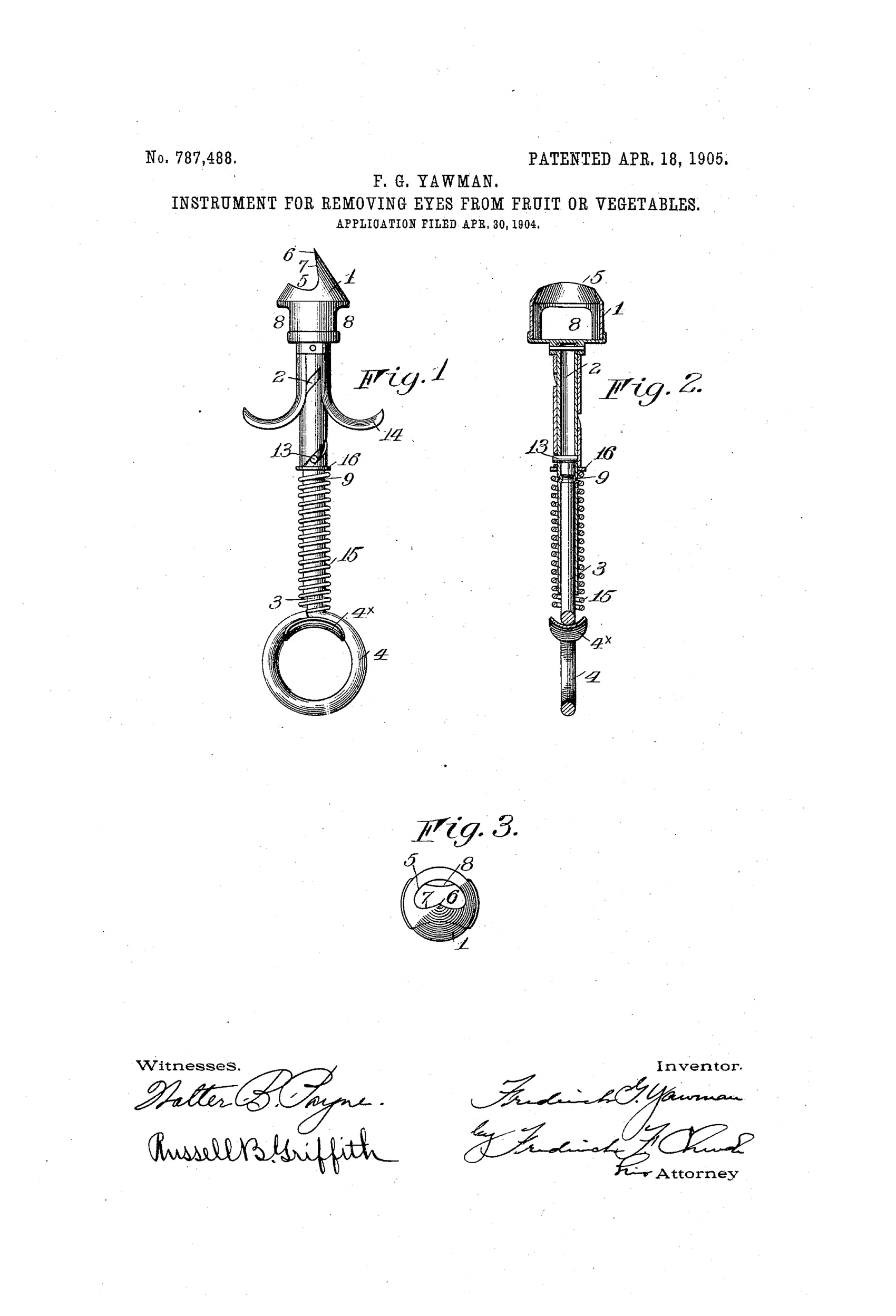

Rotary hand tool for coring fruit eyes
❧ How it works
A conical cutting tool with a sharpened point and diverging cutting edges is mounted on a tubular shaft journaled onto a handle stem. The shaft carries an inwardly-extending rib that rides in a circular groove of the stem, preventing it from being pulled off while allowing it to revolve freely. A longitudinally-movable sleeve fitted with a helical cam-slot engages a pin or head on the shaft, so that pulling the sleeve rearward causes the shaft and cutting tool to rotate. A coiled spring returns the sleeve to its forward position after each cut, and lateral finger-arms on the sleeve let the operator grip and pull it with two fingers while the thumb passes through a loop on the handle.
❧ What was claimed
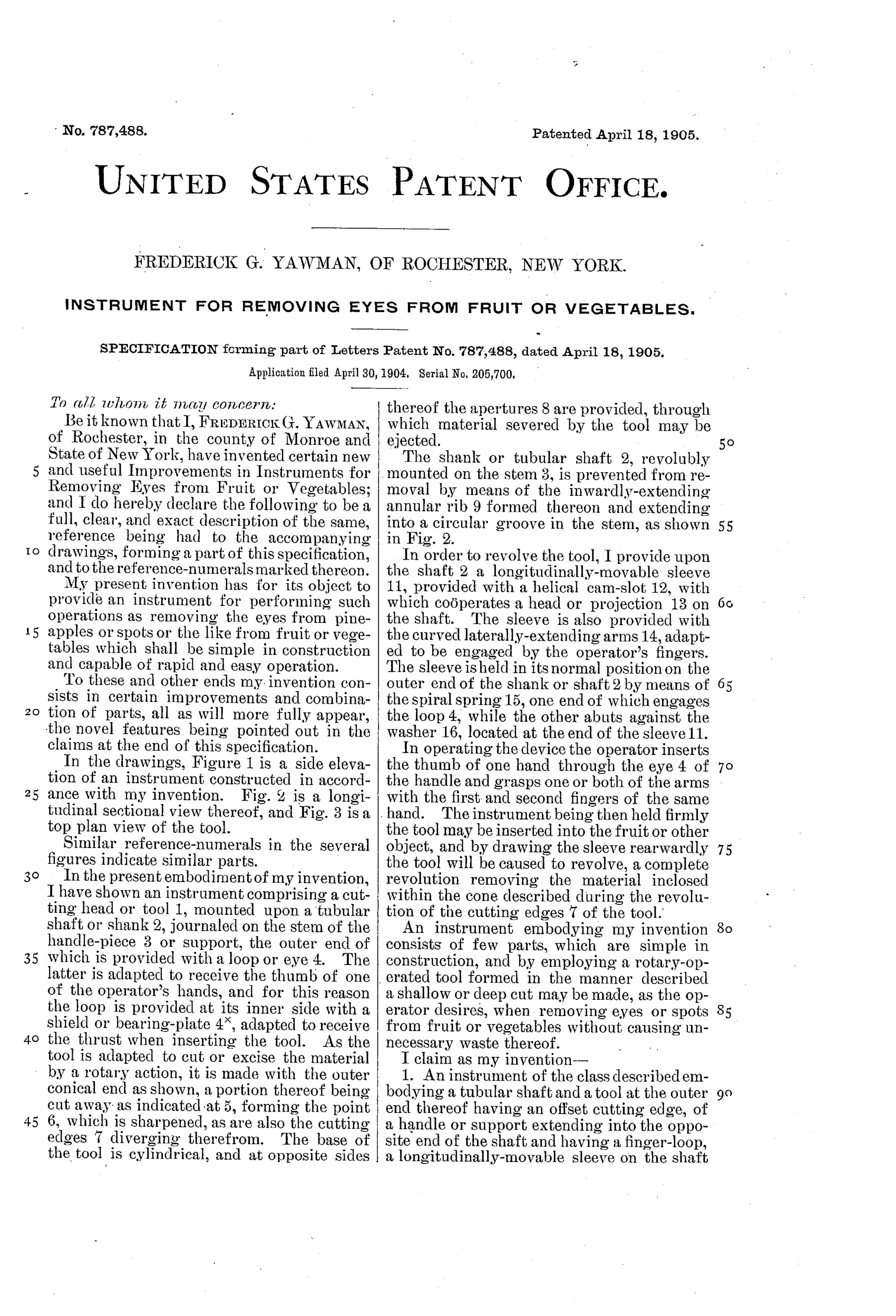
“An instrument of the class described embodying a tubular shaft and a tool at the outer end thereof having an offset cutting edge, of a handle or support extending into the opposite end of the shaft and having a finger-loop, a longitudinally-movable sleeve on the shaft provided with a helical slot and having a finger projection and a pin on the shaft cooperating with the slot.”
In plain English: The tool has a tubular shaft with an angled cutting edge at one end, a handle with a thumb-loop at the other, and a sliding sleeve with a helical slot and finger-grip that rotates the shaft when pulled.
❧ In the inventor’s words
“My present invention has for its object to provide an instrument for performing such operations as removing the eyes from pineapples or spots or the like from fruit or vegetables which shall be simple in construction and capable of rapid and easy operation.”— Frederick G. Yawman, from the specification
Fate unknown
No production example or marked specimen is documented in the usual collector references; a surviving tool with Yawman's patent date would settle it.
❧ Commentary
This is the spiral-ratchet push drill — the "Yankee" screwdriver principle that was very much in the air around 1900 — miniaturized into a kitchen gouge. Pull the finger-armed sleeve back against the spring, the helical slot rides over a pin on the tubular shaft, and the conical cutter spins in the wound. Thumb through the loop, two fingers on the arms, and you can pump out pineapple eyes one squeeze at a time without ever twisting your wrist.
The mechanical thinking is sound. A pineapple has dozens of eyes, and each one needs a small rotary cut; doing that with a plain knife tip is tedious and does it badly. Yawman's Fig. 2 section shows the real care in the design: the rib-and-groove joint that lets the shaft revolve freely on the handle stem without pulling off, and the long return spring that resets the sleeve for the next stroke. Fig. 3 shows the business end — an offset cutting edge on a cone, so the point anchors in the eye while the edge sweeps the cylinder around it.
Where it sits in this category's story: nowhere near the geared clamp-on parers. It belongs to the quieter parallel tradition of small hand corers and eye-removers, and it's one of the more mechanically ambitious of those. Whether cooks wanted a spring-loaded machine for a job a curved paring knife already did is the open question — that's usually what killed this class of tool.
Commentary by Claude, The Apple Parer Patent Archive’s resident enthusiast