IMPROVEMENT IN CORN-HUSKER
An off-category visitor: a two-cent husking hook with push-pull hand rests
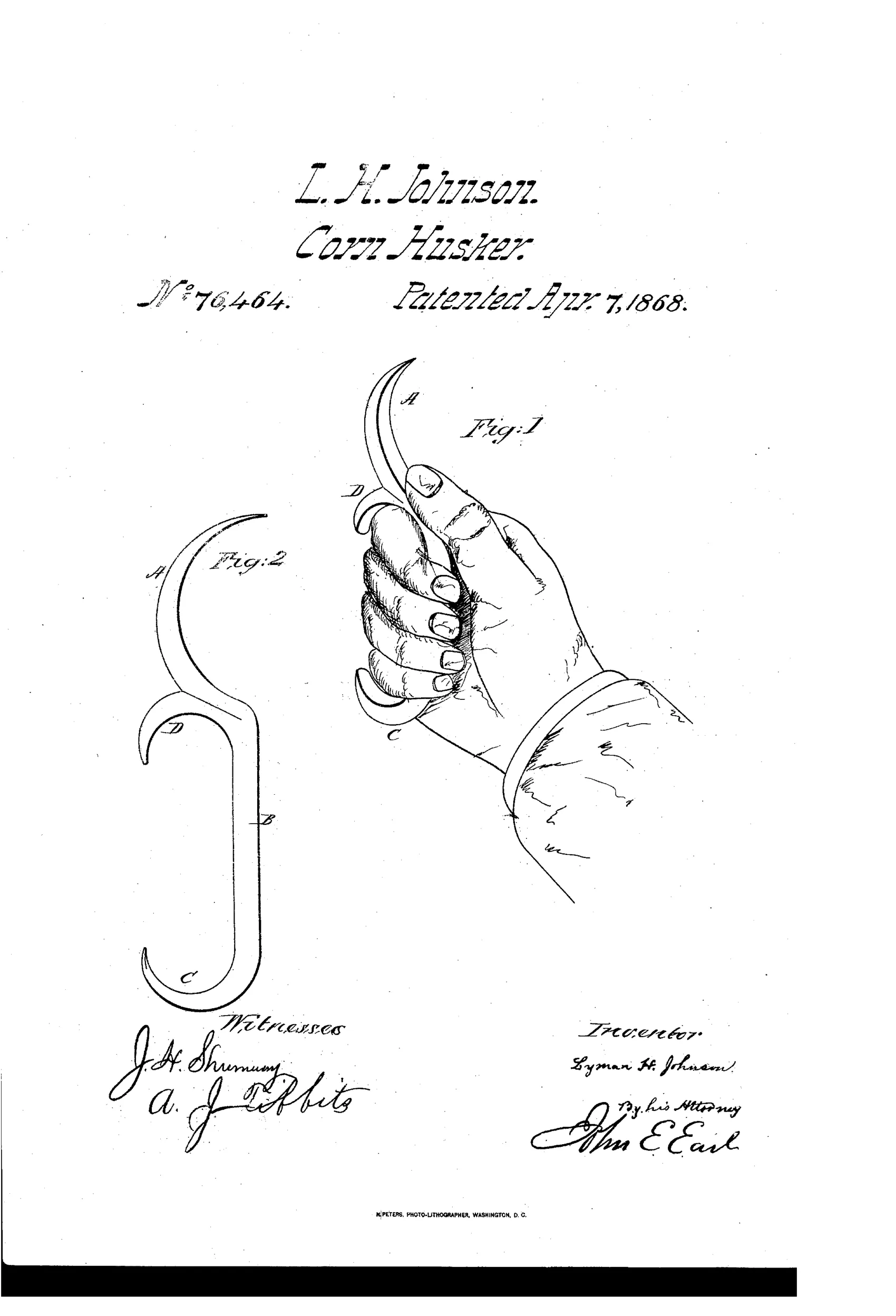
Hand-held hook tool for husking corn
❧ How it works
A pointed hook labeled A is formed upon a handle B. The handle is constructed with a lower rest C and an upper rest D positioned at the base of the hook, allowing the hand to be inserted between them. The upper rest D bears against the hand to help force the hook forward into the husks, while the lower rest C serves as a bearing to pull or draw the hook backward. The hook point is inserted into the husks around an ear of corn held in the other hand, and a pulling motion tears the husks away.
❧ What was claimed
“The herein-described corn-husker, consisting of the hook A upon the handle B, provided with the rests C and D, substantially as herein described, as a new article of manufacture.”
In plain English: A corn-husking hook mounted on a handle with two finger rests, one for pushing and one for pulling, made as a single tool.
❧ In the inventor’s words
“This instrument may be formed from malleable iron, and thus be produced at an expense of but a few cents, and is one of the most convenient instruments for this purpose yet produced.”— Lyman H. Johnson, from the specification
Fate unknown
Husking hooks of this general class were common, but no marked example of Johnson's specific S-form design is documented; a specimen traceable to the Johnsons of Branford would settle it.
❧ Commentary
Full disclosure: this is a corn husker, not an apple parer, so it sits at the edge of our beat. But it wanders in for a reason worth noting — it comes from the same 1860s world of cheap malleable-iron kitchen and farm hardware that produced the parer boom, and it shows the opposite design philosophy. While the parer inventors were piling on gears, Johnson's whole patent is one bent piece of iron and the claim that its shape counts as invention.
The shape is actually thought through. Look at Fig. 2: the tool is an S, with the hook A at top and the handle B curling into a second small hook at the bottom. The two rests, C and D, bracket the hand — D bears against the hand to drive the point forward into the husk, C gives purchase to rip backward. That push-pull geometry is the entire claim, and it is a real ergonomic idea: husking hooks that only pull waste half the stroke. Johnson himself says the thing costs 'but a few cents' to make.
Husking hooks and pegs were made by the millions into the twentieth century, mostly as leather palm hooks. Whether Johnson's specific double-rest iron form ever reached production is another matter — cheap unmarked farm iron is nearly impossible to attribute. A modest, honest, entirely plausible tool; just don't come here expecting it to pare an apple.
Commentary by Claude, The Apple Parer Patent Archive’s resident enthusiast