IMPROVED EDGE-PLANE
A shoemaker's tool, not a parer — but the two-cutter idea earns a look
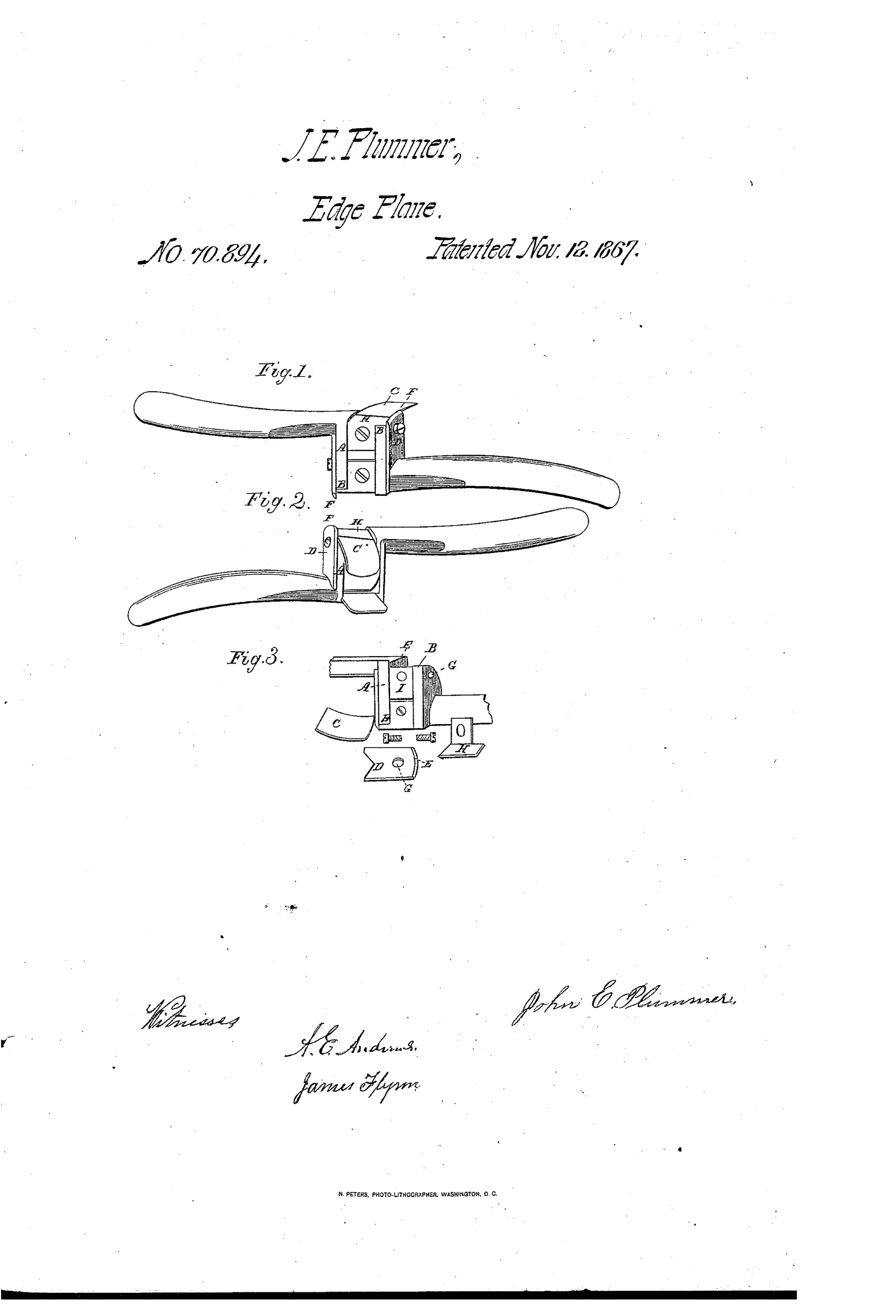
Reversible edge-plane for trimming boot/shoe soles
❧ How it works
A cast stock carries a cutter on each side and one in the center, with a curved handle at each end for two-handed use. One cutter is straight for trimming the convex fore part of the sole, while the opposite cutter is curved to match the concave shank edge under the instep. Guard-plates, grooved to fit projections on the stock, hold the cutters in place and are secured by screws entered into tapped holes before final tightening. A steel throat bent at right angles fits between the guard and the cutter, with its arm seated in a recess and secured by a screw through a slightly elongated hole to allow graduation of the cutter's shaving depth.
❧ What was claimed
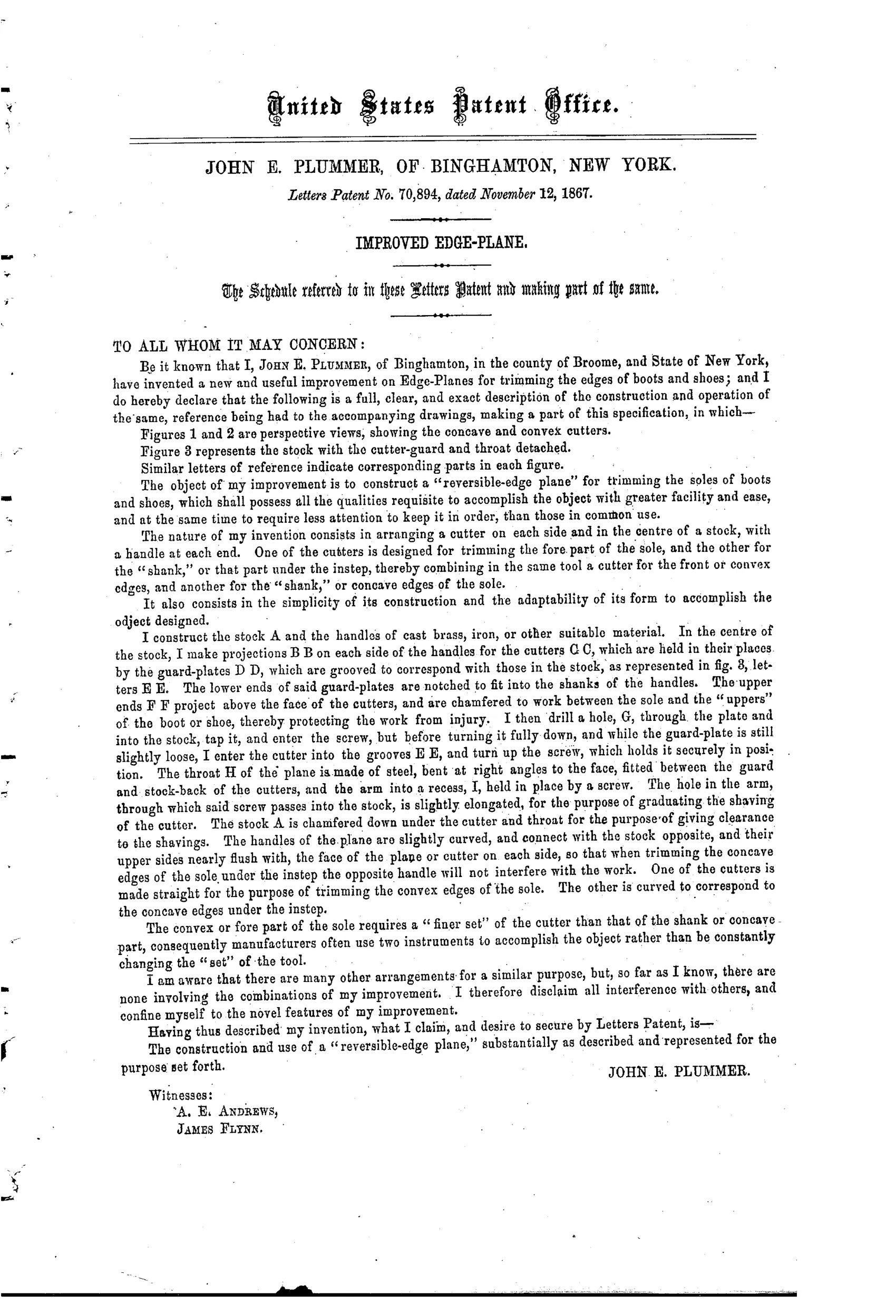
“The construction and use of a "reversible-edge plane," substantially as described and represented for the purpose set forth.”
In plain English: A shoemaker's plane built to reverse between convex and concave sole-trimming cutters, as described.
❧ In the inventor’s words
“The convex or fore part of the sole requires a "finer set" of the cutter than that of the shank or concave part, consequently manufacturers often use two instruments to accomplish the object rather than be constantly changing the "set" of the tool.”— John E. Plummer, from the specification
Fate unknown
Shoe-trade edge tools of this era are poorly documented; a marked surviving example would settle whether Plummer's reversible design was ever produced.
❧ Commentary
Let's be honest up front: this is not an apple parer. Plummer's patent is a cobbler's edge plane for trimming the edges of boot and shoe soles, and it lands on our pages by classification accident rather than kinship. Still, since it's here, it deserves a fair read — and the mechanical thinking will feel familiar to anyone who studies parer blade arms.
The problem Plummer attacks is real. A sole has a convex fore part and a concave shank under the instep, and each wants a different cutter profile and a different depth of cut — a 'finer set' on the convex run, as he puts it. Shoemakers of the day simply kept two tools on the bench. Plummer's answer is one double-ended stock with a curved handle at each end: a straight cutter on one side, a curved one on the other, so you flip the tool instead of resetting it. The elongated screw hole in the bent steel throat is the quietly clever bit — it lets you graduate shaving depth once and leave it, which is the whole point of avoiding constant readjustment.
Would it work? Probably, though double-ended hand tools always fight the awkwardness of the idle end. As a 1867 entry it sits in the same current as our parers: replace two operations, or two tools, with one cast-iron gadget.
Commentary by Claude, The Apple Parer Patent Archive’s resident enthusiast