IMPROVEMENT IN CORN-HUSKER
A clawed glove for corn husking wanders into our apple-parer parlor
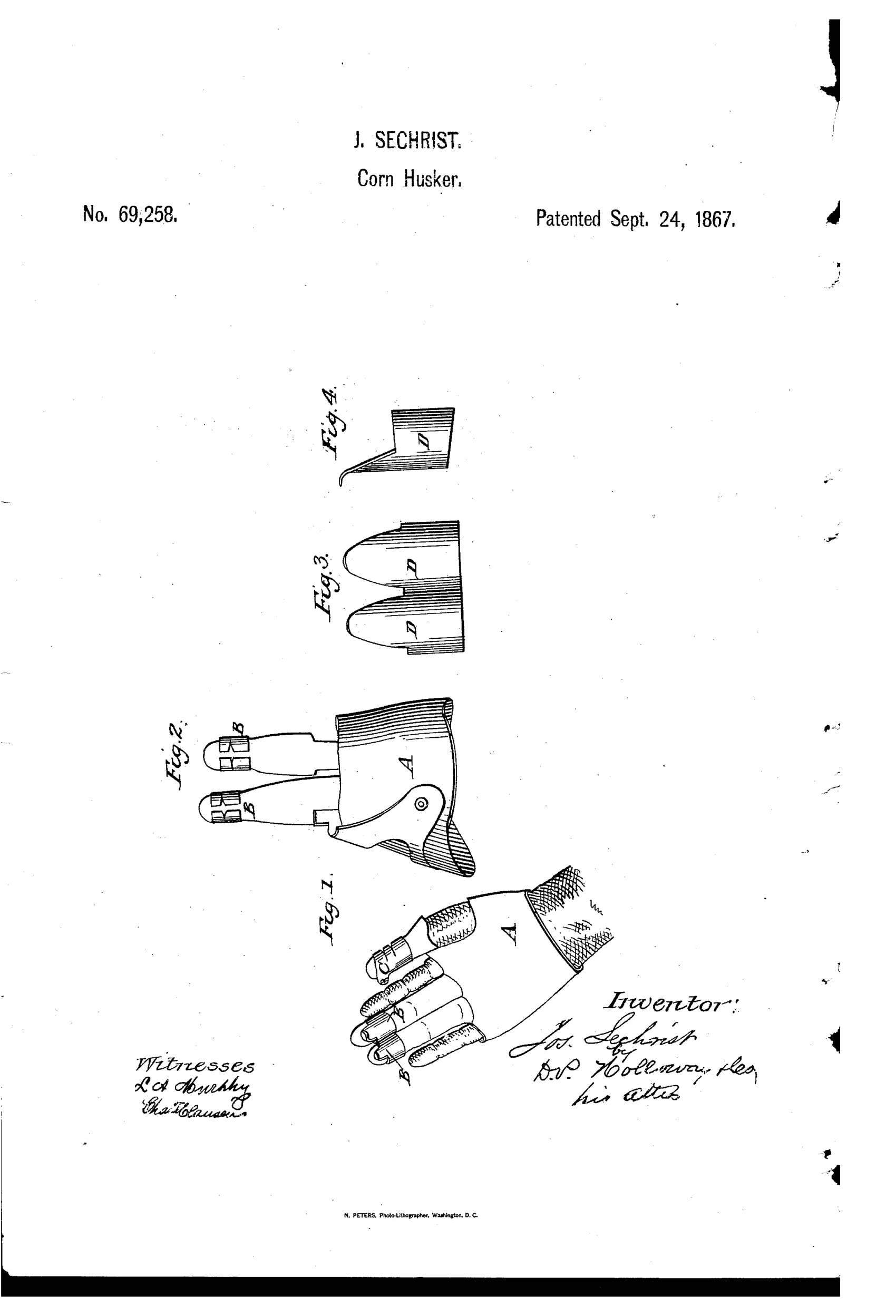
Metal-clawed leather glove for husking corn
❧ How it works
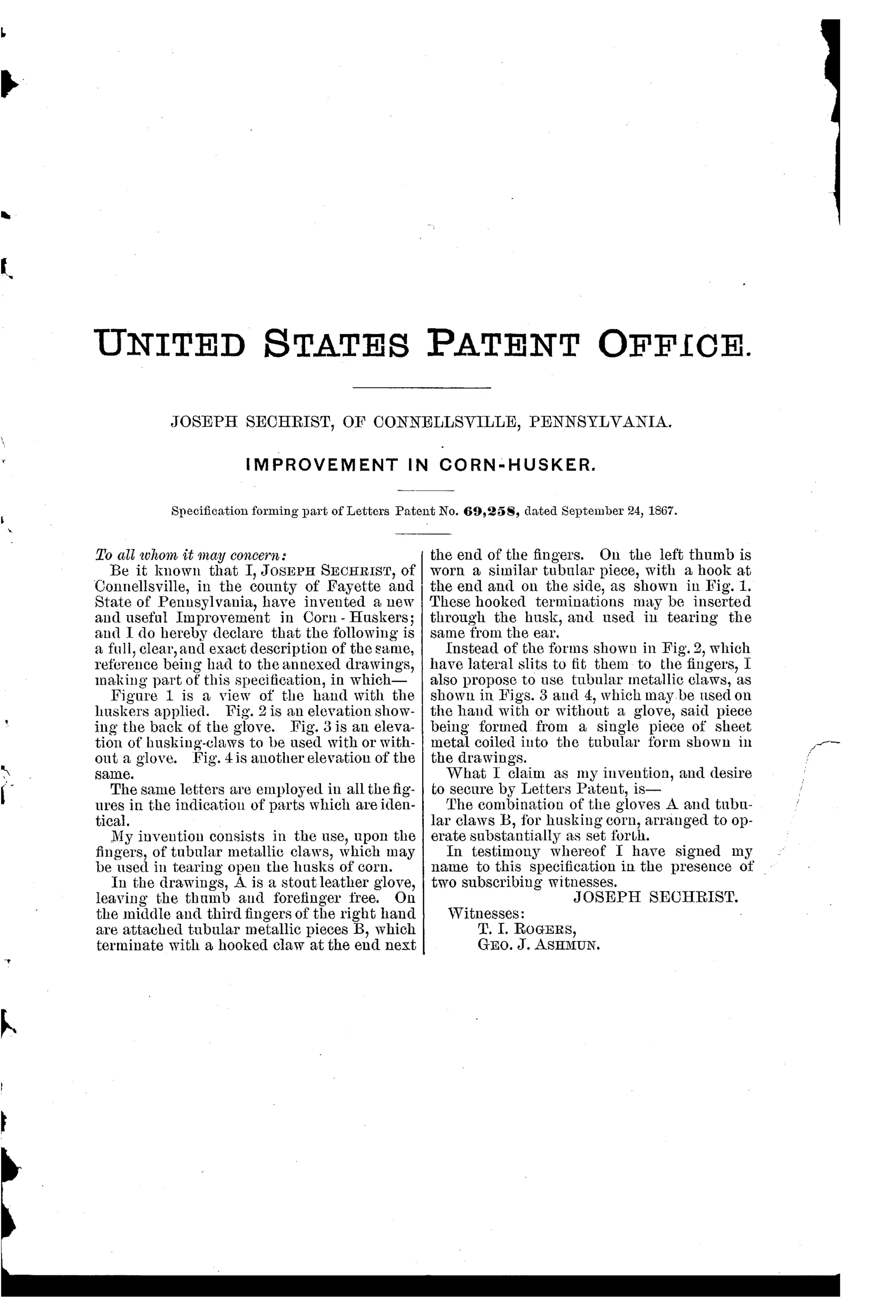
A stout leather glove leaves the thumb and forefinger free while tubular metallic claws are fitted to the middle and third fingers. Each claw terminates in a hooked point that can be inserted through the husk to tear it from the ear. A similar hooked tubular piece is worn on the thumb for the same purpose. The claws may alternatively be made as separate lateral-slit pieces to strap onto the fingers with or without a glove, formed from a single sheet of coiled metal.
❧ What was claimed
“The combination of the gloves A and tubular claws B, for husking corn, arranged to operate substantially as set forth.”
In plain English: The invention claims a leather glove fitted with tubular metal claws on the fingers to husk corn.
❧ In the inventor’s words
“These hooked terminations may be inserted through the husk, and used in tearing the same from the ear.”— Joseph Sechrist, from the specification
Fate unknown
Husking hooks of this general type were later mass-produced, but no example marked to Sechrist or this patent is documented; a marked specimen would settle it.
❧ Commentary
First, honesty: this is not an apple parer. Sechrist's patent is a corn husker — a leather glove with tubular metal claws on the middle and third fingers, plus a hooked thimble for the thumb. It lands on this site as a neighbor, not a member, but it's worth the detour because it shows the other answer to the same 1860s question our category asks: do you build a machine to do the hand's work, or do you armor the hand itself?
The mechanics are simple and sound. Each claw is a tube slipped over the finger, ending in a hooked point that punches through the husk so a pull strips it from the ear. The clever detail is in Figs. 3 and 4: the claws can be made as separate slit tubes coiled from a single sheet of metal, strapped on with or without the glove. That's a cheap, one-piece manufacturing path — no casting, no gearing, just tinner's work.
Husking pegs and hooks became a huge genre of farm hardware in the decades after this, and the strap-on hook Sechrist sketches is recognizably an ancestor of the palm hooks that flooded catalogs by 1900. Whether his version was ever made under this patent is another matter. Where an apple parer of 1867 needed a foundry, this needed a harness maker and a tinsmith — which is exactly why the hand-armor approach won in corn while machinery won in apples.
Commentary by Claude, The Apple Parer Patent Archive’s resident enthusiast