CORN-HUSKER.
A corn husking hook wanders into the parer files — and it's not bad
A hand-worn glove-plate corn husking peg device
❧ How it works
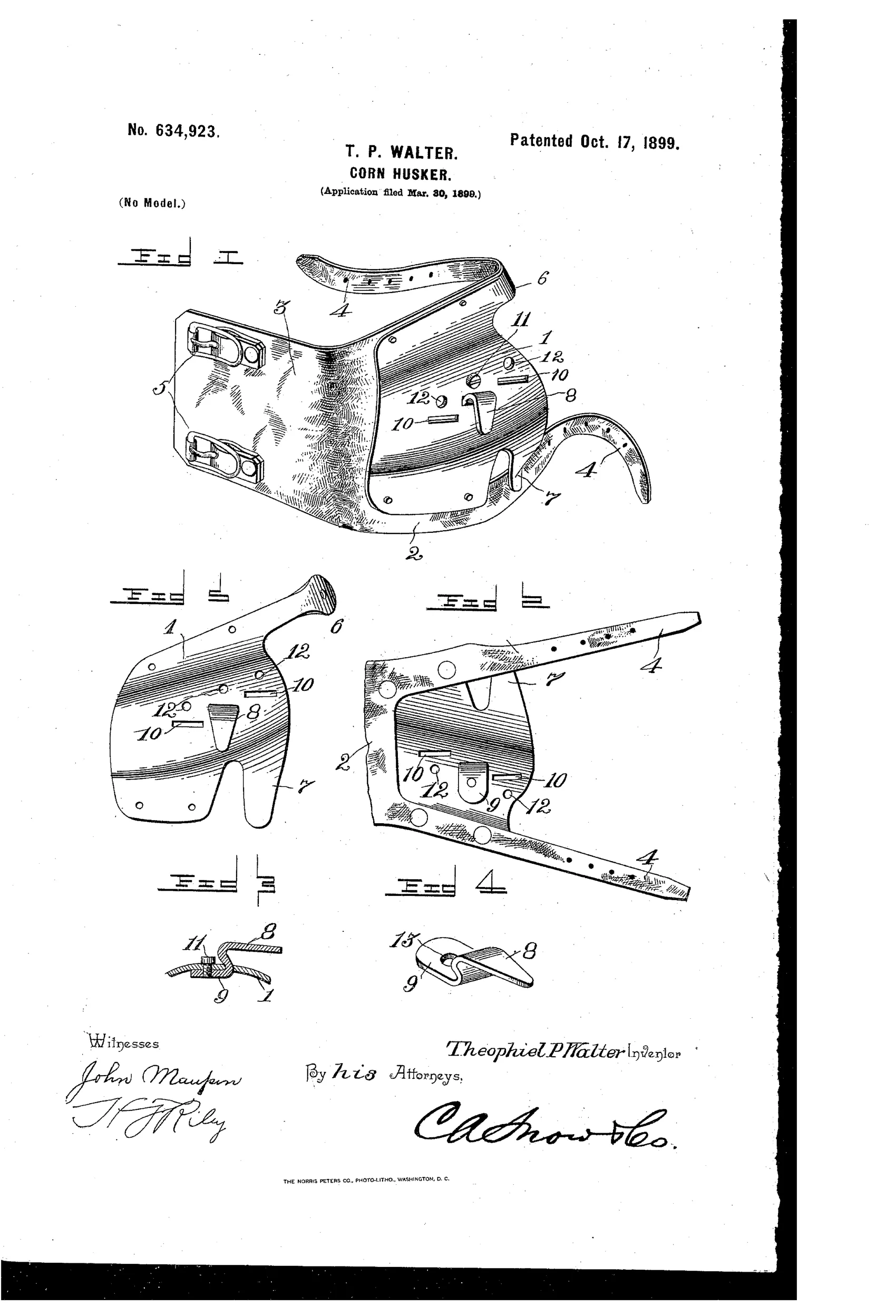
A curved metal plate or shield conforms to the hand and wrist, worn via a transverse strap with buckles that fasten around the palm. A hook with an inwardly-extending bill is mounted on an arm that slides into a transverse series of slots on the plate, allowing it to be adjusted to different positions to suit the operator's hand. The hook's arm is secured to the inner face of the plate via a screw passing through one of several perforations into a threaded opening in the arm, letting the hook be quickly repositioned or replaced when worn. The tongue portion of the plate is free to bend, letting the shield conform to the hand and distribute the force of husking blows over a larger surface.
❧ What was claimed
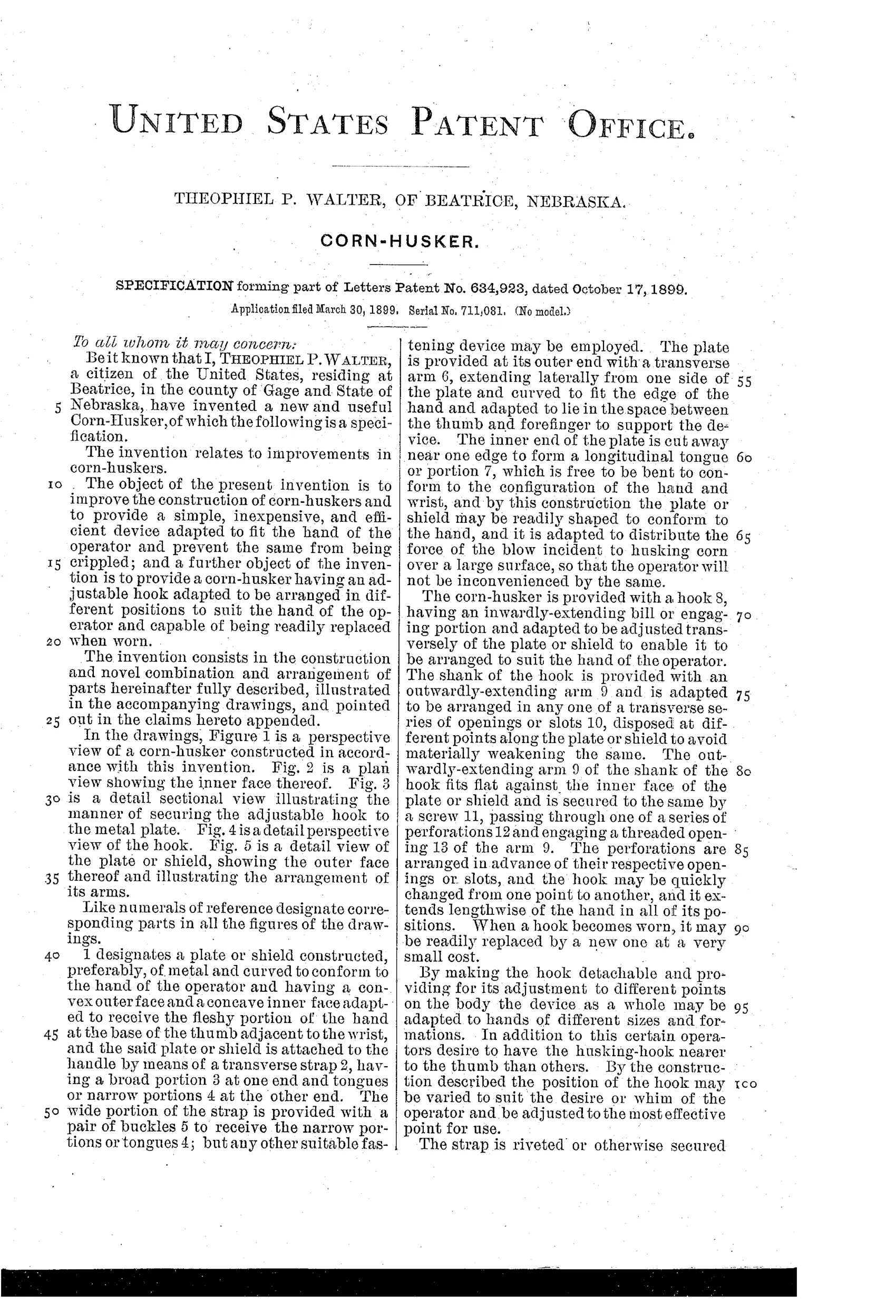
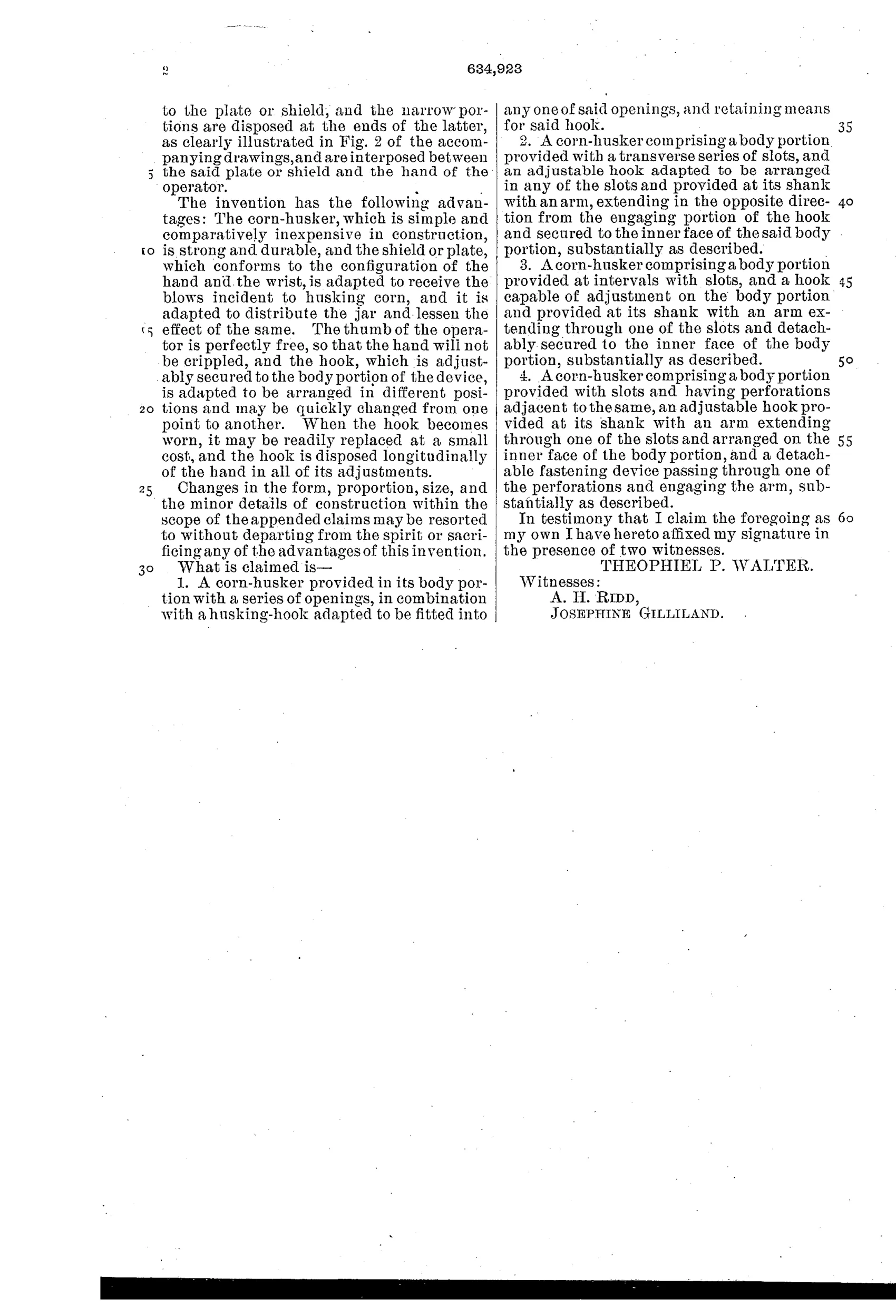
“1. A corn-husker provided in its body portion with a series of openings, in combination with a husking-hook adapted to be fitted into any one of said openings, and retaining means for said hook.”
In plain English: A corn husker with a body that has several openings so the hook can be fitted into any one of them and held in place.
❧ In the inventor’s words
“The thumb of the operator is perfectly free, so that the hand will not be crippled, and the hook, which is adjustably secured to the body portion of the device, is adapted to be arranged in different positions and may be quickly changed from one point to another.”— Theophiel P. Walter, from the specification
Fate unknown
Husking hooks were mass-produced generally, but no example matching Walter's slotted adjustable design is known to us; a marked specimen or catalog listing would settle it.
❧ Commentary
Full disclosure: this is not an apple parer. Walter's patent is a husking peg — a hand-worn hook for stripping the shuck off ear corn — and it landed in our stack by way of a loose keyword net. But since it's here, it deserves a fair reading, because it shares the same instinct that drives the best kitchen-machine patents: take a repetitive hand motion done thousands of times a day and shave friction out of it.
The mechanical idea is the row of transverse slots on the palm plate. The hook's arm slides into any one of them and locks with a single screw, so the operator can position the bill exactly where his own hand wants it — and swap in a fresh hook when the point wears down, which it would, fast, in a season of husking. That's genuinely thoughtful. Most husking pegs of the era were fixed-position; Walter is selling adjustability and cheap replacement of the wear part. Note also the free-bending tongue of the plate in Fig. 2, meant to spread the shock of each husking blow across the hand instead of concentrating it.
Husking hooks broadly were manufactured by the millions before mechanical corn pickers killed the trade around the 1930s. Whether this specific slotted-plate design ever left the drawing board is another matter, and outside our reference shelf — DATAMP won't help us here.
Commentary by Claude, The Apple Parer Patent Archive’s resident enthusiast