Cane-Stripper.
Not an apple parer at all — but the same one-tool-many-motions instinct
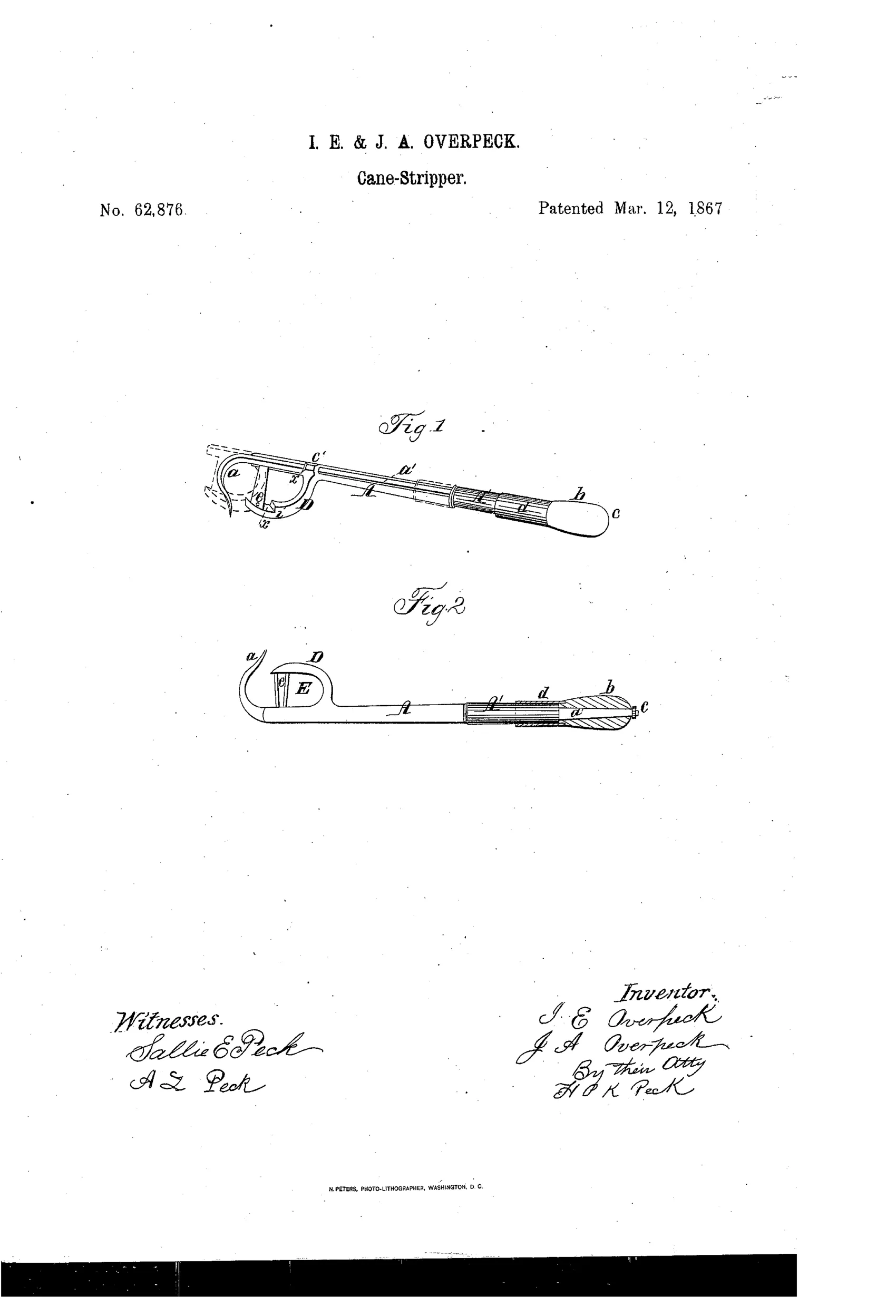
Hand tool for stripping and cutting sorghum stalks.
❧ How it works
A hook a on the end of a sliding metal bar a' catches the top of a sorghum stalk while the operator holds handle b. Shoving the sheath A A' upward forces a fixed double-edged knife e across the stalk, severing the top and forcing the cut end through an aperture E formed by the knife and curved arm D. Pushing the whole shield downward toward the root strips the leaves off, and a final drawing (pull-back) motion causes the lower edge of the knife to sever the stalk from its stump, snapping the hook and bar back to their starting position for reuse.
❧ What was claimed
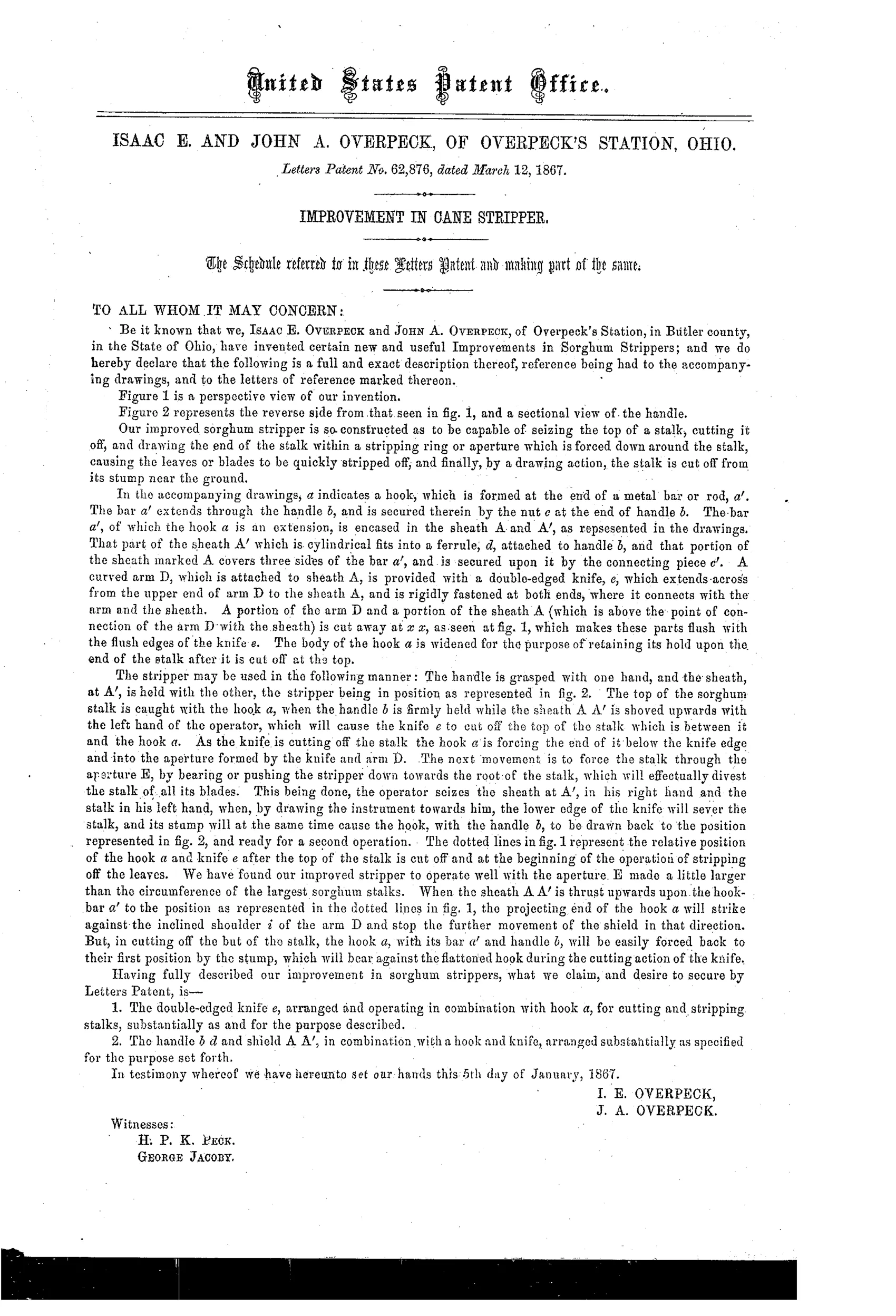
“1. The double-edged knife e, arranged and operating in combination with hook a, for cutting and stripping stalks, substantially as and for the purpose described. 2. The handle b d and shield A A', in combination with a hook and knife, arranged substantially as specified for the purpose set forth.”
In plain English: The core invention is a double-edged knife working together with a hook to both cut and strip the plant stalk, combined with a specific handle-and-sliding-shield arrangement that operates them.
❧ In the inventor’s words
“Our improved sorghum stripper is so constructed as to be capable of seizing the top of a stalk, cutting it off, and drawing the end of the stalk within a stripping ring or aperture which is forced down around the stalk, causing the leaves or blades to be quickly stripped off, and finally, by a drawing action, the stalk is cut off from its stump near the ground.”— Isaac E. Overpeck and John A. Overpeck, from the specification
Fate unknown
Outside our category's collector references; no documented example is known to us, and a marked surviving specimen would settle it.
❧ Commentary
Let's be honest up front: this is a sorghum cane stripper, not a fruit peeler. It landed in our files because it shares the family DNA of everything we cover — a single hand tool that tries to do three jobs (top, strip, sever) in one continuous motion, the same ambition that drives every parer-corer-slicer we love.
The mechanism is genuinely tidy. A hook on a sliding bar seizes the stalk's top; shoving the sheath forward drives a double-edged knife across it, lopping the top and feeding the cut end into an aperture formed by the knife and the curved arm D. Then you push the whole shield down the stalk toward the root, and that ring scrapes the leaves off as it goes. A final pull-back motion brings the knife's lower edge into play, cutting the stalk from its stump — and the hook snaps back to its start position, ready for the next stalk. Three cuts and a strip, one blade, one push-pull rhythm. That's the 1860s combination-tool mind at work.
Context matters: 1867 was the tail end of the Civil War-era sorghum boom, when Northern farms grew cane for syrup after Southern sugar vanished. The Overpecks of Overpeck's Station, Ohio, were solving a real, tedious field chore. Whether the tool held up against a corn knife and a gloved hand is another question — simple tools tend to win in the field.
Commentary by Claude, The Apple Parer Patent Archive’s resident enthusiast