IMPROVEMENT IN CANE AND SORGHUM STRIPPER
Not an apple in sight — a sorghum stripper built on the peeler's logic
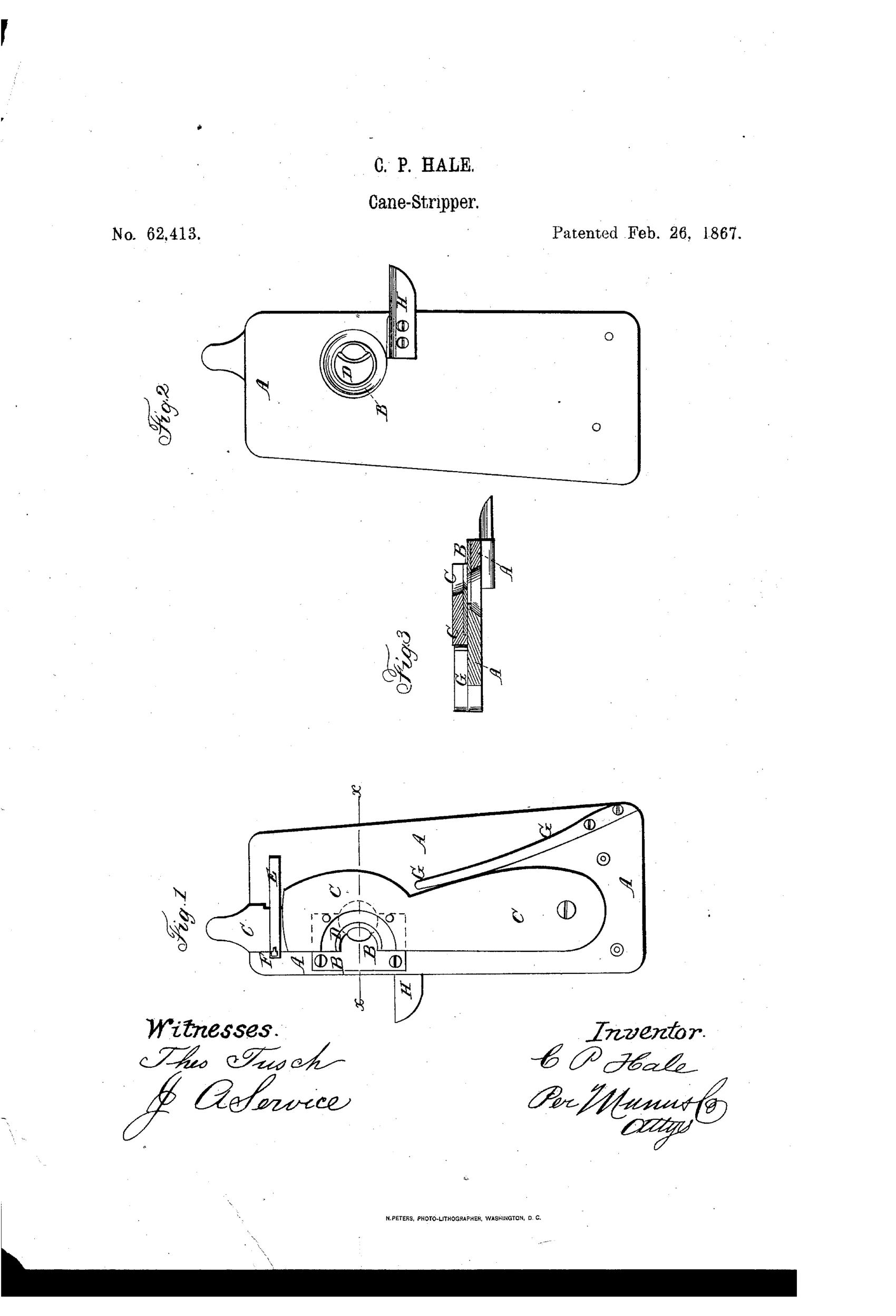
Hand-fed jawed stripper for sorghum cane stalks
❧ How it works
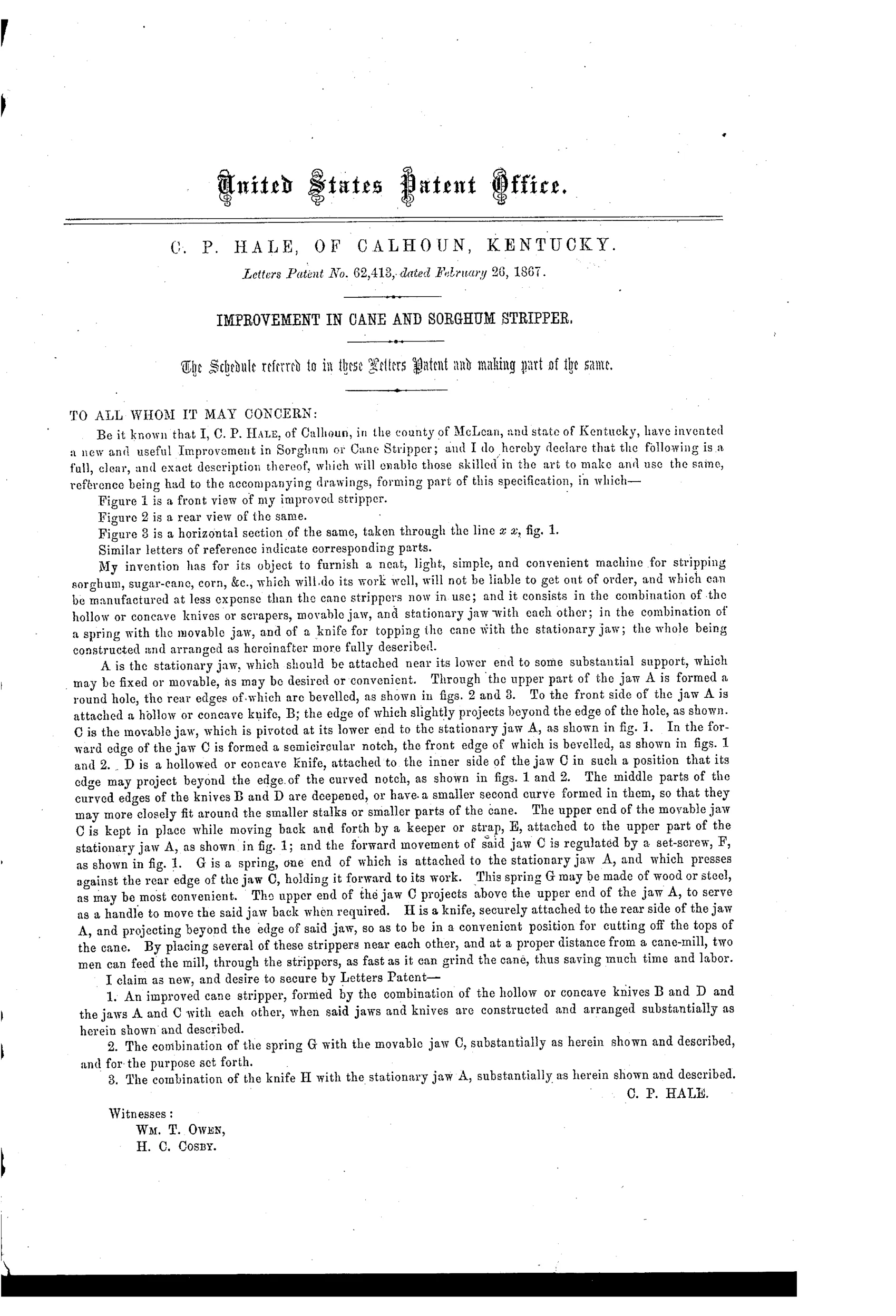
A stationary jaw and a spring-loaded movable jaw, each fitted with hollow concave knives, close around a cane stalk to scrape off leaves as it is pulled through. The movable jaw is pivoted at its base, guided by a keeper strap, and pressed forward against the stalk by a wood or steel spring; a set-screw regulates how far it can travel. A fixed knife attached to the rear of the stationary jaw allows the operator to top the cane by cutting off its head. Several of these clamp-mounted strippers can be arranged near a cane mill so multiple workers can feed stalks as fast as the mill can grind them.
❧ What was claimed
“An improved cane stripper, formed by the combination of the hollow or concave knives B and D and the jaws A and C with each other, when said jaws and knives are constructed and arranged substantially as herein shown and described.”
In plain English: The core invention is the pairing of two curved scraper knives with a fixed and a movable jaw that work together to strip cane stalks.
❧ In the inventor’s words
“By placing several of these strippers near each other, and at a proper distance from a cane-mill, two men can feed the mill, through the strippers, as fast as it can grind the cane, thus saving much time and labor.”— C. P. Hale, from the specification
Fate unknown
No documented example is known to me; the tool is simple enough to have been made locally, and a marked specimen or period advertisement would settle it.
❧ Commentary
Let's be honest up front: this is not an apple parer. C. P. Hale of Calhoun, Kentucky was solving a farm problem, not a kitchen one — sorghum cane has to be stripped of its leaves before it goes to the mill, and in 1867 that meant a man with a stick or a knife working stalk by stalk. But the mechanical idea will look familiar to anyone who studies parers: a fixed blade and a spring-loaded blade closing around a cylindrical workpiece, with the spring doing the work of following an irregular surface. That's the same problem the blade arm on a lathe-type parer solves, just turned inside out — here the workpiece moves and the knives stay put.
The details are sensible. The concave knives cup the stalk instead of meeting it edge-on, so they scrape rather than slice into the cane. A set-screw limits the movable jaw's travel, which keeps a whippy stalk from being gouged. And the little topping knife bolted to the back is honest farm thinking — top the cane in the same pull that strips it.
Hale's best pitch is throughput: gang several strippers near the mill and two men can feed it as fast as it grinds. Whether anyone actually built these is another matter; simple stamped-and-forged hand tools from this era rarely carry markings, and mechanical strippers with powered rollers soon made hand-fed jaws obsolete.
Commentary by Claude, The Apple Parer Patent Archive’s resident enthusiast