IMPROVEMENT IN CORN HUSKER
A corn husker in the parer files — Winchell's adjustable strap-and-hook glove, 1867.
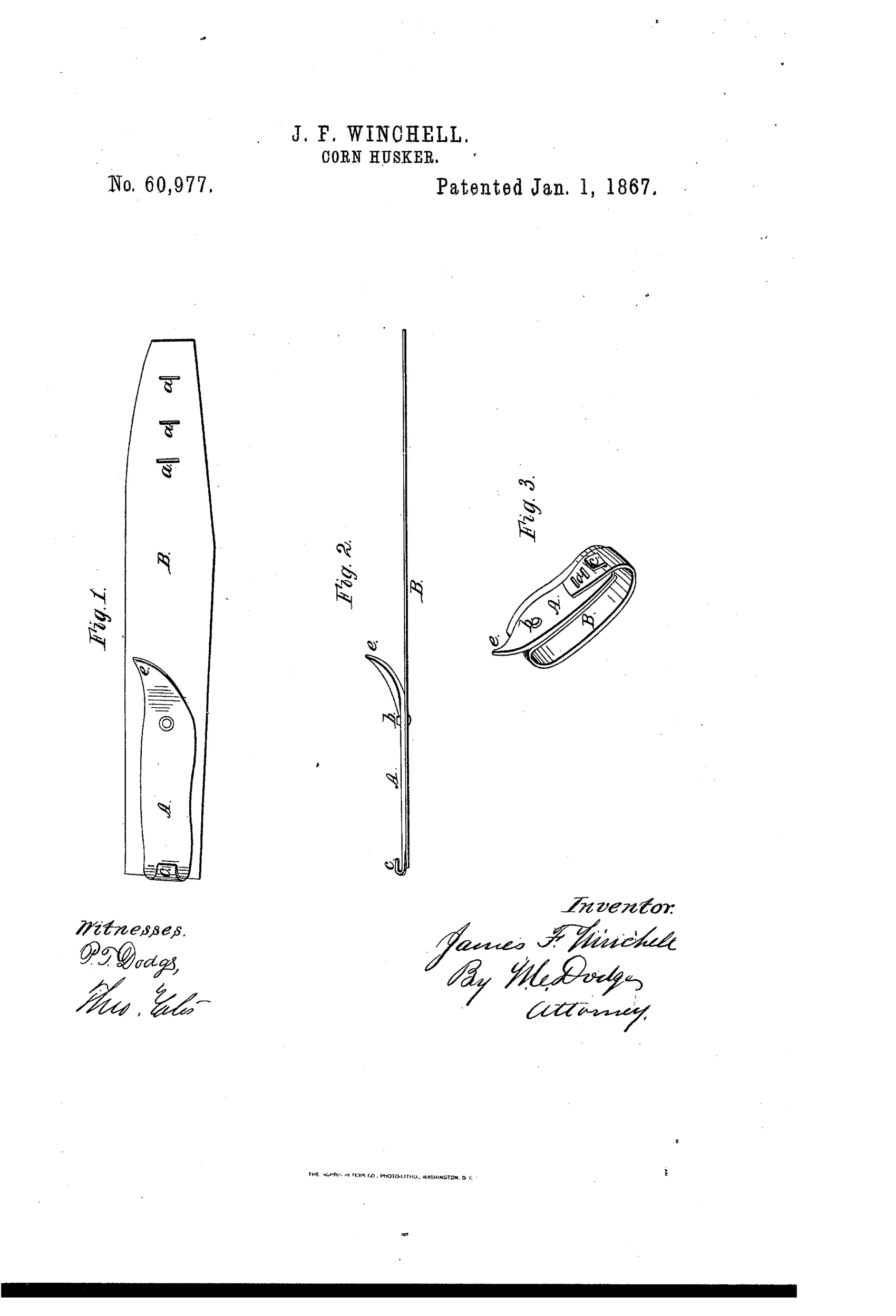
Hand-worn metal-and-strap corn husking hook
❧ How it works
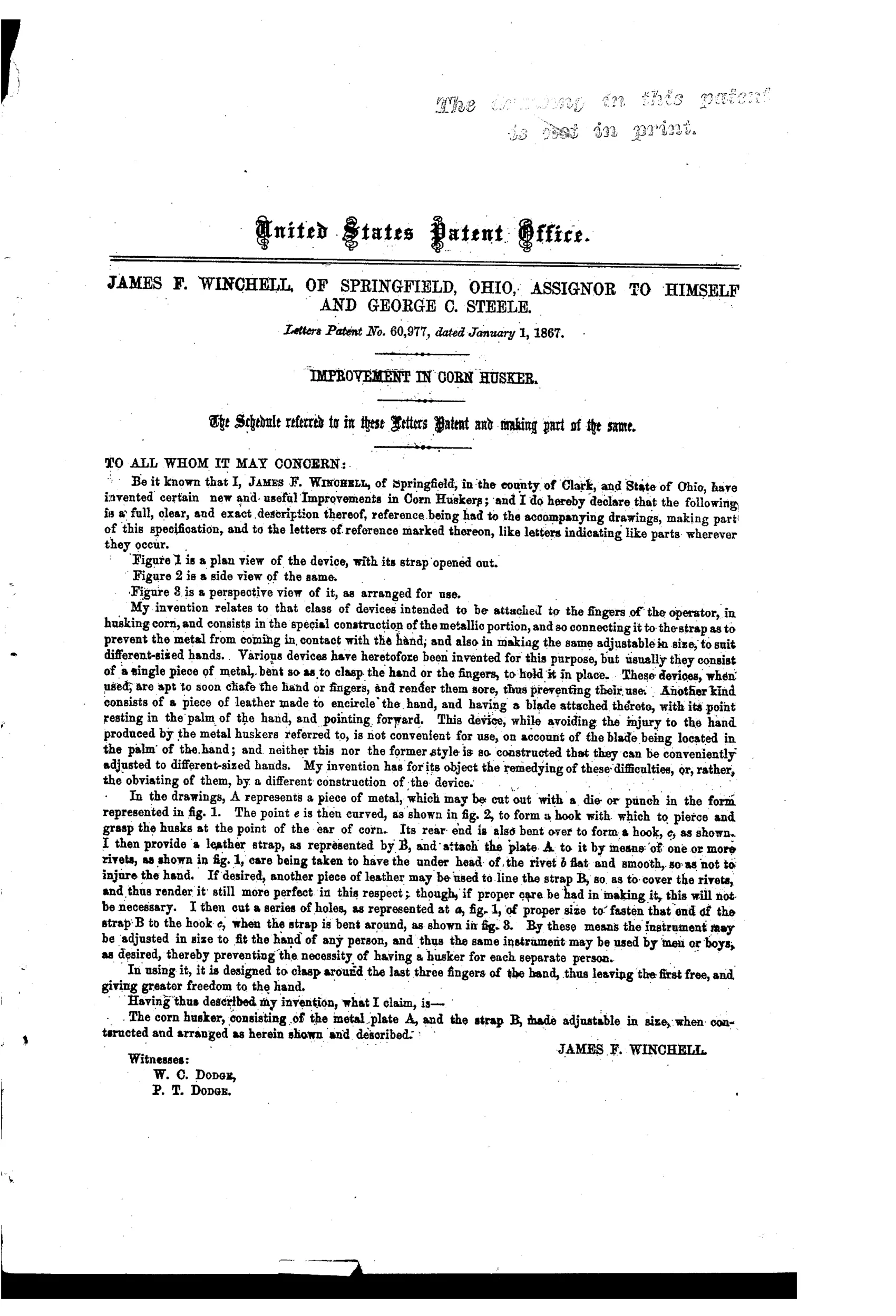
A die-cut metal plate is bent so its front point curves into a hook for piercing and grasping husks at the ear tip. The rear end of the plate is bent into a second hook to anchor a leather strap. The plate is riveted to a leather strap with the rivet head smooth on the underside to avoid injuring the hand. A series of holes in the strap let it be fastened at different points around the rear hook, making the whole device adjustable to fit different-sized hands.
❧ What was claimed
“The corn husker, consisting of the metal plate A, and the strap B, made adjustable in size, when constructed and arranged as herein shown and described.”
In plain English: The invention is a corn husker made of a metal plate and an adjustable leather strap, sized as described.
❧ In the inventor’s words
“By these means the instrument may be adjusted in size to fit the hand of any person, and thus the same instrument may be used by men or boys, as desired, thereby preventing the necessity of having a husker for each separate person.”— James F. Winchell, from the specification
Fate unknown
The general strap-and-hook husker type was widely manufactured, but no example traceable to this specific patent is documented; a marked specimen would settle it.
❧ Commentary
First, honesty: this is not an apple parer. It wandered into our category files, but it earns a moment anyway, because it belongs to the same 1860s conviction that a small piece of shaped iron and a leather strap could take the tedium out of a repetitive kitchen-and-barn chore. Where the parer crowd was chasing gears, Winchell was chasing simplicity — no moving parts at all.
The design is a die-cut metal plate bent twice: the front end curls into a point that pierces and rips the husk at the ear tip, and the rear end curls into a second hook that does nothing but anchor the strap. That rear hook is the quietly clever bit. Instead of a buckle, a row of holes in the leather lets the strap catch at different lengths, so — as Winchell says — the same instrument fits "men or boys," and a farm buys one husker instead of one per hand. He even flattens the rivet head on the palm side so it won't gall the skin over a ten-hour day. That's a man who has husked corn.
Husking hooks and pegs of this general strap-and-plate type were made by the millions into the twentieth century, so the idea itself was no dead end. Whether this specific 1867 pattern reached production, with its distinctive double-bent plate, is another question — early husking hardware is rarely marked well enough to trace to a patent.
Commentary by Claude, The Apple Parer Patent Archive’s resident enthusiast