HUSKING-PIN
A buckle-less strap trick: oblique slits lock onto a T-head, from Nebraska corn country
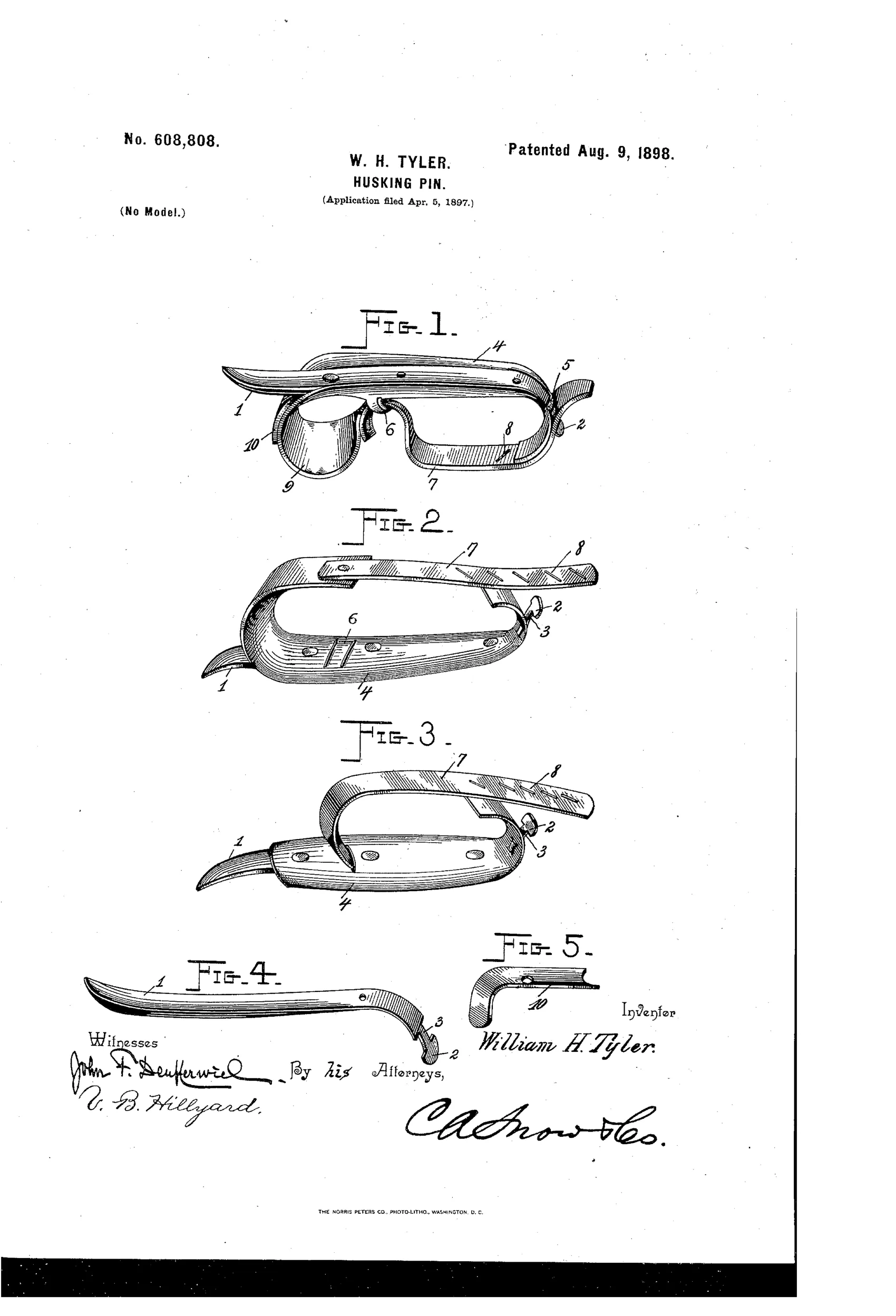
Hand-worn corn-husking pin with finger strap
❧ How it works
A curved metal pin has one end pointed for stripping husks and the other end curved with a T-head to engage the little finger. A leather strap is riveted to the pin near the T-head and encircles the hand, with its loose end formed with a series of obliquely-disposed slits that interlock adjustably with the T-head. A separate finger-guard blank is riveted to the pin's convex side, bending over the forefinger to protect it and the strap from wear. Loops on the strap allow an optional finger cot to be formed for the forefinger.
❧ What was claimed
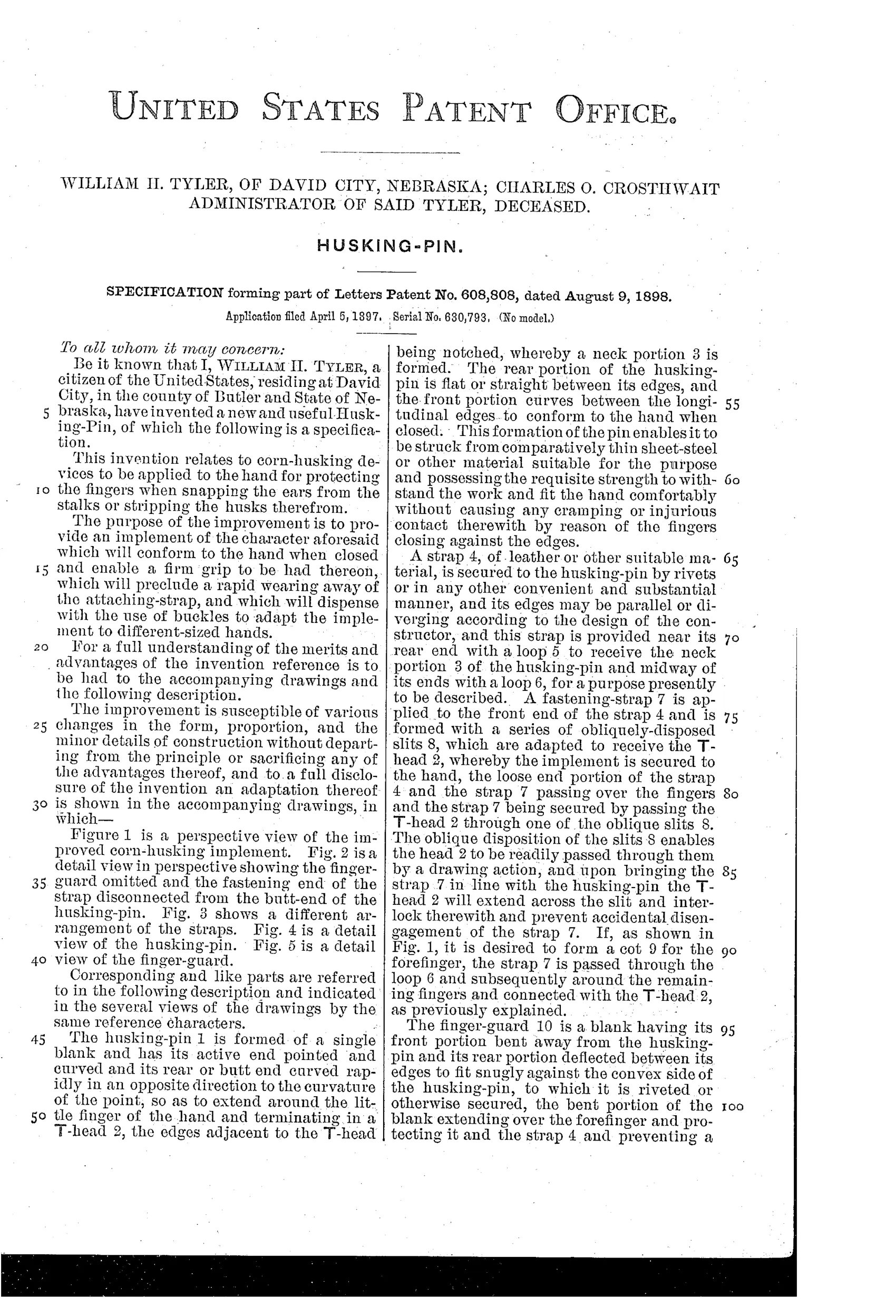
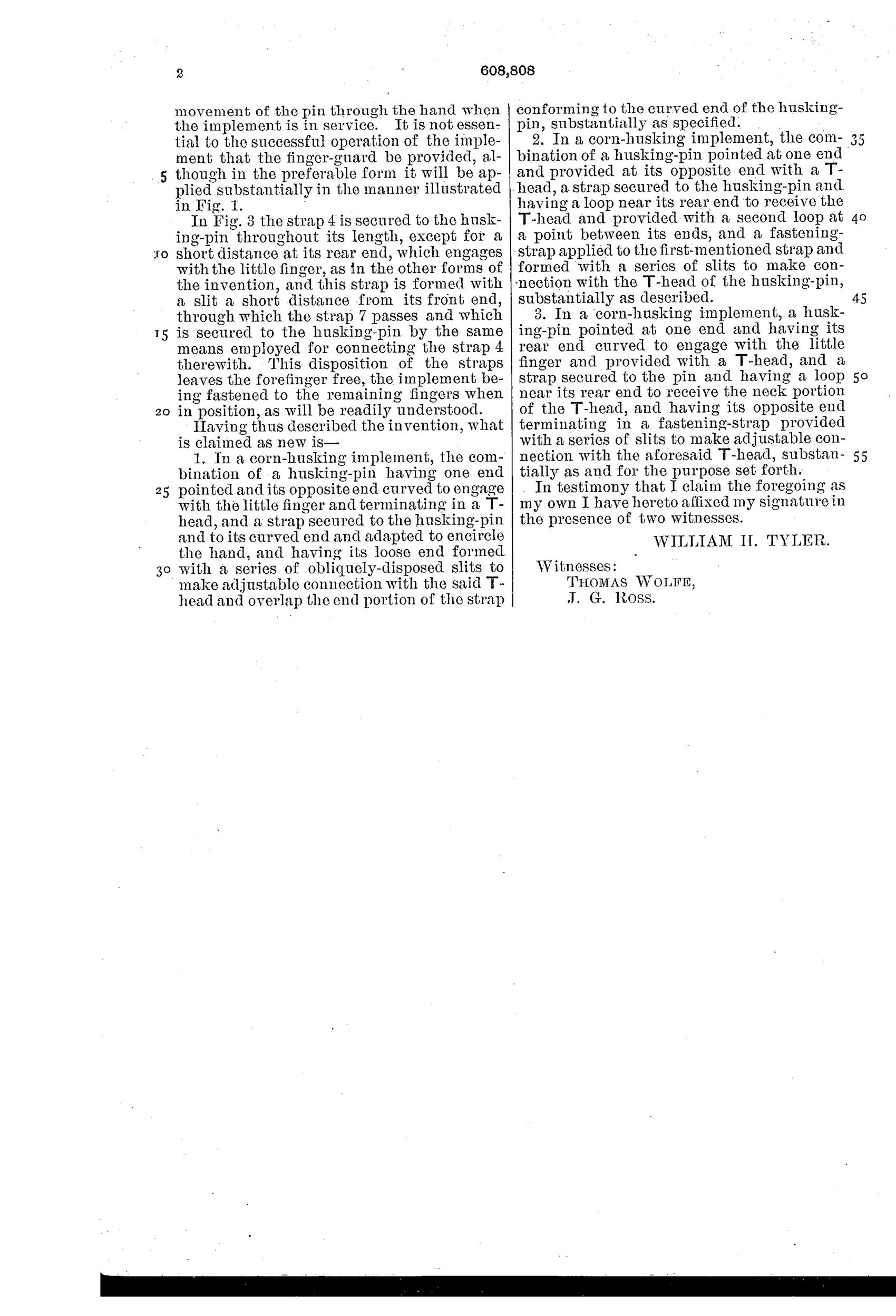
“In a corn-husking implement, the combination of a husking-pin having one end pointed and its opposite end curved to engage with the little finger and terminating in a T-head, and a strap secured to the husking-pin and to its curved end and adapted to encircle the hand, and having its loose end formed with a series of obliquely-disposed slits to make adjustable connection with the said T-head and overlap the end portion of the strap conforming to the curved end of the husking-pin, substantially as specified.”
In plain English: The husking pin has a pointed end and a curved T-headed end, with a hand-encircling strap whose slitted loose end adjustably locks onto the T-head.
❧ In the inventor’s words
“The purpose of the improvement is to provide an implement of the character aforesaid which will conform to the hand when closed and enable a firm grip to be had thereon, which will preclude a rapid wearing away of the attaching-strap, and which will dispense with the use of buckles to adapt the implement to different-sized hands.”— William H. Tyler, from the specification
Fate unknown
Husking pins in general were mass-produced, but I know of no documented example of Tyler's slit-strap T-head design; a marked or patent-dated specimen would settle it.
❧ Commentary
A confession first: this isn't an apple parer. It's a corn-husking pin, the little hand-worn hook a husker used to rip the shuck off an ear thousands of times a day. But it lives in the same universe of small, hard-used farm-kitchen ironmongery, and Tyler's contribution is worth a minute of your attention for one detail alone.
That detail is the fastener. Husking pins and pegs wore straps, and straps wore buckles, and buckles either dug into the back of the hand or fell apart. Tyler's answer is to end the pin in a T-head and cut a row of obliquely-angled slits into the strap's loose end — you hook whichever slit fits your hand over the T and the oblique angle keeps it from working free under tension. No buckle, infinite-ish adjustment, and the same curved end that carries the T-head also hooks the little finger, so one forging does two jobs. Fig. 4 shows how spare the pin itself is: a curved blade with a point at one end and the hook-and-T at the other.
The riveted finger-guard (Fig. 5) is the tell of a man who actually husked corn: it protects both the forefinger and the strap from the abrasion of ear after ear. Husking pins were made in enormous variety and are their own collecting field; whether Tyler's specific slit-strap pattern ever left David City is another question.
Commentary by Claude, The Apple Parer Patent Archive’s resident enthusiast