CORN-HUSKING IMPLEMENT.
A husking hook, not a parer — but the same 1890s hand-tool logic applies
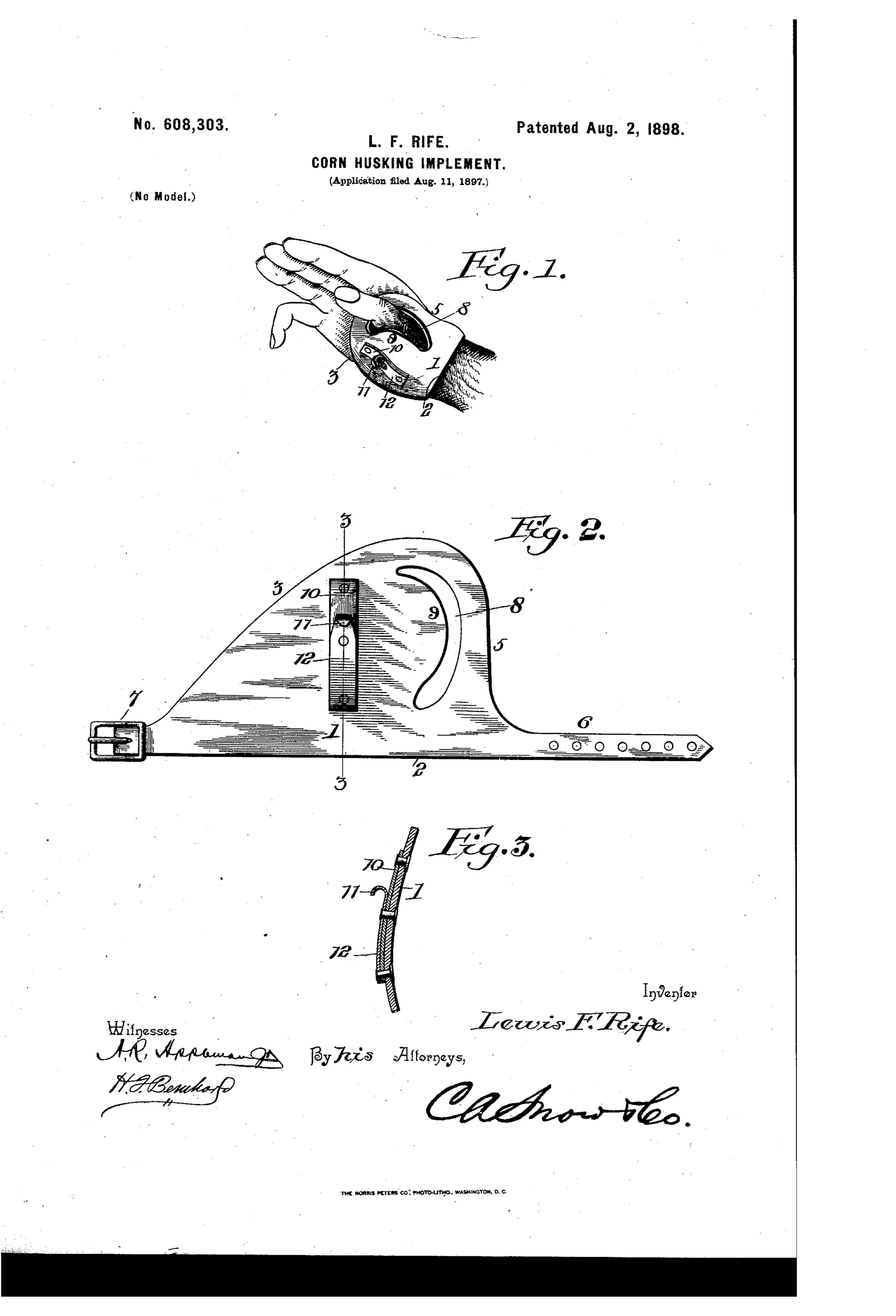
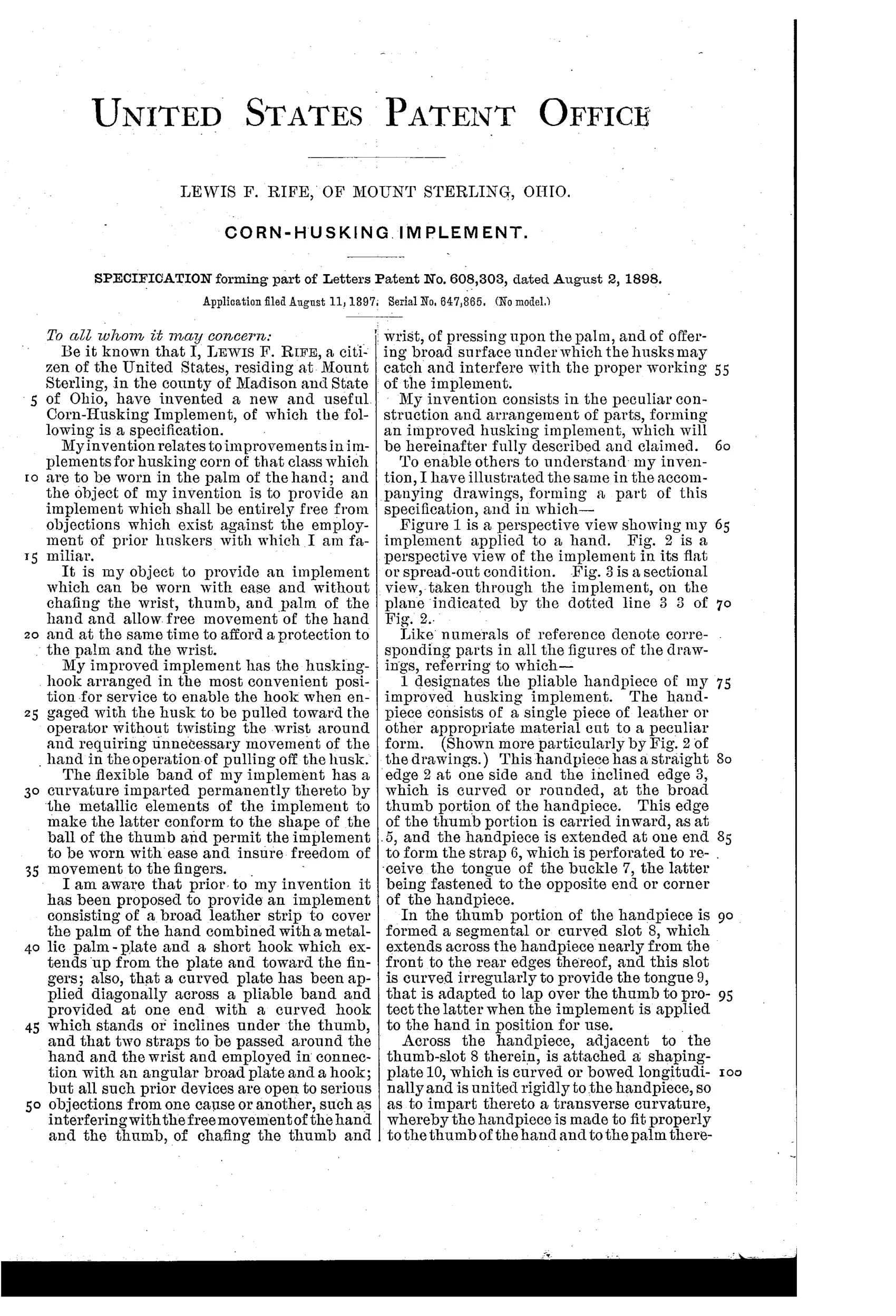
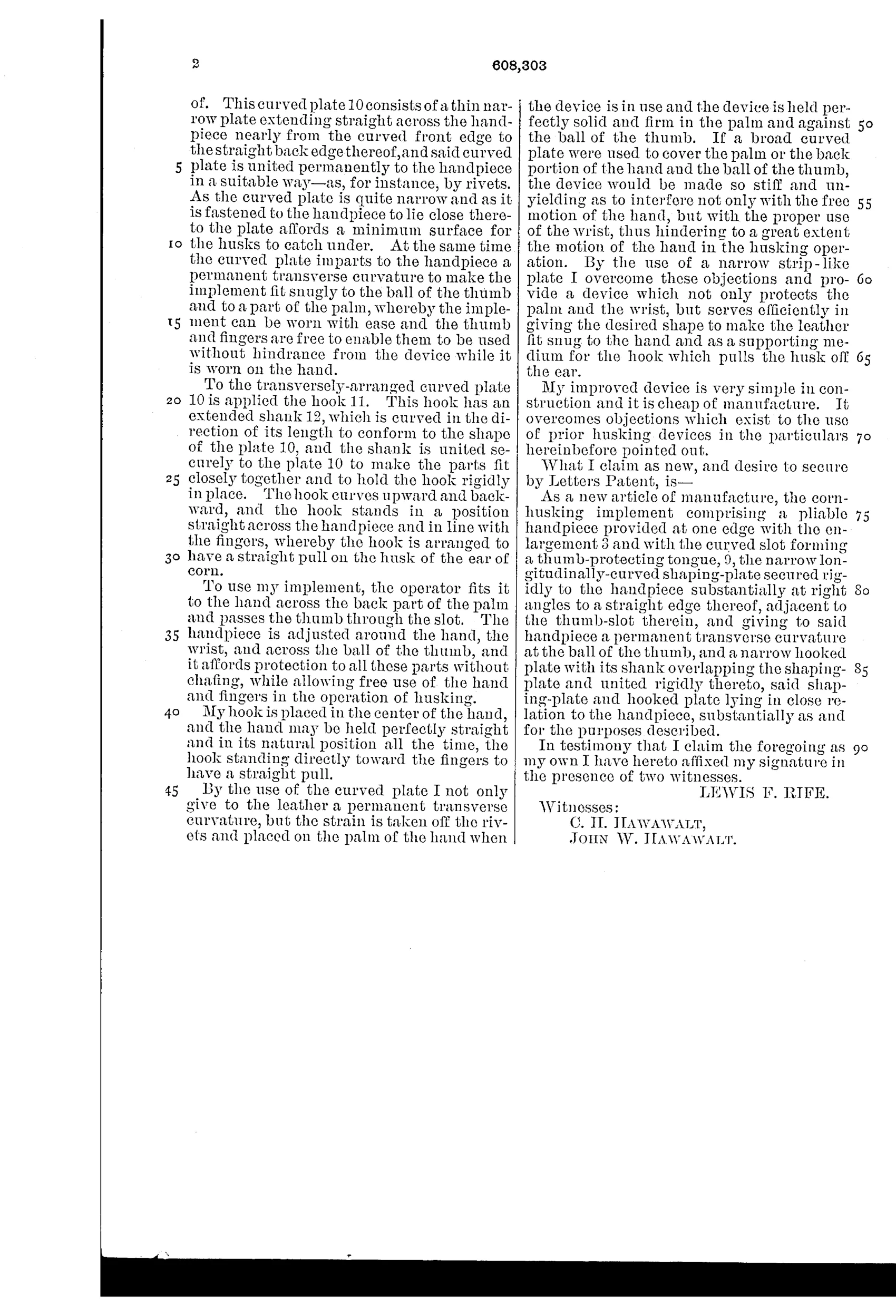
Hand-worn leather husking hook implement
❧ How it works
A pliable leather handpiece wraps around the palm and thumb, secured by a buckle strap at the wrist. A curved slot in the thumb portion forms a tongue that laps over the thumb for protection. A narrow, longitudinally-curved metal shaping-plate is riveted across the handpiece near the thumb slot, giving the leather a permanent transverse curvature to fit the ball of the thumb. A hooked plate with a curved shank overlaps and is united rigidly to the shaping-plate, positioning the hook straight across the palm in line with the fingers for a direct pulling action on the husk.
❧ What was claimed
“As a new article of manufacture, the corn-husking implement comprising a pliable handpiece provided at one edge with the enlargement 3 and with the curved slot forming a thumb-protecting tongue, 9, the narrow longitudinally-curved shaping-plate secured rigidly to the handpiece substantially at right angles to a straight edge thereof, adjacent to the thumb-slot therein, and giving to said handpiece a permanent transverse curvature at the ball of the thumb, and a narrow hooked plate with its shank overlapping the shaping-plate and united rigidly thereto, said shaping-plate and hooked plate lying in close relation to the handpiece, substantially as and for the purposes described.”
In plain English: A leather hand-worn husking implement with a thumb-protecting tongue formed by a curved slot, a rigid narrow curved metal plate that shapes the leather to the thumb, and a hooked plate attached to that shaping plate to pull husks off corn.
❧ In the inventor’s words
“My hook is placed in the center of the hand, and the hand may be held perfectly straight and in its natural position all the time, the hook standing directly toward the fingers to have a straight pull.”— Lewis F. Rife, from the specification
Fate unknown
Hand husking hooks were mass-produced for decades, but no example marked to this patent is documented to us; a stamped specimen would settle it.
❧ Commentary
Full disclosure: this one wandered into our orbit from a neighboring field, literally. Lewis Rife of Mount Sterling, Ohio patented a corn-husking hook, not an apple parer. But it earns a look because it shows the other end of the mechanization story we follow here. While the parer makers were piling gears onto cast iron frames, corn husking in 1898 was still done by hand, one ear at a time, and inventors competed on ergonomics rather than gearing.
Rife's contribution is subtler than it looks. Most husking pegs and hooks of the era strapped to a finger or sat off-center on the palm, forcing the wrist to cock for each pull. Rife's own words are the pitch: the hook sits 'in the center of the hand... standing directly toward the fingers to have a straight pull.' The mechanical trick is the narrow curved shaping-plate riveted across the leather — it does double duty, stiffening the handpiece into a permanent curve over the ball of the thumb and serving as the anchor for the hook's shank. Fig. 2, the flat spread-out view, shows the elegant part a casual reader misses: the curved slot cut into the leather that leaves a tongue lapping over the thumb, protection with no added material.
Husking hooks of this general family were made in enormous quantities into the 1930s. Whether Rife's specific plate-and-tongue pattern reached production, we can't say.
Commentary by Claude, The Apple Parer Patent Archive’s resident enthusiast