CORN-HUSKING IMPLEMENT.
A stray from the cornfield: spring-jawed husking hands, not an apple in sight
Paired hand-held plates for husking corn
❧ How it works
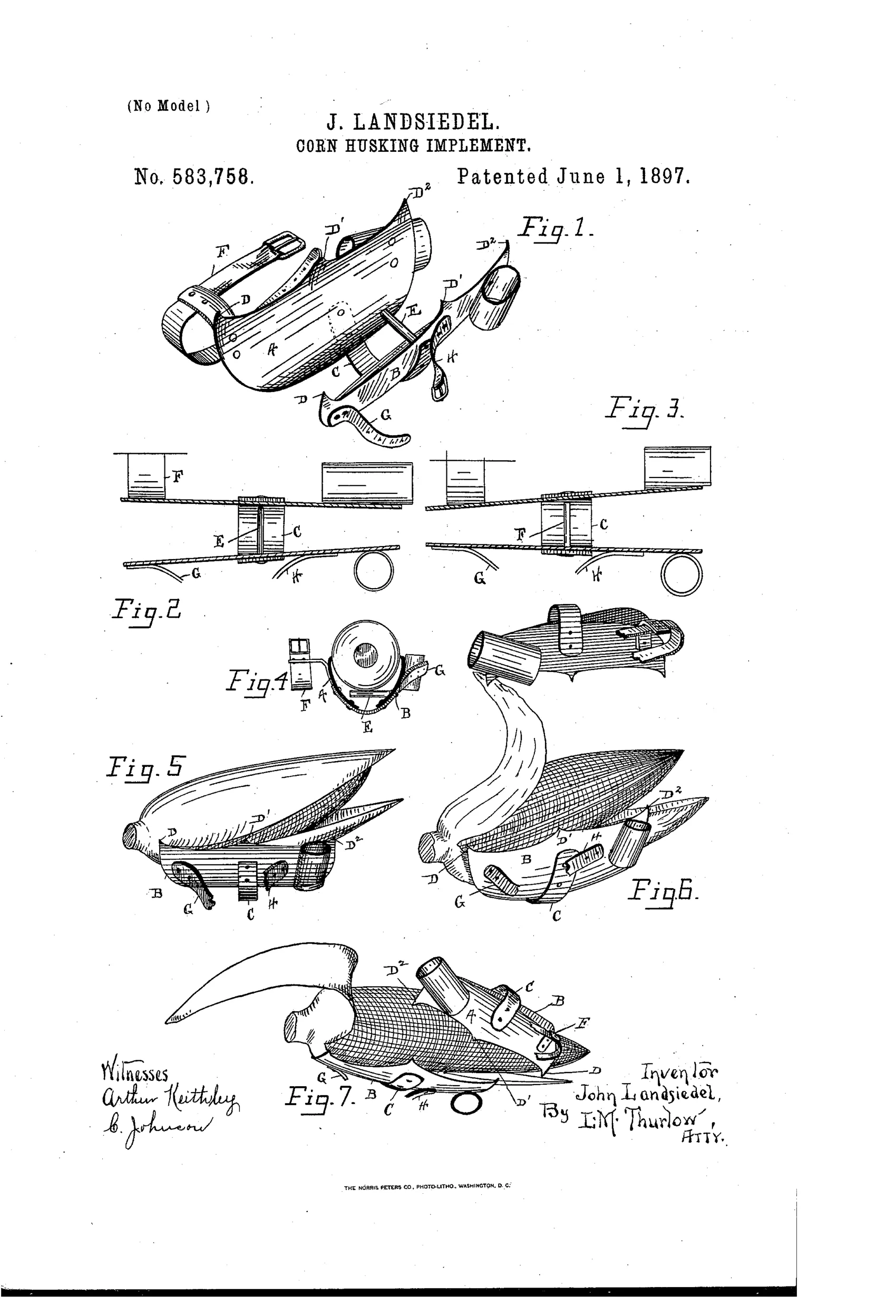
Two sheet-metal plates, A and B, are joined by a light flexible spring C at the middle of their length so they can pivot toward one another. Each plate has curved points D, D2, and D1 at the corners and middle of its upper edge that grip the husk or ear. A pin E fixed at right angles to plate B acts as a stop, preventing the plates from closing too far and cushioning the ear as it drops in. Wrist and finger straps (F, G, H) secure the device to the hand, allowing the operator to use one implement on each hand to grip, lift, strip, and snap the ear from its stem in sequence.
❧ What was claimed
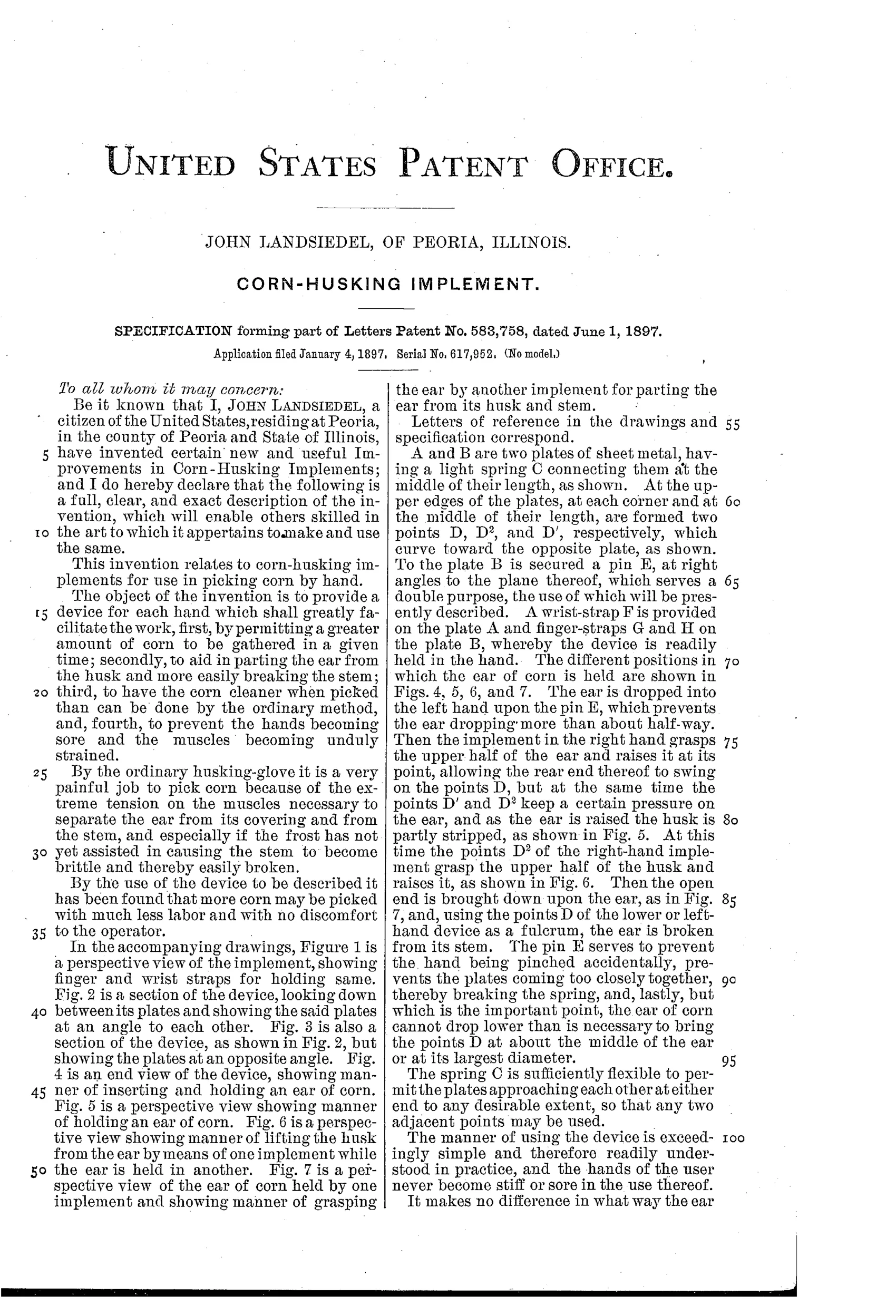
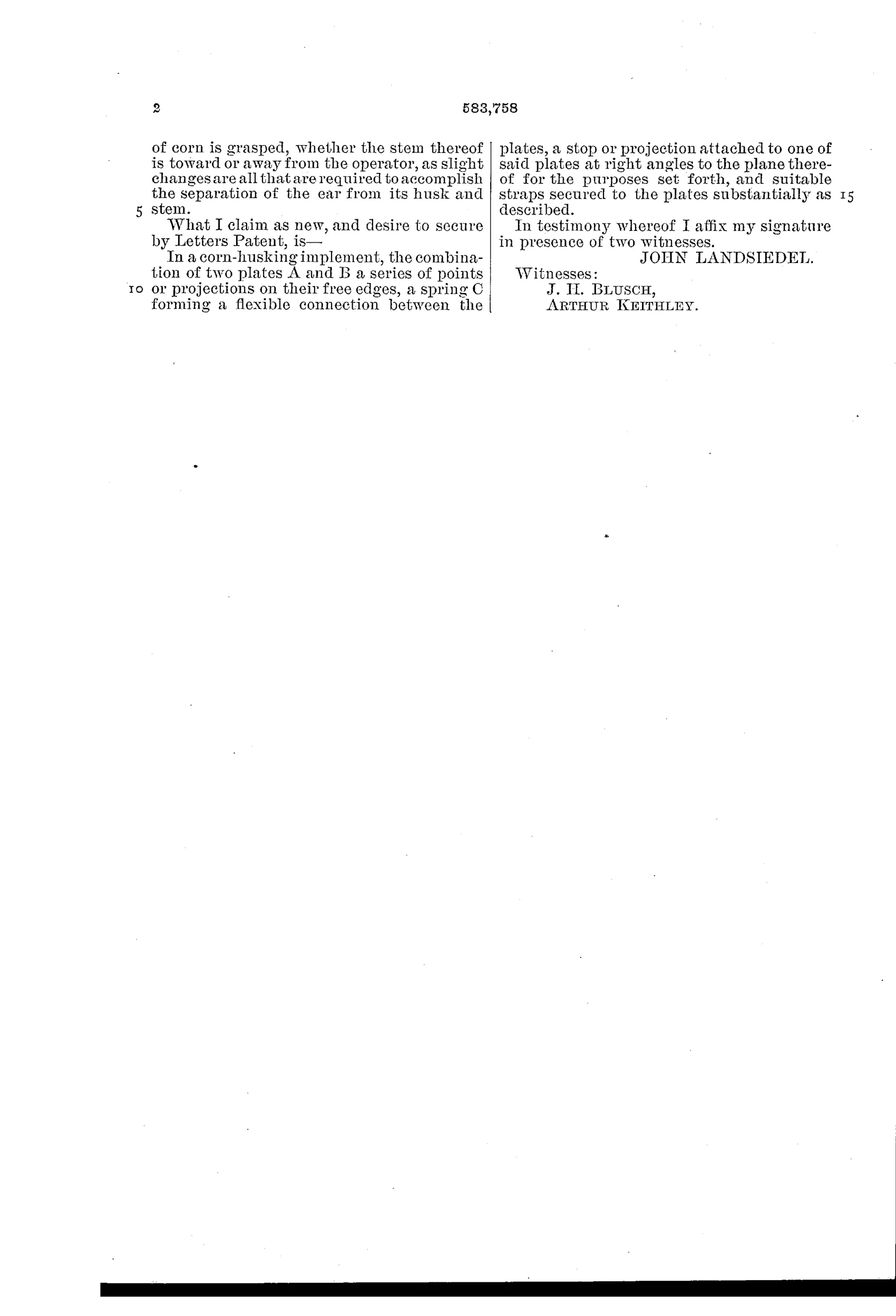
“In a corn-husking implement, the combination of two plates A and B a series of points or projections on their free edges, a spring C forming a flexible connection between the plates, a stop or projection attached to one of said plates at right angles to the plane thereof for the purposes set forth, and suitable straps secured to the plates substantially as described.”
In plain English: The invention is a hand-worn husking tool made of two spring-connected metal plates with gripping points, a right-angle stop pin, and straps to hold it to the hand.
❧ In the inventor’s words
“By the ordinary husking-glove it is a very painful job to pick corn because of the extreme tension on the muscles necessary to separate the ear from its covering and from the stem, and especially if the frost has not yet assisted in causing the stem to become brittle and thereby easily broken.”— John Landsiedel, from the specification
Fate unknown
Simple husking pegs dominated the market and no example of this spring-plate design is known to us; a marked or strap-fitted specimen in a farm-tool collection would settle it.
❧ Commentary
Let's be honest up front: this is not an apple parer. Landsiedel's patent wandered into our collection the way a corn husk blows into an orchard, but it's worth a look anyway, because it solves the same core problem our category obsesses over — how to grip and strip produce without wrecking your hands — with none of the cast-iron gearing we usually celebrate.
The mechanism is two curved sheet-metal plates joined at their middles by a light spring, worn strapped to the palm like a glove with jaws. The pointed corners bite into the husk, the spring lets the plates pivot to clamp, and a stop pin keeps them from closing so far they bruise the ear. The drawing sequence (Figs. 4 through 7) is the best part: it shows a two-handed choreography — one implement grips the ear, the other lifts and peels the husk, then a twist snaps the stem. It's a manual analogue of what our parer inventors did with segment gears: break one messy job into discrete mechanical strokes.
Landsiedel's complaint about ordinary husking gloves — painful muscle tension, especially before frost makes stems brittle — is the authentic voice of a man who has husked a lot of corn. Husking pegs and hooks were made by the million; this elaborate spring-plate variant faced them as cheap, entrenched competition, which is usually fatal for a fussier design.
Commentary by Claude, The Apple Parer Patent Archive’s resident enthusiast