CORN-HUSKER.
A chain-mail glove with a built-in husking hook — and a steel thumbnail
Metal-tipped husking glove for shucking corn
❧ How it works
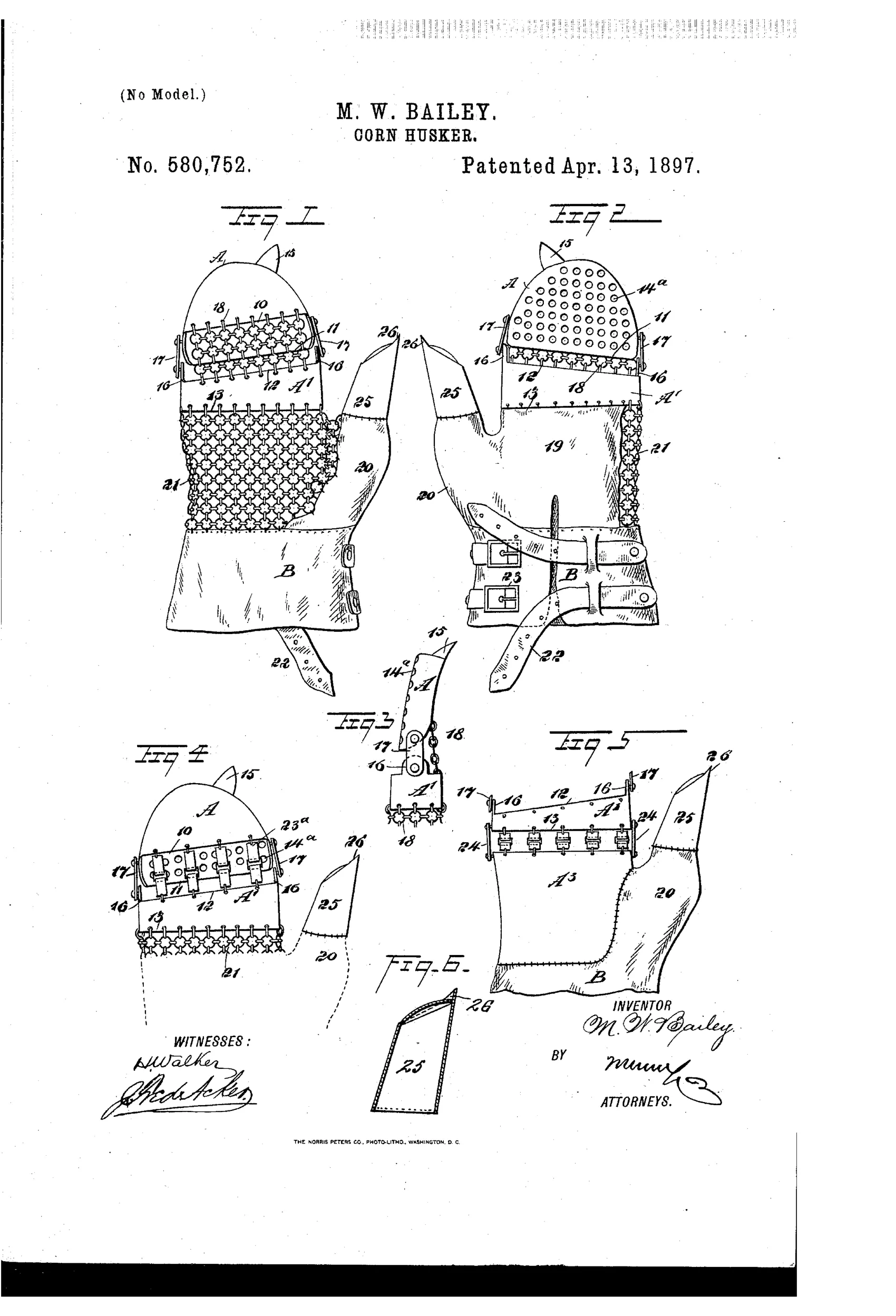
A rigid metal finger-cap fits over the fingertip and carries a pointed metal hook at its top for tearing open the husk. A hinged finger-band encircles the fingers below the cap, connected to it at the sides by pivoting links and at the front by flexible linked wire rings, allowing the cap to move while husking. The palm and thumb of the glove are formed of leather or flexible linked wire-ring cloth attached to the finger-band and a gauntlet wrist section secured by buckled straps. A rigid ferrule caps the thumb tip with an upward flange representing a thumbnail to aid in gripping and stripping husks.
❧ What was claimed
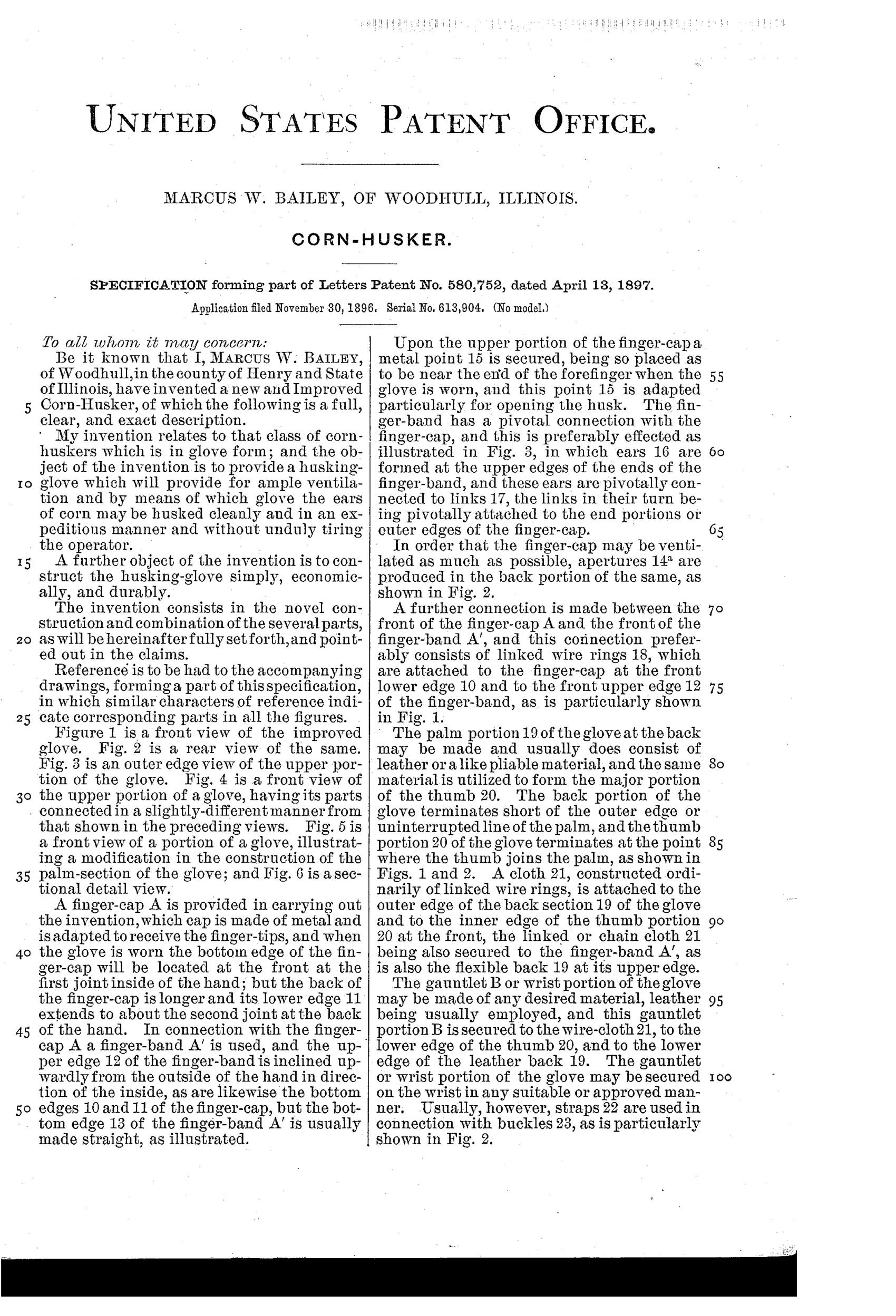
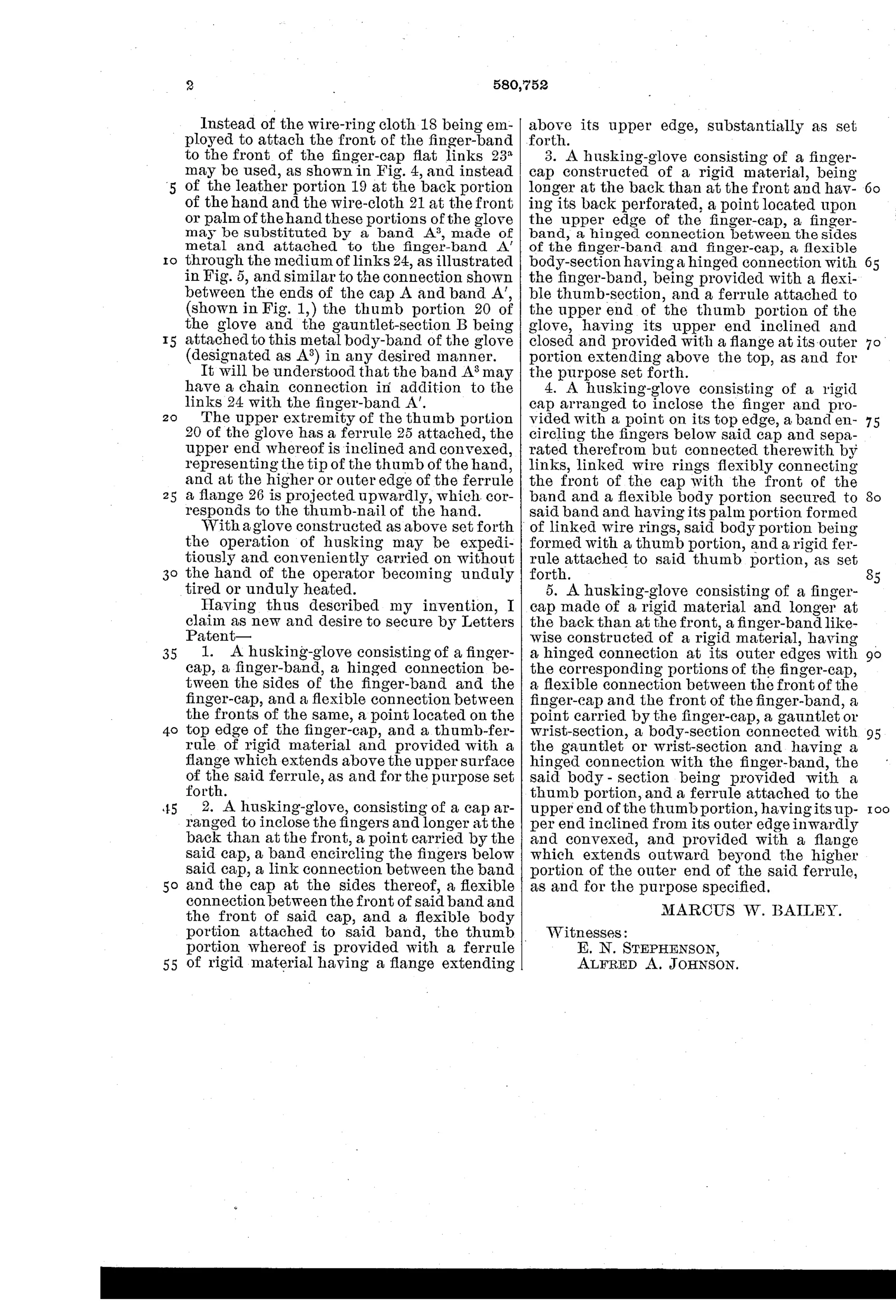
“A husking-glove consisting of a finger-cap, a finger-band, a hinged connection between the sides of the finger-band and the finger-cap, and a flexible connection between the fronts of the same, a point located on the top edge of the finger-cap, and a thumb-ferrule of rigid material and provided with a flange which extends above the upper surface of the said ferrule, as and for the purpose set forth.”
In plain English: The glove has a metal fingertip cap hinged to a finger band, joined flexibly at front, with a husking point on top and a rigid thumb tip fitted with a raised flange.
❧ In the inventor’s words
“With a glove constructed as above set forth the operation of husking may be expeditiously and conveniently carried on without the hand of the operator becoming unduly tired or unduly heated.”— Marcus W. Bailey, from the specification
Fate unknown
Simple husking pegs were mass-produced, but I know of no surviving example of this hinged-cap chain-mail glove; a marked specimen would settle it.
❧ Commentary
Fair warning: this is not an apple parer. Bailey's patent wandered into our files because it solves the same class of problem our category obsesses over — how to get a machine's speed out of a hand task — but he goes the opposite direction. Instead of a clamp-on geared contraption, he armors the hand itself.
The drawing rewards a close look. The palm and cuff in Figs. 1 and 4 are drawn as linked wire rings — literal chain mail, in an 1897 farm patent. The working parts are up top: a rigid metal cap over the fingertips carrying a pointed hook (the numeral 15 in the figures) for ripping the husk open, hinged at the sides to a finger-band so the hand can still close around the ear. The detail I like best is the thumb ferrule in Fig. 6, with a raised flange the specification frankly calls an artificial thumbnail — because that is exactly what a husker's thumbnail does all day, and exactly what wears out first.
Husking pegs and hooks strapped to the palm were made and sold by the million; whole hardware catalogs carried them. Bailey's contribution is folding the peg into an articulated, armored glove. It is heavier and costlier than a fifteen-cent peg on a leather strap, which is probably why the simpler tool is the one collectors find today.
Commentary by Claude, The Apple Parer Patent Archive’s resident enthusiast