POTATO-PEELING KNIFE
A swivel-blade hand peeler, decades before the swivel peeler became a kitchen staple
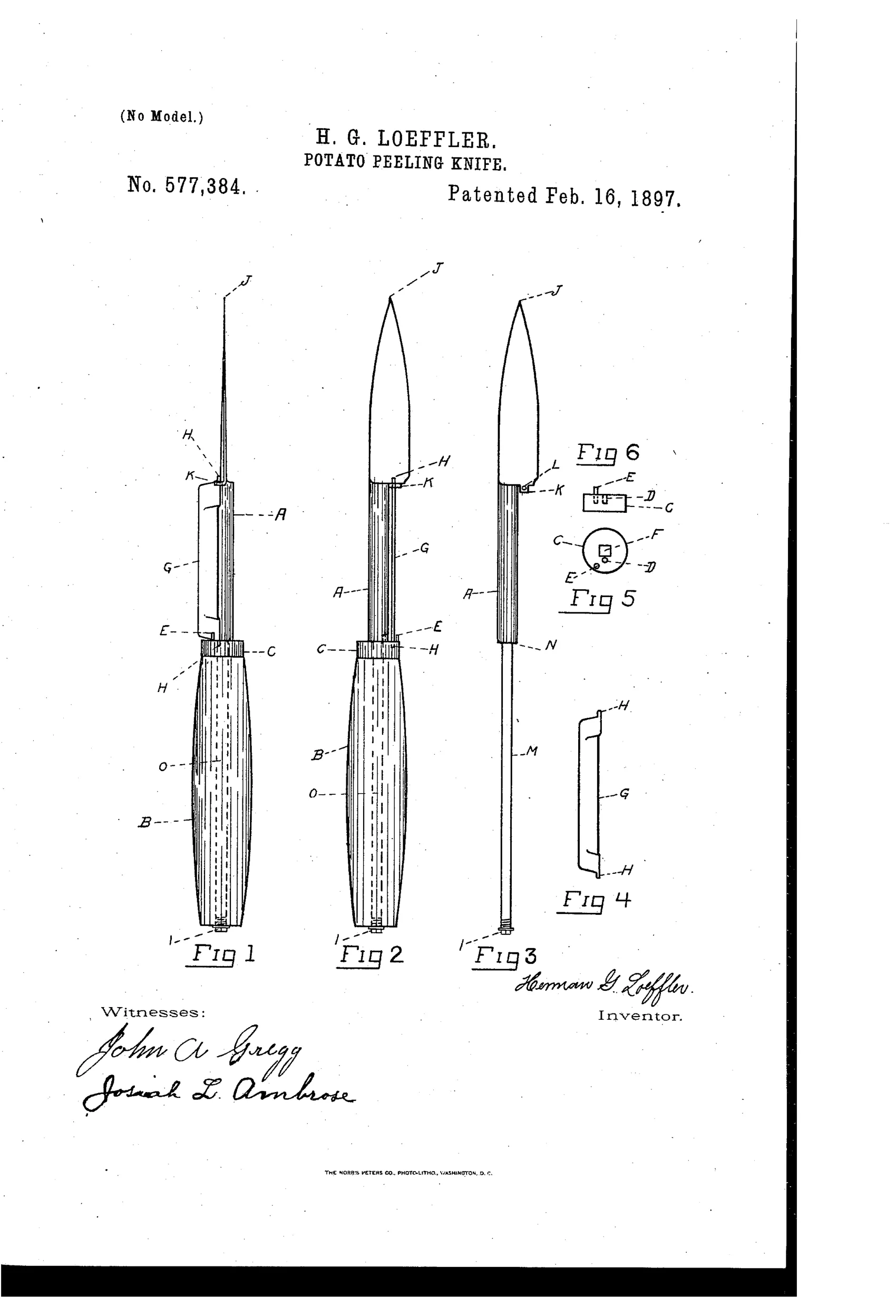
Adjustable, removable-blade potato peeling knife
❧ How it works
A peeling-blade is journaled at both ends in bearings formed on a ferrule and a lug of a knife-blade stem, so it pivots to the proper cutting angle. A gage-pin set into the ferrule limits how far the peeling-blade can drop back, thereby controlling the thickness of the peeling cut. The handle threads onto a squared shank and is drawn tight by a nut, clamping the bearings together to hold the blade firmly in working position. Loosening the nut and sliding the handle down releases the lower journal so the blade can be removed for sharpening or replacement.
❧ What was claimed
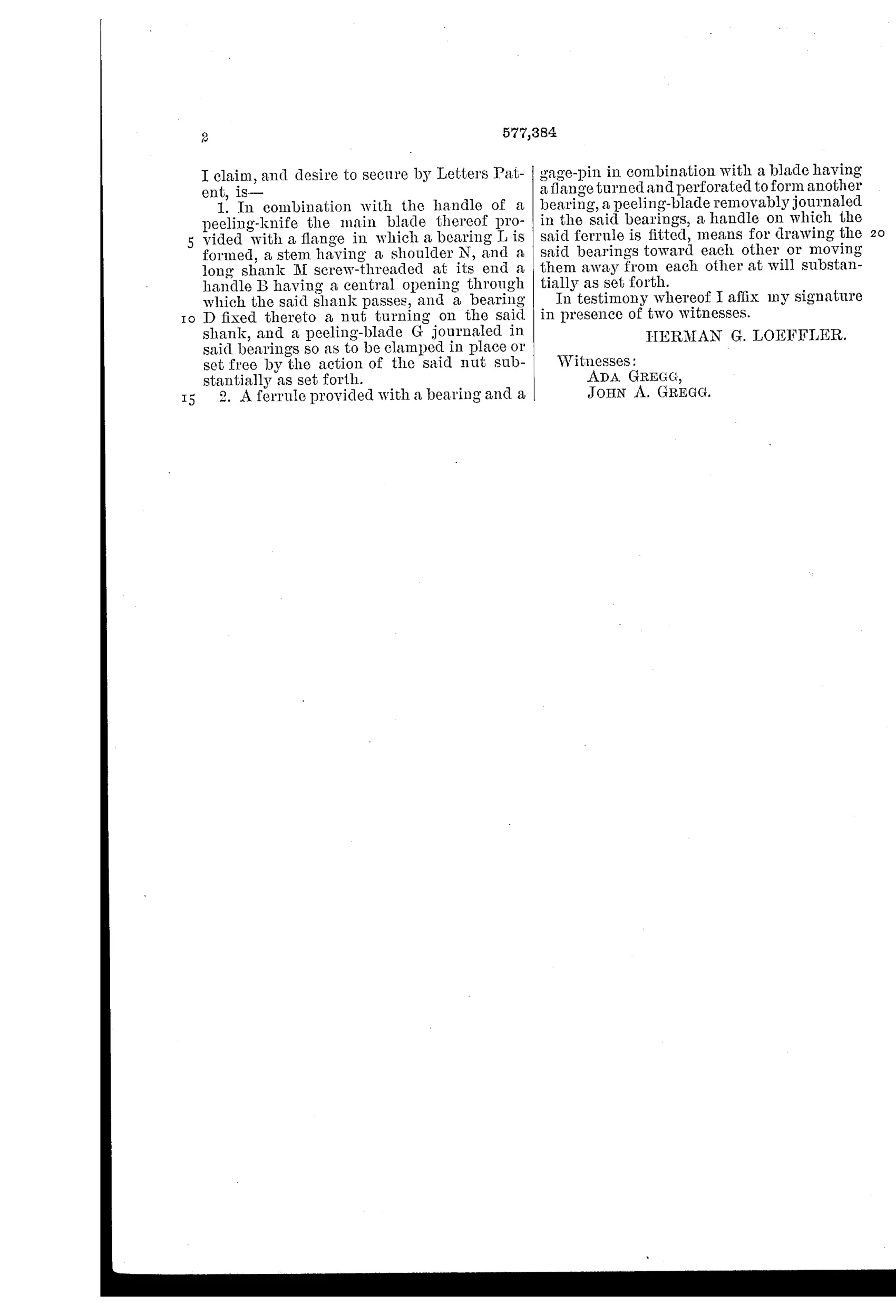
“In combination with the handle of a peeling-knife the main blade thereof provided with a flange in which a bearing L is formed, a stem having a shoulder N, and a long shank M screw-threaded at its end a handle B having a central opening through which the said shank passes, and a bearing D fixed thereto a nut turning on the said shank, and a peeling-blade G journaled in said bearings so as to be clamped in place or set free by the action of the said nut substantially as set forth.”
In plain English: The knife combines a stemmed main blade with a flanged bearing, a shouldered, threaded handle-shank, and a nut, so that turning the nut clamps or releases the peeling blade that pivots in the bearings.
❧ In the inventor’s words
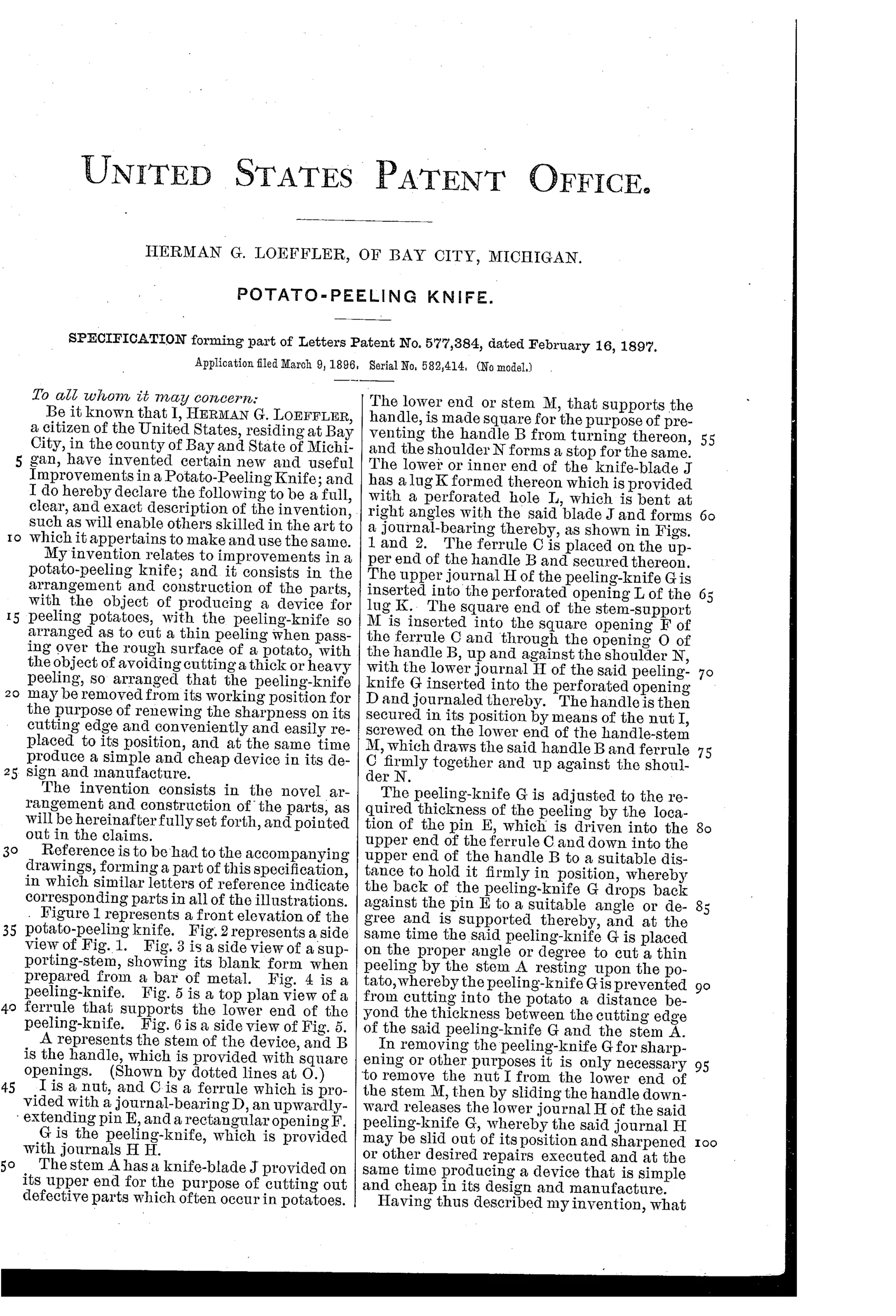
“My invention relates to improvements in a potato-peeling knife; and it consists in the arrangement and construction of the parts, with the object of producing a device for peeling potatoes, with the peeling-knife so arranged as to cut a thin peeling when passing over the rough surface of a potato, with the object of avoiding cutting a thick or heavy peeling.”— Herman G. Loeffler, from the specification
Fate unknown
No manufactured example or trade listing is documented; a marked specimen or period catalog entry would settle it.
❧ Commentary
Most of what crosses this desk is cast iron with gears, so a hand tool is a change of pace — and Loeffler's knife is quietly ahead of its time. The peeling blade G pivots on journals at both ends, free to rock as it rides the lumpy surface of a potato, while a gage-pin limits how far it can tip back and so fixes the depth of cut. That is, in essence, the floating-blade principle behind the swivel peeler everyone owns today, worked out in Bay City in 1896.
The clever bit a casual reader will miss is the clamping arrangement. The handle threads onto a long squared shank; tightening the nut at the butt draws the handle up and pinches the blade's journal bearings closed. Loosen the nut, slide the handle down, and the lower bearing opens so the blade lifts out for sharpening or replacement. One nut does triple duty: assembly, blade retention, and quick release. The pointed main blade J doubles for eyeing and general knife work.
Where it sits in the story: a dead end commercially, so far as anyone can show, but a legitimate step toward the self-regulating peeler. The complexity is its enemy — a threaded shank, ferrule, gage-pin, and two-journal blade is a lot of machining for a tool competing with a paring knife that costs a dime. The idea was sound; the economics probably weren't.
Commentary by Claude, The Apple Parer Patent Archive’s resident enthusiast