IMPROVEMENT IN CORN-HUSKERS
Not an apple parer at all — a husking hook you strap to your palm
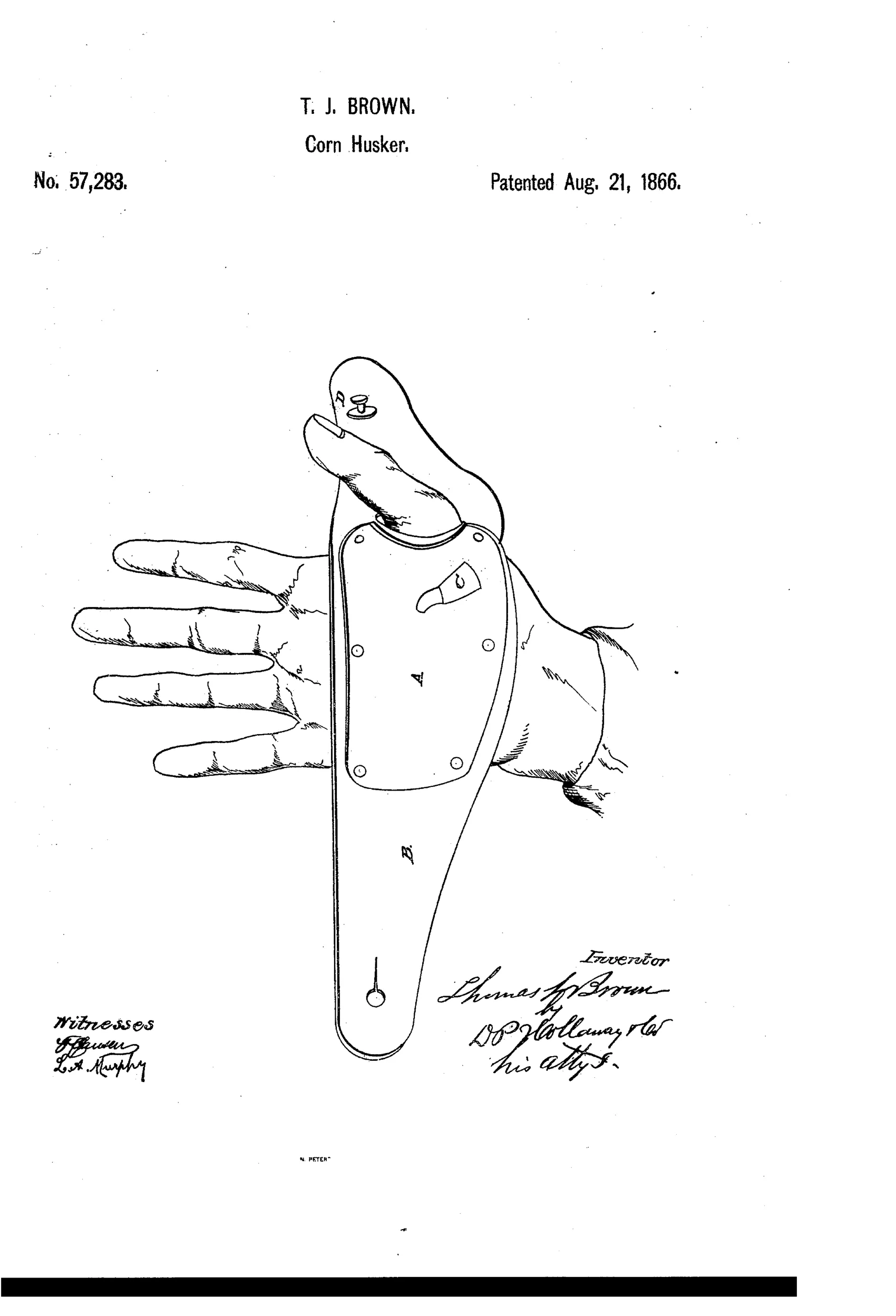
Hand-worn metal-and-leather corn husking tool
❧ How it works
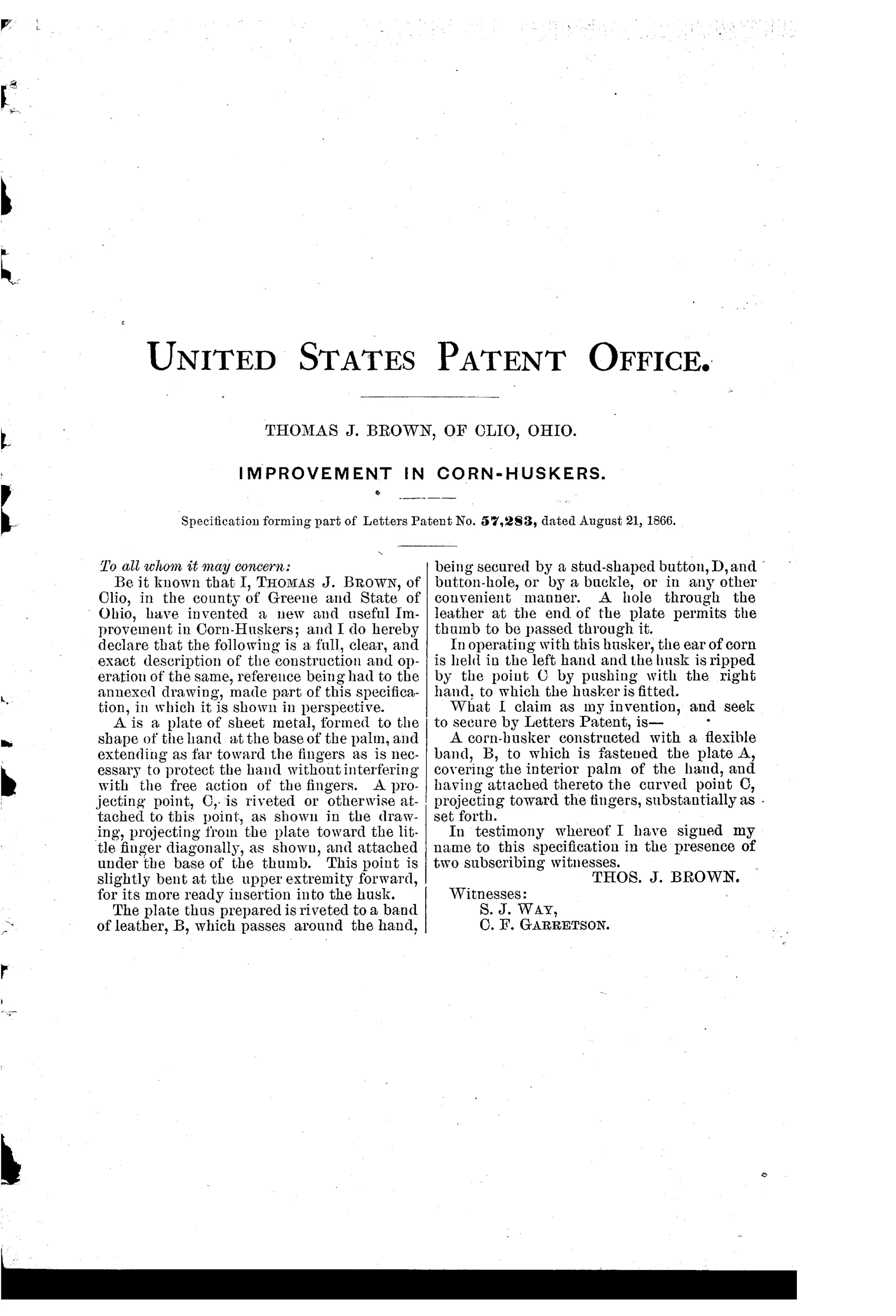
A sheet-metal plate shaped to the palm of the hand is riveted to a flexible leather band that wraps around the hand. A curved metal point projects diagonally from the plate toward the little finger, attached near the base of the thumb, and is bent slightly forward at its tip for easy insertion into the husk. The leather band is fastened with a stud-shaped button and buttonhole, or a buckle, and a hole in the leather lets the thumb pass through. The wearer holds the ear of corn in the left hand and uses the point on the right hand to rip open the husk.
❧ What was claimed
“A corn-husker constructed with a flexible band, B, to which is fastened the plate A, covering the interior palm of the hand, and having attached thereto the curved point C, projecting toward the fingers, substantially as set forth.”
In plain English: A hand-worn husking device made of a flexible band holding a palm-covering plate with an attached curved hook that points toward the fingers for ripping husks.
❧ In the inventor’s words
“In operating with this husker, the ear of corn is held in the left hand and the husk is ripped by the point C by pushing with the right hand, to which the husker is fitted.”— Thomas J. Brown, from the specification
Fate unknown
Palm-plate husking hooks of this general type were manufactured in huge numbers later, but no marked example tied to Brown's 1866 patent is documented; a stamped specimen would settle it.
❧ Commentary
Full disclosure: this one wandered into our parer collection by way of the broader 'kitchen and harvest ironmongery' net, and it belongs to corn, not apples. But it's worth the detour, because it shows the opposite answer to the question our whole category asks. While parer inventors of the 1860s were bolting gears and cranks to the kitchen table, Brown looked at husking — a job done by the millions of ears, outdoors, in cold weather — and decided the machine should be the hand itself.
The design is disarmingly simple: a sheet-metal plate shaped to the palm, riveted to a leather band with a thumb hole, closed by a stud button or buckle. The working part is the curved point C, set near the base of the thumb and angled toward the little finger, its tip bent slightly forward so it slips under the husk on the push stroke. You hold the ear in your left hand, rake with your right, and the husk rips open. No moving parts to freeze or clog with silk.
The idea is sound — hand-worn husking hooks and pegs of exactly this family became one of the most common farm tools in America, made by the tens of thousands into the 20th century. Whether Brown's particular 1866 version was ever produced and marked is another matter; the type's later ubiquity makes any one early patent hard to trace.
Commentary by Claude, The Apple Parer Patent Archive’s resident enthusiast