IMPROVEMENT IN IMPLEMENTS FOR STRIPPING AND CUTTING SORGHUM
A sorghum stripper on an apple-parer site — spring-jawed cousin worth the detour
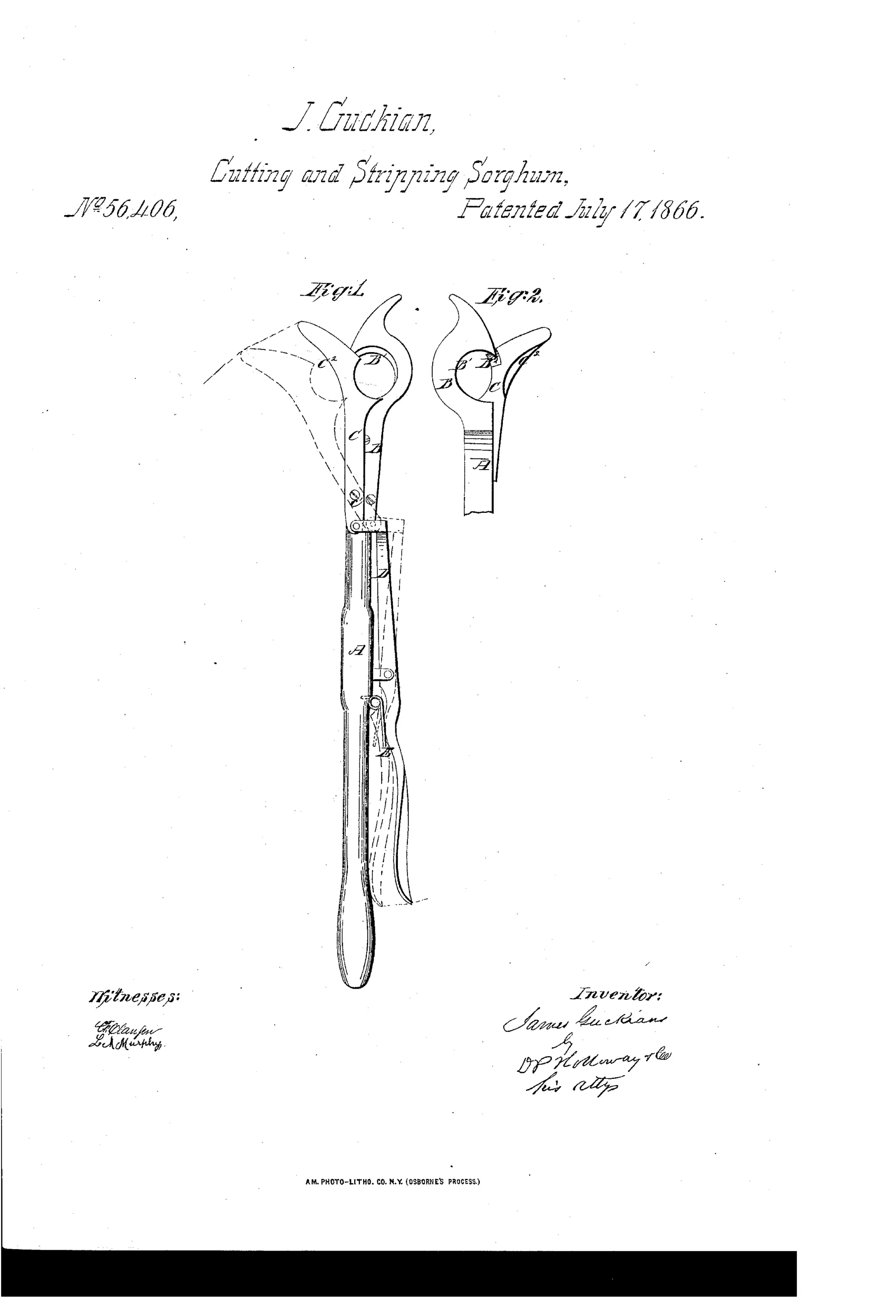
Hand tool for stripping and cutting sorghum stalks
❧ How it works
A wooden handle carries a fixed hooked blade B whose inner rim is sharpened at B'. A movable blade or jaw C is pivoted to the fixed blade and to the handle, and is worked by a lever D pivoted near its center to the handle and to the end of blade C. A spring E presses outward against the lever handle, keeping blade C closed against blade B until the lever is pressed to open the jaws; the stalk is then inserted between the jaws near the top and drawn down through them to strip the leaves, while the sharpened edge C2 striking against the shoulder B2 severs the stalk at the foot if cutting is also desired.
❧ What was claimed
“An implement for stripping and cutting sorghum, and other analogous uses, constructed with a fixed blade, B, a movable blade or jaw, C, and a lever, D, or its equivalent, said parts being respectively constructed, and the whole combined for use, substantially as set forth.”
In plain English: The claim covers a sorghum tool made of a fixed blade, a movable jaw blade, and a lever, all combined and shaped to work together as described.
❧ In the inventor’s words
“It is observed that the frost does not readily affect the stalks of the sorghum, but that the leaves are exceedingly susceptible to its influence.”— James Guckian, from the specification
Fate unknown
No marked example or manufacturing record is known to me; a surviving specimen or period hardware listing would settle it.
❧ Commentary
Full disclosure: this is not an apple parer. Guckian's tool strips and cuts sorghum cane, and it lands on this site because it shares the same mid-1860s hand-tool DNA our category grew out of — a fixed blade, a spring-loaded moving jaw, and the idea of drawing the workpiece through a controlled gap rather than freehanding a knife at it. That's the exact conceptual move Moses Coates made in 1803, applied to a stalk instead of a fruit.
The mechanism is honest and simple. The hooked fixed blade B has a sharpened inner rim; the pivoted jaw C is held closed by spring E acting on lever D. Squeeze the lever, open the jaws, insert the stalk near the top, release, and drag downward — the leaves shear off as the stalk runs through. Then, if you want, the edge C2 meeting shoulder B2 lets you snip the stalk at the base with the same grip. Two operations, one tool, no gears. The best line in the specification is agricultural, not mechanical: frost spares the stalk but ruins the leaves, so a farmer racing an early freeze needs to strip fast. That's the whole business case in one sentence.
Would it work? Almost certainly, though a farmhand with a corn knife was cheap competition, and countless sorghum strippers of this era stayed on paper. It's a workmanlike design solving a real seasonal problem.
Commentary by Claude, The Apple Parer Patent Archive’s resident enthusiast