IMPROVEMENT IN PARING-KNIVES.
A hand knife with set-screws, swimming against the cast-iron machine tide
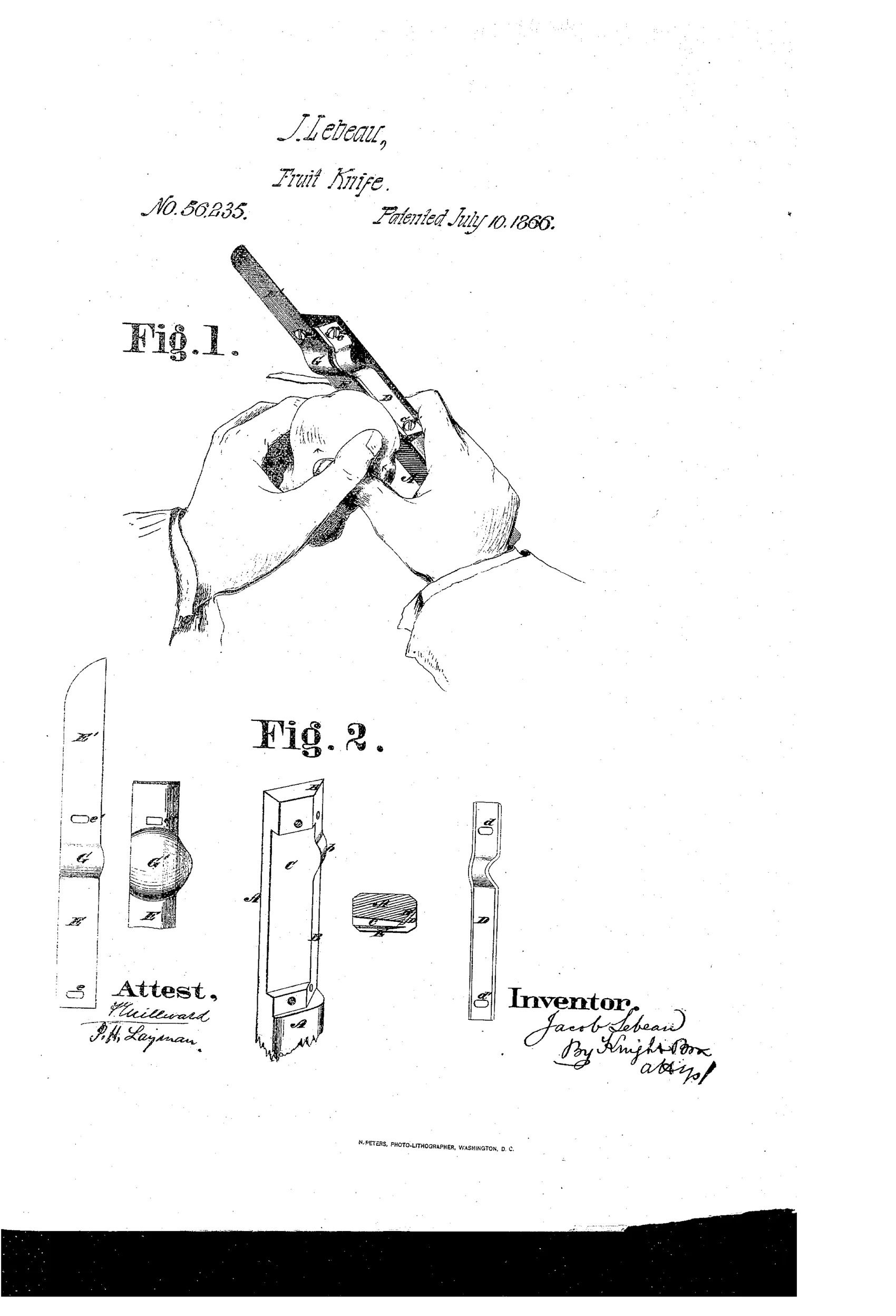
Adjustable combination paring, coring, and slicing knife.
❧ How it works
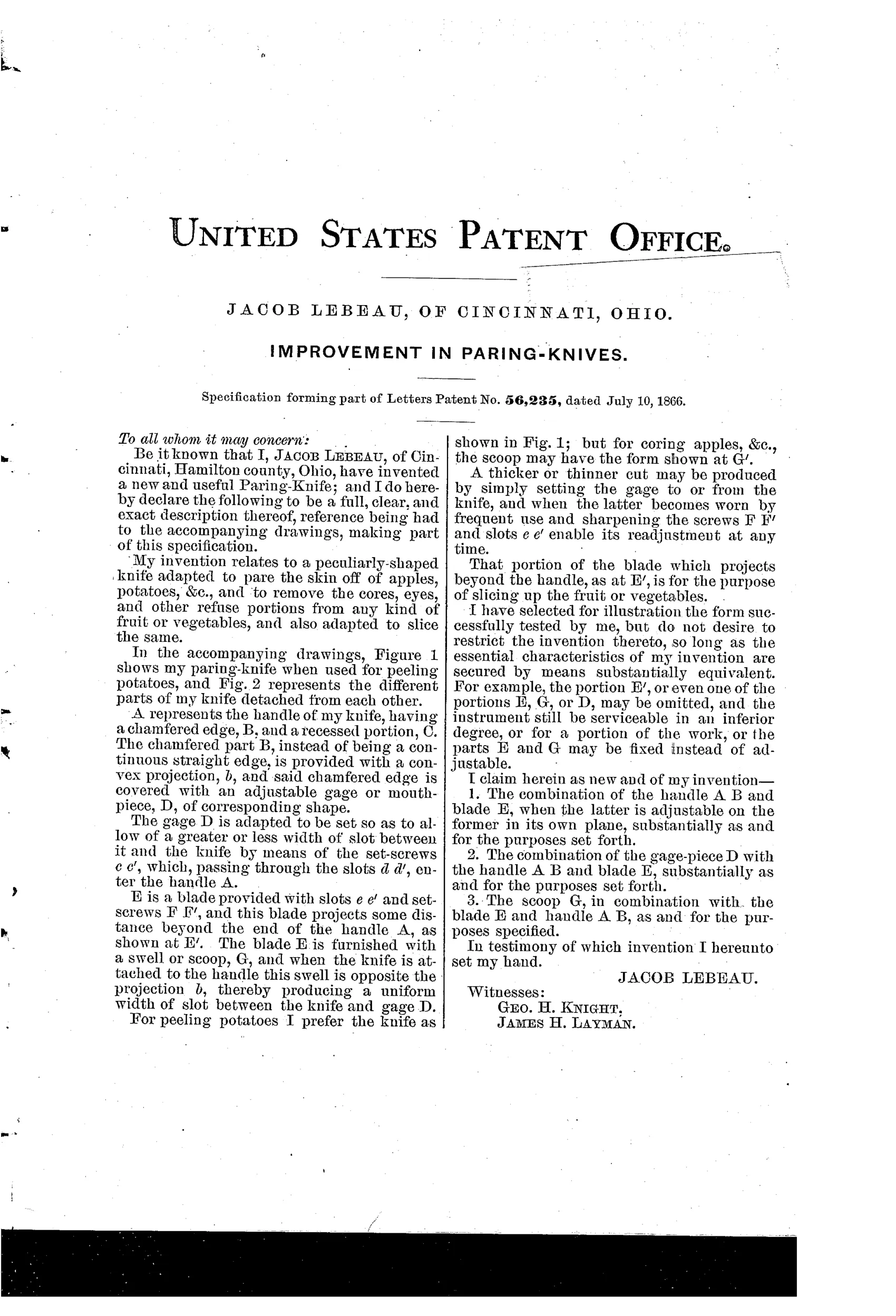
The knife consists of a handle A with a chamfered edge B bearing a convex projection b, over which an adjustable gage or mouthpiece D of corresponding shape is fitted. A blade E, fitted with slots and set-screws F F', attaches to the handle and can be moved closer to or farther from the gage D to widen or narrow the paring slot. The blade E also carries a scoop or swell G positioned opposite projection b, producing a uniform slot width for peeling, while a portion of the blade projecting beyond the handle at E' allows slicing of the fruit or vegetable. Thickness of cut is adjusted by loosening the set-screws and sliding the blade within its slots, then retightening to fix the setting.
❧ What was claimed
“1. The combination of the handle A B and blade E, when the latter is adjustable on the former in its own plane, substantially as and for the purposes set forth. 2. The combination of the gage-piece D with the handle A B and blade E, substantially as and for the purposes set forth. 3. The scoop G, in combination with the blade E and handle A B, as and for the purposes specified.”
In plain English: The invention claims a handle with an adjustable blade, combined with an adjustable gage piece and a scoop, all working together to pare, core, and slice fruit or vegetables.
❧ In the inventor’s words
“I have selected for illustration the form successfully tested by me, but do not desire to restrict the invention thereto, so long as the essential characteristics of my invention are secured by means substantially equivalent.”— Jacob Lebeau, from the specification
Fate unknown
Hand tools like this rarely carried patent markings or maker identification; a marked surviving specimen or period hardware advertisement would settle it, and DATAMP lists none to my knowledge.
❧ Commentary
In 1866 the parer world was busy bolting geared machines to kitchen tables, and here comes Jacob Lebeau of Cincinnati with the opposite bet: keep the tool in the hand, but make the blade adjustable. His knife is essentially a swivel-peeler ancestor without the swivel — a blade held a fixed distance from a gage piece, with that distance set by slots and thumbscrews. Loosen the screws, slide the blade, retighten, and you've dialed in your paring thickness. The convex projection on the handle and the matching swell in the blade keep the slot width uniform as the knife rides over a curved surface, which is the genuinely thoughtful detail here.
Look closely at Fig. 1 and you'll notice the subject is a potato, not an apple. That's honest marketing: a hand tool like this earns its keep on irregular vegetables where a lathe-type machine chokes. The blade tip projecting past the handle at E' gives you a slicer in the same tool, and the scoop G handles eyes and cores.
The weakness is the very feature being claimed. Set-screw adjustment sounds precise on paper, but in a wet kitchen hand, screws loosen, gaps clog with peel, and the fixed-slot geometry can't follow deep hollows the way a pivoting blade can. It's a clever, workmanlike answer to a question the fixed-gage peelers of the next decades answered more simply.
Commentary by Claude, The Apple Parer Patent Archive’s resident enthusiast