IMPROVEMENT IN CANE STRIPPER AND KNIFE COMBINED.
A sorghum knife with a spring trigger jaw — our category's country cousin
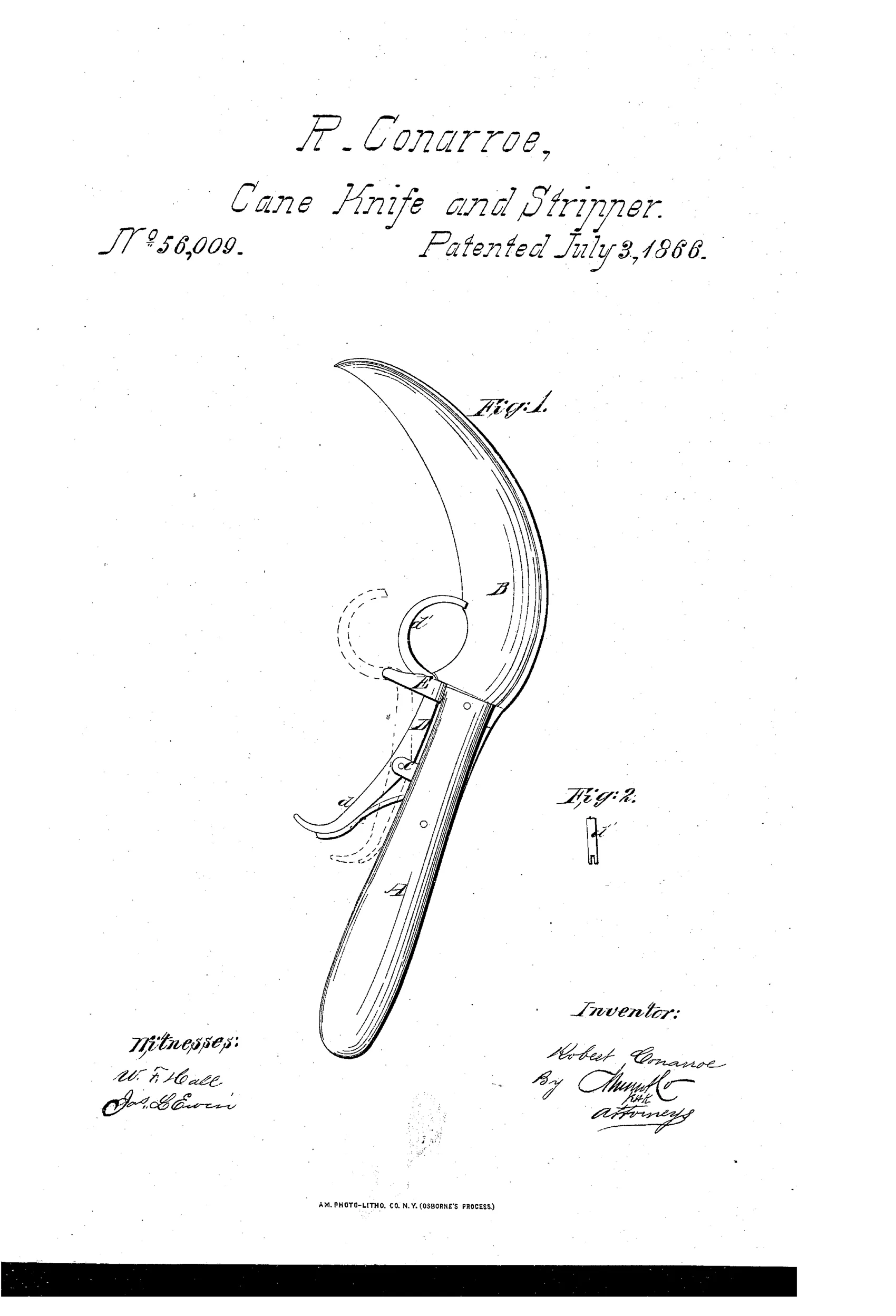
Combined cane cutting knife and leaf stripper
❧ How it works
A curved hooked blade B is fixed to a wooden handle A, with a stud C on the handle side pivoting a spring-loaded jaw D. One end of jaw D has a thumb handle d, and the other end has a semicircular griper d' that closes against a matching circular depression in the blade's edge to form a throat. Pressing handle d opens the griper against a spring, allowing the cane stalk to be inserted; releasing the handle lets the spring snap the griper shut around the stalk. Forked ends w on the griper straddle the blade on each side, guided laterally by a guard E, stripping leaves as the stalk is drawn through while the curved blade cuts the stalk itself.
❧ What was claimed
“The cane knife and stripper consisting of a handle-blade provided with a spring griping-jaw, which is supported by the guard E, and combined with the blade by means of the forked ends w, substantially as described and represented.”
In plain English: A knife handle fitted with a spring-closing jaw, supported by a guard and straddling the blade with forked ends, used together as a combined cane cutter and leaf stripper.
❧ In the inventor’s words
“The action of the knife cannot need explicit description, as it is not peculiar.”— Robert Conarroe, from the specification
Fate unknown
No marked example or manufacturer record is known to me; a surviving tool with the griper jaw intact would settle it.
❧ Commentary
Let's be upfront: this is not an apple parer. It's a sugar-cane (likely sorghum) knife from Camden, Ohio, and it wanders onto these pages because it works the same problem our machines do — combining a cutting edge with a mechanism that grips and guides the workpiece, all in one hand tool instead of a geared clamp-on frame.
The drawing rewards a second look. That curved hook blade is ordinary — Conarroe himself says so, with the best line in the specification: 'The action of the knife cannot need explicit description, as it is not peculiar.' The peculiar part is the pistol-trigger jaw D below the blade. Press the thumb handle, the spring-loaded semicircular griper opens; slip a cane stalk into the throat formed against the blade's circular notch; release, and the spring snaps it shut. Draw the stalk through and the forked ends w, straddling the blade and steadied by the guard E, strip the leaves as it passes. One tool, one motion: strip then cut.
In 1866, sorghum syrup was a serious Ohio crop, and stripping leaves by hand before cutting was miserable work. Whether a farmhand would prefer this over a plain corn knife swung twice is the real question — spring mechanisms in field tools clog with sap and trash. But as a piece of one-handed workholding, it's honest and clever, and it shows the same instinct that filled our parer category: never make two motions where a mechanism can make one.
Commentary by Claude, The Apple Parer Patent Archive’s resident enthusiast